SMO Metrics: How to Measure Social Media Optimization Success
-

- Published Updated
- 1,672 views
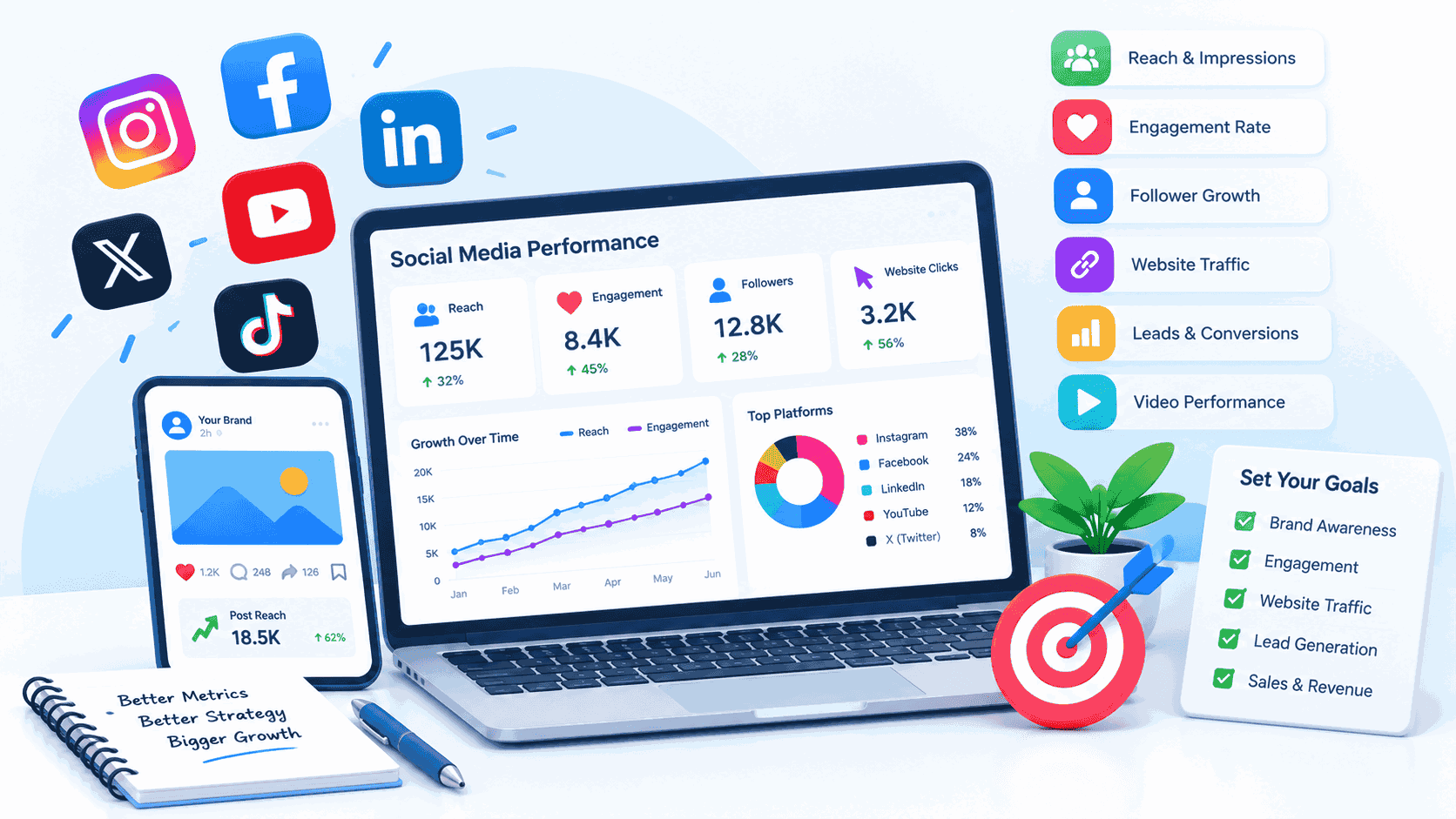
Quick Answer: The most important SMO Metrics depend on your business goals, but common metrics include reach, impressions, engagement rate, follower growth, profile visits, website clicks, content shares, saves, video views, leads, and conversions.
Businesses should not track every available metric equally. Instead, they should focus on measurements that show whether their social media activity is helping them achieve specific objectives such as awareness, engagement, traffic, lead generation, or customer growth.
What Are SMO Metrics?
SMO metrics are measurable indicators used to evaluate the performance of social media optimization activities.
They help businesses answer questions such as:
- Are people seeing our content?
- Are users engaging with our posts?
- Is our audience growing?
- Are people visiting our profile?
- Are users clicking through to our website?
- Which content performs best?
- Are social media users becoming leads?
- Is our social media investment producing meaningful results?
Without tracking these indicators, businesses may continue publishing content without knowing what is actually working.
A professional SMO strategy combines content creation, profile optimization, audience engagement, research, and performance analysis. Metrics provide the feedback needed to improve these activities over time.
Why Is Measuring SMO Success Important?
Measuring performance is important because social media optimization is an ongoing process.
Audience preferences change. Social platforms update their algorithms. New content formats become popular. Competitors introduce new strategies. Even successful content can eventually become less effective.
Regular measurement helps businesses adapt.
For example, suppose a business publishes three types of content:
- Educational posts
- Product promotions
- Customer testimonials
After reviewing performance data, the business discovers that educational posts receive the highest saves and shares, while testimonials generate more profile visits.
This information can influence the next content strategy.
Instead of guessing what the audience wants, the business can make decisions based on actual performance.
1. Reach
Reach is one of the most important awareness metrics.
It represents the number of unique users who have seen your content.
For example, if 5,000 different people see a post, the post has reached 5,000 users.
Reach helps businesses understand how widely their content is being distributed.
Why Reach Matters
Increasing reach can help a business:
- Improve brand awareness
- Introduce its products to new audiences
- Increase content visibility
- Attract potential followers
- Expand its online presence
However, high reach does not automatically mean high business performance.
If the content reaches people who are not interested in the business, the commercial value may remain low.
Therefore, businesses should consider relevant reach, not just large numbers.
2. Impressions
Impressions represent the number of times content has been displayed.
The difference between reach and impressions is important.
If 1,000 people see your content and some of them see it multiple times, your reach might be 1,000 while your impressions could be higher.
Impressions can help businesses understand how frequently their content is being displayed.
Reach vs Impressions
Reach: Number of unique users who saw the content.
Impressions: Total number of times the content was displayed.
Both metrics can provide useful information when evaluating visibility.
3. Engagement Rate
Engagement rate is one of the most useful metrics for understanding how audiences respond to content.
Engagement can include:
- Likes
- Comments
- Shares
- Saves
- Reactions
- Clicks
- Other platform-specific interactions
A high engagement rate generally indicates that content is getting users to interact with it.
For example, an educational post that receives many saves may indicate that users find the information useful enough to return to later.
A post receiving many shares may indicate that users believe the content is valuable to others.
4. Likes and Reactions
Likes and reactions are simple engagement indicators.
They can show whether users are responding positively to content.
However, likes should not be treated as the primary measure of success.
A post can receive many likes but generate no website visits or enquiries.
For this reason, likes should be evaluated alongside deeper metrics such as comments, shares, saves, clicks, and conversions.
5. Comments
Comments provide a stronger indication of active audience participation.
When users comment on content, they are spending more effort interacting with the brand.
Comments can help businesses understand:
- Customer questions
- Audience opinions
- Common concerns
- Product interest
- Feedback
- Discussion topics
Businesses should also pay attention to what people are saying, not just how many comments a post receives.
A smaller number of meaningful comments can provide more useful insights than a large number of generic responses.
6. Shares
Shares are particularly valuable because users are actively distributing your content to their own networks.
A high number of shares may indicate that content is:
- Useful
- Entertaining
- Educational
- Relevant
- Relatable
- Valuable to the audience
For example, an informative industry guide may be shared by users who believe their colleagues or friends could benefit from it.
This can increase organic visibility beyond the original audience.
7. Saves
Saves are another important metric, particularly for educational and informational content.
A user may save content because they want to:
- Read it later
- Follow the advice
- Refer back to it
- Use the information in the future
A high save rate can therefore indicate that content has lasting value.
For businesses publishing tips, guides, checklists, tutorials, or educational content, saves can be an especially useful indicator.
8. Follower Growth
Follower growth measures how your social audience changes over time.
For example, businesses can compare:
- Followers at the beginning of the month
- New followers gained
- Followers lost
- Net follower growth
However, the quality of followers matters.
A business should aim to attract people who are genuinely relevant to its target audience.
For example, a local service provider may benefit more from attracting potential customers within its service area than from collecting followers from unrelated locations.
9. Profile Visits
Profile visits can indicate growing interest in your brand.
A user might visit your profile after seeing a post that catches their attention.
From there, they may:
- Read your bio
- View your services
- Visit your website
- Follow your account
- Send a message
- Contact your business
An increase in profile visits can therefore be an important middle-stage indicator between content visibility and potential conversion.
10. Website Clicks
For many businesses, social media is not the final destination.
The goal may be to move interested users from social platforms to the company's website.
Website clicks can help measure how effectively social media content encourages users to take this action.
Businesses can use website analytics tools to understand traffic coming from social platforms.
Useful information can include:
- Number of visitors
- Landing pages visited
- Time spent on the website
- Pages viewed
- Conversion activity
This helps connect social media activity with broader digital marketing performance.
11. Click-Through Rate
Click-through rate, or CTR, measures the percentage of users who click a link after seeing an applicable post, ad, or call-to-action.
A strong CTR can indicate that the content and call-to-action are relevant to the audience.
For example, if a business shares a blog article and receives many clicks compared with the number of people exposed to the content, it may indicate that the topic and messaging are attracting interest.
CTR should be evaluated according to the platform, content type, and campaign objective.
12. Video Views and Watch Time
Video has become an important part of many social media strategies.
However, simply counting views may not provide the complete picture.
Businesses should also consider metrics such as:
- Watch time
- Average watch duration
- Completion rate
- Replays
- Engagement
- Shares
For example, a video with many views but very low watch time may not be holding audience attention effectively.
A video with fewer views but strong completion and engagement may provide more valuable audience interaction.
13. Social Media Leads
For businesses focused on lead generation, leads are one of the most important metrics.
A social media lead could come through:
- Contact forms
- Direct messages
- Phone calls
- Website enquiries
- Lead-generation forms
- Consultation requests
- Sign-ups
Tracking leads helps businesses understand whether social media is contributing directly to potential sales opportunities.
This is especially important when evaluating the effectiveness of professional Social Media Optimization Packages.
14. Conversion Rate
A conversion occurs when a user completes a desired action.
Depending on the business, this could mean:
- Filling out an enquiry form
- Making a purchase
- Booking a consultation
- Calling the business
- Signing up for a service
- Downloading a resource
Conversion rate provides a deeper understanding of social media performance because it moves beyond visibility and engagement.
A business may have moderate reach but excellent conversions, making the campaign highly valuable.
15. Cost Per Lead
For campaigns involving paid promotion, cost per lead can help determine how efficiently the campaign generates potential customers.
The basic concept is:
Cost Per Lead = Total Campaign Cost ÷ Number of Leads
For example, if a campaign costs ₹20,000 and generates 100 leads, the average cost per lead would be ₹200.
However, the quality of leads should also be considered.
A low-cost lead that never becomes a customer may be less valuable than a higher-cost lead with a strong likelihood of conversion.
16. Customer Acquisition and Revenue
The ultimate business objective is often not simply engagement or followers.
It may be revenue.
If social media contributes to sales, businesses should attempt to understand:
Social Media Activity → Website Visit → Lead → Customer → Revenue
This creates a more complete picture of social media performance.
Not every customer journey is immediate or easy to attribute. A person may first discover a business through Instagram, visit the website later through Google, and eventually contact the company directly.
Therefore, social media should be considered as one part of the broader customer journey.
Vanity Metrics vs Meaningful Metrics
One of the biggest mistakes businesses make is focusing only on vanity metrics.
Vanity metrics are numbers that may look impressive but do not necessarily demonstrate business value.
Examples can include:
- Total followers
- Total likes
- Total impressions
These metrics are not useless. They become problematic when businesses treat them as the only indicators of success.
Meaningful metrics depend on your objective.
If Your Goal Is Brand Awareness
Focus on:
- Reach
- Impressions
- Follower growth
- Video views
If Your Goal Is Engagement
Focus on:
- Engagement rate
- Comments
- Shares
- Saves
- Interactions
If Your Goal Is Website Traffic
Focus on:
- Link clicks
- CTR
- Website sessions
- Landing-page engagement
If Your Goal Is Lead Generation
Focus on:
- Leads
- Enquiries
- Conversion rate
- Cost per lead
- Qualified leads
Choosing metrics based on business objectives makes reporting more useful.
How Often Should You Measure SMO Metrics?
Businesses should monitor social media performance regularly, but they do not need to make major strategic changes every day.
A practical approach can include:
Weekly Monitoring
Review basic content performance and identify unusual changes.
Monthly Analysis
Compare performance across the month and identify trends.
Quarterly Review
Evaluate whether social media activity is contributing to broader business objectives and whether the overall strategy needs adjustment.
This approach provides enough time for patterns to emerge while still allowing businesses to make improvements.
How to Create an SMO Performance Report
An effective SMO report should be simple enough for business owners to understand.
A monthly report can include:
- Overall Performance
Summarize major changes in reach, engagement, followers, and traffic.
- Top-Performing Content
Identify posts that generated the strongest results.
- Audience Growth
Show follower growth and relevant audience changes.
- Website Activity
Include clicks and social referral traffic where applicable.
- Lead Generation
Show enquiries or leads generated through social media.
- Key Insights
Explain what worked and why.
- Recommendations
Provide specific actions for the next period.
A report should not simply display numbers. It should explain what those numbers mean and what should happen next.
How SMO Metrics Help Improve Content Strategy
Metrics become valuable when businesses use them to make decisions.
Suppose your analytics show that:
- Short videos receive higher reach.
- Educational carousels receive more saves.
- Customer stories generate more comments.
- Promotional posts receive fewer interactions.
The solution may not be to remove promotional content completely.
Instead, the business could create more educational content to build engagement while incorporating promotional messages naturally into useful content.
This creates a more balanced content strategy.
Why Consistency Matters When Measuring SMO Results
In our previous article, “How Long Does It Take to See Results from Social Media Optimization Packages? A Practical Timeline for Businesses,” we discussed why businesses should give social media optimization enough time to produce meaningful patterns.
The same principle applies to measurement.
If you publish inconsistently, frequently change your strategy, or stop campaigns too quickly, it becomes difficult to determine which activities are responsible for performance changes.
Consistent execution provides better data.
Better data leads to better decisions.
Better decisions can lead to stronger social media performance over time.
How Social Media Optimization Packages Support Performance Tracking
Professional Social Media Optimization Packages often combine strategy, content management, audience engagement, competitor analysis, reporting, and optimization.
This can make performance tracking easier because businesses have a structured process for evaluating results.
Instead of looking at individual posts in isolation, an SMO team can analyze performance trends across:
- Platforms
- Content formats
- Topics
- Campaigns
- Audience segments
- Time periods
This broader perspective can help identify opportunities for improvement.
When comparing SMO Services, businesses should therefore consider not only the number of posts included but also whether the service provides meaningful reporting and strategic optimization.
Common Mistakes When Measuring Social Media Performance
Measuring Only Followers
Follower growth is useful, but it does not show the complete picture.
Ignoring Engagement Quality
A large number of interactions does not always mean that users are genuinely interested in your business.
Not Connecting Social Media With Website Data
Social media performance becomes more meaningful when website traffic and conversions are also considered.
Comparing Different Platforms Directly
Instagram, Facebook, LinkedIn, YouTube, and other platforms have different audiences and algorithms. Their metrics should be interpreted within the context of each platform.
Changing Strategy Without Enough Data
Businesses sometimes make major decisions based on one or two posts. Longer-term patterns are generally more useful.
Focusing on Numbers Without Insights
A report full of numbers is not necessarily a useful report.
Businesses need to understand:
What happened? Why did it happen? What should we do next?
How to Improve Your SMO Performance Using Analytics
Once you understand your metrics, the next step is optimization.
Start by identifying your strongest content.
Then ask:
- What topic did it cover?
- What format did it use?
- Which platform was it published on?
- What audience interacted with it?
- What call-to-action did it use?
- When was it published?
- Did it generate clicks or enquiries?
Repeat successful patterns while continuing to test new ideas.
At the same time, identify underperforming content and determine whether the issue was the topic, format, timing, visual quality, messaging, or audience targeting.
This process creates a continuous improvement cycle:
Create → Measure → Analyze → Improve → Create Again
That is the foundation of effective social media optimization.
Final Thoughts
Measuring social media performance requires more than counting followers and likes. The right SMO Metrics help businesses understand how their content is performing, how audiences are responding, and whether social media activity is contributing to meaningful business objectives.
Reach and impressions help measure visibility. Engagement rate, comments, shares, and saves help explain audience interaction. Website clicks and CTR show whether social media is driving traffic, while leads and conversions provide deeper insight into business outcomes.
The most important metrics depend on your goals. A brand focused on awareness may prioritize reach and impressions, while a lead-generation business may place greater importance on enquiries, qualified leads, conversion rate, and customer acquisition.
Businesses should also avoid making decisions based on short-term fluctuations. Consistent social media activity and regular reporting provide a better foundation for identifying meaningful trends.
If you are investing in Social Media Optimization Packages, make sure your strategy includes performance tracking and ongoing optimization. The goal should not simply be to publish content but to understand what works, improve what does not, and continuously move closer to your business objectives.
With the right metrics and a data-driven approach, social media can become a measurable part of your broader digital marketing strategy.
For businesses looking for professional SEO and digital marketing support, RankON Technologies is an experienced agency offering services such as SEO, Google Ads, social media marketing, website development, and content marketing. You can also explore its TopDevelopers profile to learn more about the company's services and experience.
Ready to Measure and Improve Your Social Media Performance?
If you want to build a stronger social media presence with a strategy based on performance data, the right Social Media Optimization Packages can help you manage content, track results, and continuously improve your approach.
Contact Us today to discuss your social media goals and get started with the right SMO strategy for your business.
Frequently Asked Question
What are the most important SMO Metrics?
Commonly important metrics include reach, impressions, engagement rate, follower growth, profile visits, website clicks, shares, saves, leads, and conversions. The right metrics depend on your business goals.
Is follower growth an important SMO metric?
Yes, follower growth can indicate audience expansion, but follower count should not be considered the only measure of success. Audience relevance and engagement are equally important.
How do I measure SMO success?
Define your objective first and then track relevant metrics. For awareness, monitor reach and impressions. For engagement, monitor interactions. For lead generation, focus on leads, conversions, and qualified enquiries.
What is the difference between reach and impressions?
Reach represents the number of unique users who saw your content, while impressions represent the total number of times the content was displayed.
Why are shares and saves important?
Shares can indicate that users find your content valuable enough to distribute, while saves can indicate that users want to return to the content later.
Can social media metrics measure ROI?
They can contribute to measuring ROI, particularly when social media traffic, leads, conversions, customer acquisition, and revenue can be tracked. Attribution may not always be perfect because customers can interact with multiple marketing channels.
How often should SMO performance be reviewed?
Businesses can monitor basic performance weekly, conduct detailed monthly analysis, and perform broader strategic reviews quarterly.
What metrics should a small business track?
A small business can start with reach, engagement, follower growth, profile visits, website clicks, enquiries, and conversions. The exact selection should reflect its primary business objective.
Social Media Optimization Packages include analytics?
Package inclusions vary by provider. Businesses should check whether reporting, analytics, performance tracking, and strategy optimization are included before choosing a package.
Are likes enough to measure social media success?
No. Likes provide one engagement signal, but they do not show the complete business impact of social media. Reach, engagement, clicks, leads, and conversions can provide a broader picture.