Why Is Your Room Still Noisy? Finding and Fixing Sound Leaks in Qatar
-

- Published Updated
- 4,376 views
Start by Finding Where the Sound Is Actually Entering
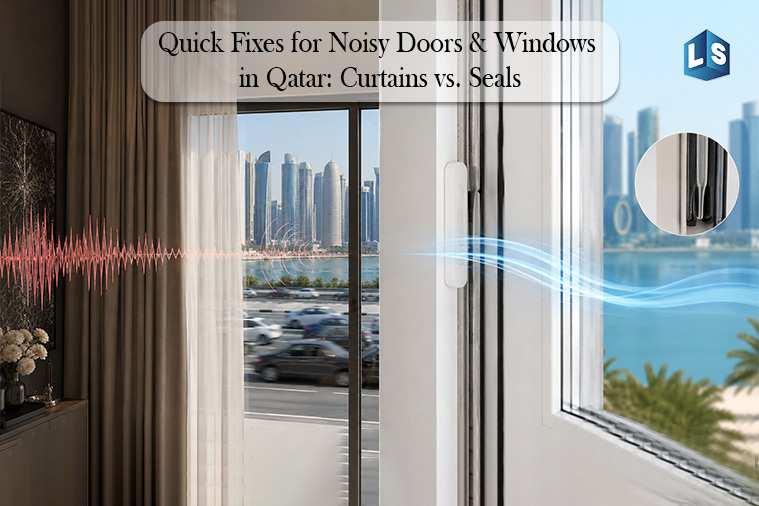
A room can have solid walls, a substantial ceiling, and quality flooring yet still feel surprisingly noisy because sound often finds its easiest path through doors and windows. The physics is straightforward: even a relatively small air gap can allow sound to pass through an opening far more easily than through a well-built, dense wall assembly. Common problem areas include gaps around door frames, window edges, sliding systems, and the space beneath internal doors. In offices, these openings can allow conversations, traffic noise, and equipment sounds to enter workspaces, while homes may experience noise from corridors, neighboring units, or outdoor activity. Before investing in additional acoustic materials, it is therefore important to identify whether the main weakness is the wall construction or simply an unsealed opening. Diagnosing the actual sound path first helps homeowners, tenants, and facility managers avoid spending money on treatments that address the wrong part of the room.
When a Quick Acoustic Fix Makes Sense
For tenants and renters, structural modifications may not be practical or permitted, making reversible acoustic treatments a useful starting point. Heavy soundproof curtains can help reduce the amount of sound entering through windows and can also improve the acoustic comfort of a room by reducing reflections from hard glass surfaces. They are particularly useful when the window is clearly contributing to the noise problem but replacing the entire glazing system is outside the project's scope or budget. However, curtains should not be treated as a complete soundproofing solution because they cannot fully compensate for significant gaps around frames or beneath doors. Their effectiveness depends on factors such as material density, coverage, installation position, and how completely the opening is covered. Used appropriately, they can provide a practical improvement while allowing occupants to evaluate whether additional treatment is required before committing to more permanent work.
Why Sealing the Gap Comes Before Adding More Treatment
When sound is clearly passing through a physical opening, addressing that opening is usually more effective than simply adding another layer of material elsewhere in the room. Properly specified door and window acoustic seals help close the air paths around frames, meeting rails, edges, and other vulnerable points where sound can bypass otherwise effective construction. This approach can improve isolation across a broader range of frequencies because it removes the direct pathway rather than attempting to absorb sound after it has already entered the room. Door undercuts deserve particular attention because even a visually minor gap can become a significant acoustic weakness, especially when the rest of the door assembly is relatively solid. For commercial spaces, sealing can also improve speech privacy by reducing the leakage of conversations between offices, meeting rooms, and circulation areas. A thorough inspection should therefore consider the entire opening, including the frame, perimeter, threshold, glazing interfaces, and operating hardware, before deciding whether additional acoustic measures are necessary.
Building a Layered Acoustic Strategy for Better Room Comfort
The strongest results often come from combining source-level sealing with treatments that manage the sound remaining inside the room. Once doors and windows have been addressed, wall and ceiling surfaces can be evaluated for excessive reflection, reverberation, or sound transmission between adjacent spaces. Materials incorporating acoustic fabric can provide a practical way to introduce sound absorption while maintaining a refined appearance suitable for residential interiors, offices, meeting rooms, and hospitality environments. Where transmission through a shared wall is contributing to the problem, a broader wall soundproofing range can be considered based on the required level of isolation, available wall depth, and project constraints. This layered approach distinguishes between stopping unwanted sound from entering a room and controlling the acoustic energy that remains within it. By treating openings, wall assemblies, and reflective surfaces as parts of one system, property owners and facility managers can achieve more consistent comfort than they would by relying on a single decorative or temporary product.
Avoiding the Mistakes That Undermine Acoustic Improvements
Even a well-planned acoustic treatment can underperform when small weaknesses are overlooked during specification or installation. One common mistake is treating only part of an opening while leaving another significant gap untreated, such as sealing the sides of a door but ignoring the undercut at the bottom. Another is assuming that adding a visually thick or soft decorative product automatically provides meaningful sound isolation when it may only reduce internal reflections. In larger rooms, partial wall coverage can also create an uneven acoustic environment where some areas are controlled while others continue to produce excessive reverberation. Installation quality is equally important because poorly fitted seals, incorrectly positioned panels, or unsuitable mounting methods can reduce the effectiveness of otherwise appropriate materials. A successful treatment plan therefore starts with diagnosis, follows with targeted specification, and finishes with careful installation and verification rather than simply adding products until the room feels quieter.
Get the Right Acoustic Fix for Your Qatar Space
Persistent noise problems rarely have a single universal solution, particularly in Qatar's diverse residential, commercial, and hospitality environments. The most effective approach is to identify the actual transmission path, address vulnerable openings, and then determine whether wall, ceiling, or interior absorption treatments are needed to complete the acoustic strategy. LSTCCO provides verified acoustic materials and soundproofing solutions for projects where performance, durability, and practical installation all matter. As a local building materials supplier, the company supports homeowners, tenants, facility managers, contractors, and design professionals in selecting solutions appropriate to the requirements of each space. Whether you are dealing with a noisy window, a poorly sealed door, or persistent reverberation after an initial acoustic upgrade, professional product guidance can help you avoid unnecessary expenditure and achieve better results. Contact the LSTCCO team to discuss your acoustic requirements, request suitable product samples, or arrange a consultation for your Qatar project.
Originally Published On : https://www.lstcco.com/quick-fixes-for-noisy-doors-windows-in-qatar-curtains-vs-seals/