Why Spreadsheet-Based Travel Operations Break as Agencies Scale
-

- Published Updated
- 6,974 views
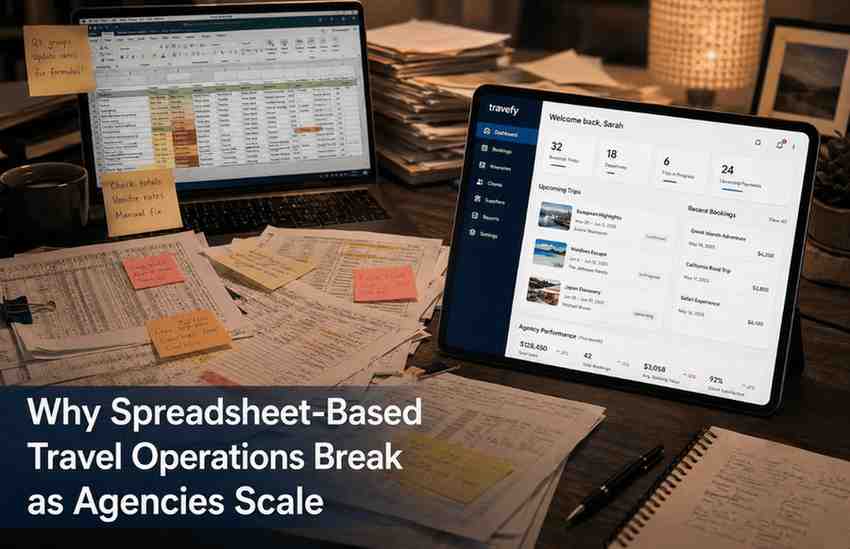
Every travel agency starts with a spreadsheet. It's free, it's familiar, and when you've got 10 bookings a month, it honestly works fine. No complaints.
But then you grow. You hire someone. You add more destinations. You're handling 40 to 50 bookings a month. And slowly, without any dramatic moment, the spreadsheet starts working against you.
Not all at once. That's the problem. It breaks in small, annoying ways that you patch with more effort, more columns, more tabs. Until one day, the patches stop working, and you're losing real money.
The Revision Problem Nobody Talks About Enough
Ask any travel agency owner where their team loses the most time. Most of them won't say "revisions" right away. But push a little, and it always comes up.
Here's how it goes. A client confirms a package, then emails asking to swap one hotel, add a night, and shift the departure by two days. Three changes. One email. Sounds simple.
In a spreadsheet setup, that email triggers a full manual loop. Update the itinerary. Recalculate the cost. Redo the margins. Reformat the PDF. Resend. Then explain to the client what changed and why the price moved. And if they want to revert one of the changes? You start that whole loop again.
Do that across 30 or 40 active bookings, and you're not losing hours. You're losing days every single month. A smarter approach to managing quotation revisions ties every amendment directly to the booking, so nothing slips through the cracks and your team isn't rebuilding the same quote four times.
But the revision spiral is just the most visible problem. The deeper ones are sneakier.
Where Else It Falls Apart
Version chaos
The moment more than one person is touching a spreadsheet, you've got a version problem. Someone saves a local copy. Someone emails an old draft. Someone updates the "confirmed" booking without realizing another tab still shows the old price. There's no audit trail, no lock on confirmed bookings, and no way to know who changed what unless you ask around.
That's not a system but organized guessing.
Supplier coordination on repeat
Every trip, your cab vendor needs a pickup schedule. Your hotel needs a rooming list. In a spreadsheet world, you're pulling that information by hand and formatting it fresh each time. It doesn't get faster as your volume grows. It just means more manual work per booking, compounding month after month.
Cash flow blind spots
Spreadsheets show you what happened. They don't show you what's coming. Upcoming supplier payments, overdue client collections, money that should've gone out last Thursday, it's all buried in tabs that someone meant to update. Agencies that look profitable on paper hit cash crunches not because the money wasn't there, but because nobody had a live view of what was due.
The single-person dependency trap
Someone on your team built the spreadsheet. They know how it works. They know which columns matter and which ones are technically broken, but "fine if you don't touch them." When that person is out, things slow down. When that person leaves, things fall apart. You've accidentally built a critical process around one person's memory instead of a real system.
Growth Makes All of This Worse, Not Better
Here's a belief that quietly kills a lot of agencies: "Once we're bigger, we'll sort out the processes."
It doesn't work that way. More bookings mean more people touching the same data. More people mean more versions, more miscommunication, more things falling through. The operational chaos doesn't shrink as you scale. It multiplies.
The agencies that actually grow well aren't the ones working harder. They're the ones who fixed their systems before the volume made fixing them painful.
What Switching Actually Changes
Moving off spreadsheets isn't just about buying new software. It's about stopping the manual loops that are quietly burning your team's time every single week.
When your quotes, bookings, supplier communications, and payments live in one connected platform such as Sembark, things start working differently. A revision request gets handled in minutes. A new team member can pick up a booking without a 20-minute briefing. Your operations head can see exactly what's due this week without chasing three people for updates.
And you stop being the person who has to hold everything together.
That last one matters more than most people admit. When the whole operation runs through spreadsheets, the business can only move as fast as you personally can track things. A proper system gives the business its own momentum.
The Right Time to Switch Is Before You Need To
Most agency owners make the move after something breaks. A client complaint. A missed supplier payment. A booking that cost them money because a revision didn't get tracked. And every one of them says the same thing afterward: they wish they'd done it sooner.
If you're already handling 20-plus bookings a month, coordinating multiple suppliers per trip, or have more than two people managing booking data, the spreadsheet is already costing you more than it's saving. You just might not have added it up yet.
The tools that got you started did their job. But scaling a travel agency on spreadsheets is like trying to run a kitchen out of a cooler. It worked at the start. It won't work forever.