SSC CPO Preparation: How Previous Year Papers Can Improve Your Exam Strategy
-

- Published Updated
- 88 views
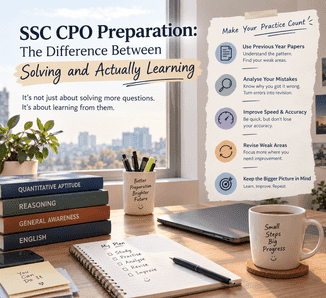
Preparing for the SSC CPO exam requires more than simply completing the syllabus. Once the basic concepts are covered, the next important step is understanding how to apply that knowledge under exam conditions. This is where regular practice becomes important.
One of the most useful resources for this is an SSC CPO Previous Year Question Paper. Solving previous year questions can help candidates become familiar with the type of questions asked, understand their preparation level, and gradually improve their speed and accuracy.
However, simply solving one paper after another is not enough. The real benefit comes from understanding what each paper teaches you about your preparation.
SSC CPO Previous Year Question Paper:
https://ifasonline.com/ssc-exam/ssc-cpo-previous-year-question-paper/69e74ac7dee415247300a51f/6aa2471a374c4b6a41f754b8/69e74b54dee415247300a5d2
Understand Where You Stand
A practice paper can give you a useful picture of your current preparation.
When you attempt a paper under a time limit, you get an opportunity to experience the pressure of solving different types of questions within a fixed period. Your performance can also show which areas you are comfortable with and which ones still need attention.
Don't worry if your initial score is lower than expected.
The purpose of early practice is not to prove that you are already prepared. It is to discover where you need to improve.
Look beyond the final score and ask yourself:
- Which questions did I get wrong?
- Which questions took too much time?
- Were my mistakes caused by weak concepts or carelessness?
- Did I leave questions that I could have solved?
- Which topics appeared difficult repeatedly?
The answers can help you make your preparation more specific.
Learn From Every Mistake
One of the biggest mistakes candidates make is checking the answer key and immediately moving on.
A wrong answer should not simply be marked as wrong. It should tell you something.
If you made a mistake because you did not understand a concept, revise that concept. If you misunderstood the question, pay more attention to how questions are worded. If you knew the answer but made a calculation error, practise similar questions until the process becomes more comfortable.
This turns mistakes into a form of revision.
You can follow a simple cycle:
Solve → Analyse → Revise → Practise Again
Over time, this approach can help reduce repeated mistakes.
Improve Speed Gradually
Speed is important in any competitive examination, but trying to become extremely fast from the beginning can sometimes affect accuracy.
First, focus on understanding the question and reaching the correct answer. Once you become more comfortable with different question types, introduce time limits into your practice.
While analysing a paper, notice where your time is going.
Some questions may take longer because the concept is difficult. Others may take longer because you are unsure about the correct approach. Identifying these patterns can help you decide what needs more practice.
With regular timed practice, you can gradually become better at managing your time without sacrificing accuracy.
The objective is not to rush through the paper.
It is to use your time intelligently.
Don't Treat Every Paper Like a Test
Previous year papers can be used for much more than checking your marks.
Think of each paper as a source of information about your preparation.
Suppose you solve a paper and find that your accuracy is good but you spend too much time on certain questions. Your next goal could be improving question selection and speed.
On the other hand, if you are solving quickly but making several avoidable mistakes, your focus should be on accuracy.
This makes your practice more personalised.
Instead of following the same routine regardless of your performance, you can adjust your preparation based on what your practice sessions reveal.
Keep Track of Repeated Mistakes
Maintaining a small mistake notebook or digital list can make revision easier.
You don't need to write down every question you get wrong. Focus on mistakes that are repeated, concepts that you frequently forget, and question types that continue to cause problems.
For example, if you notice the same type of mistake appearing in multiple practice sessions, give that topic additional attention.
Review the concept, solve a few related questions, and then test yourself again later.
This creates a continuous feedback loop where your practice directly influences your revision.
Focus on Quality, Not Just Quantity
There is often a temptation to solve as many papers as possible.
While regular practice is important, completing a large number of papers without analysing them may not lead to meaningful improvement.
A smaller number of carefully reviewed papers can be more useful than repeatedly solving papers without learning from them.
After every attempt, try to identify at least one thing you can improve.
It could be your accuracy, speed, question selection, time management, or understanding of a particular topic.
That improvement should then become part of your next study session.
Build a Consistent Practice Routine
You don't need an extremely complicated timetable to make previous year papers useful.
Set aside specific time for solving questions and reviewing your performance. Keep your practice regular rather than depending only on the days when you feel motivated.
A simple routine could look like this:
Study → Practise → Analyse → Revise → Repeat
Study the concepts first.
Practise questions based on those concepts.
Analyse what went wrong.
Revise the areas that need attention.
Then practise again.
As this cycle continues, your preparation becomes more focused and purposeful.
Final Thoughts
Preparing for SSC CPO is a gradual process. You may not see a major improvement after every single practice session, but consistent analysis can help you identify patterns and make better decisions about your preparation.
Previous year papers are valuable because they allow you to practise with questions that reflect the kind of examination you are preparing for. More importantly, they can show you what you need to work on next.
So don't measure your progress only by the number of papers you have completed.
Measure it by the mistakes you have reduced, the topics you have improved, the time you have saved, and the confidence you have gained.
The goal isn't simply to solve more questions. The goal is to become better at solving them.