How to Launch Your Own Stablecoin: Development Process, Features, and Costs
-

- Published Updated
- 1,662 views
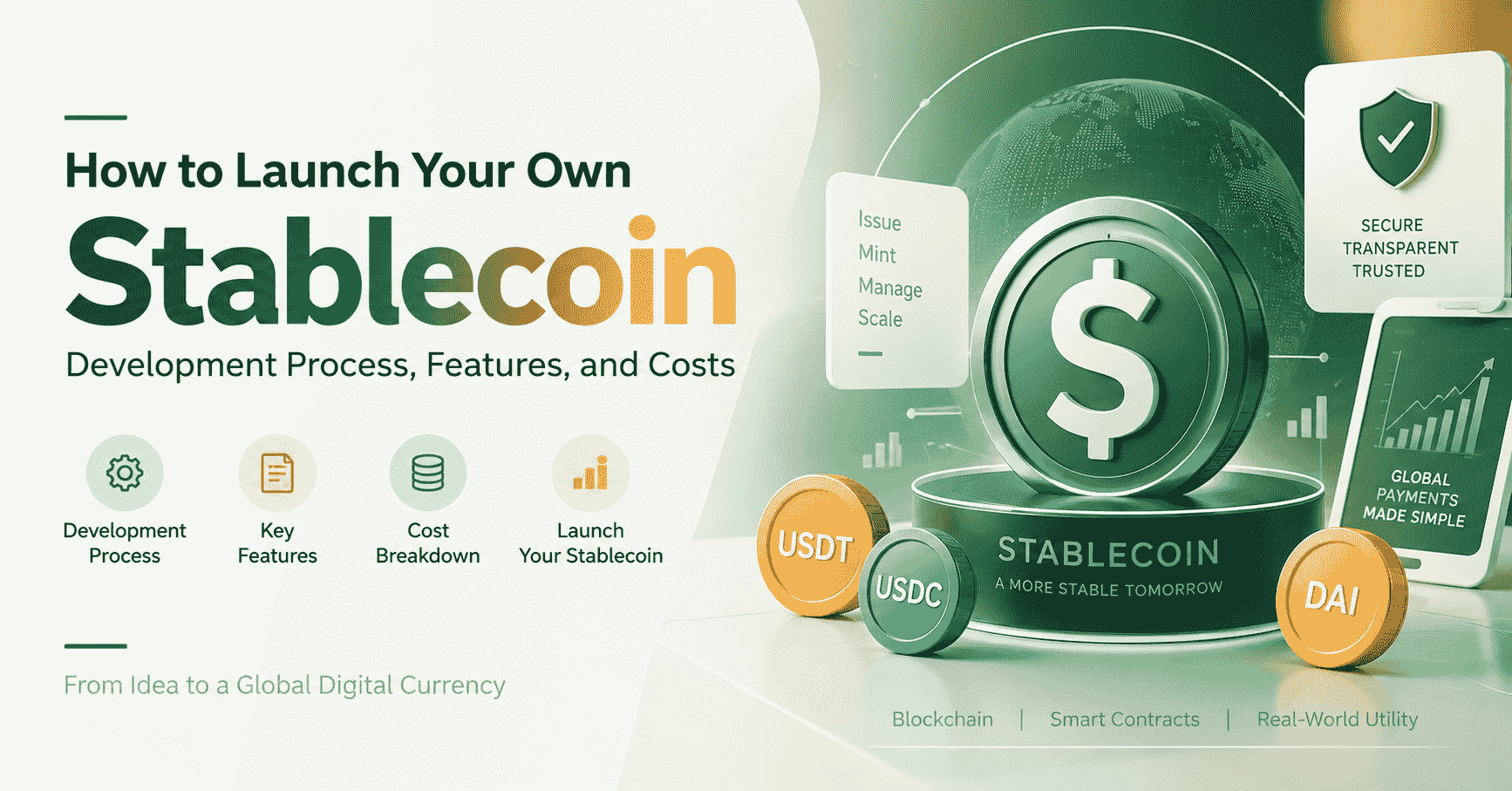
Launching a stablecoin is not simply a matter of creating a token and putting it on a blockchain. The real work starts with answering a more important question: what makes your stablecoin stable, useful, and trustworthy?
If you're a founder, fintech business, crypto entrepreneur, or someone exploring a new digital payment product, understanding this before development can save you from expensive architectural changes later.
In this guide, I'll break down how I would approach a stablecoin project—from choosing the underlying model and blockchain to developing smart contracts, adding essential features, testing the system, and estimating the overall cost.
How Do You Launch Your Own Stablecoin?
A stablecoin launch typically involves these core steps:
- Define the stablecoin's purpose and stabilization model.
- Choose the blockchain network and token standard.
- Design tokenomics, minting, burning, and redemption rules.
- Develop the smart contracts and supporting backend.
- Build reserve, administration, monitoring, and user-management systems.
- Integrate wallets, exchanges, payment platforms, or other applications.
- Conduct security testing and smart contract audits.
- Address applicable legal and compliance requirements.
- Deploy the stablecoin and establish ongoing monitoring.
The architecture changes depending on whether the token is intended to be fiat-backed, crypto-backed, commodity-backed, or designed around another stabilization mechanism.
Step 1: Define Why You're Building a Stablecoin
Before choosing a blockchain or writing a smart contract, define the business use case.
For example, a fintech company might want a stablecoin for cross-border settlement. A crypto exchange might want its own settlement asset, while a payment company could use one for programmable digital payments.
This decision affects almost everything else, including the token model, reserve structure, redemption process, integrations, compliance requirements, and infrastructure.
A useful starting question is:
Who will use this stablecoin, and what problem will it solve that existing payment or digital-asset infrastructure doesn't solve well?
Step 2: Choose the Stablecoin Model
The stabilization mechanism is one of the most important decisions in the entire project.
Fiat-Backed Stablecoin
A fiat-backed model is designed around reserves such as traditional currency or other eligible assets. The system needs clearly defined rules for issuance, reserves, redemption, and reporting.
Crypto-Backed Stablecoin
A crypto-backed model uses digital assets as collateral. Because cryptocurrency prices can fluctuate significantly, the design needs appropriate collateralization and risk-management mechanisms.
Algorithmic or Mechanism-Based Models
Some stablecoins attempt to maintain their target value through supply adjustments or other mechanisms rather than direct traditional-asset backing. These models require particularly careful economic and technical design.
The right approach depends on your business model, target market, risk framework, and regulatory requirements.
Step 3: Select the Blockchain
Your blockchain choice directly affects the technical architecture.
You may evaluate networks such as Ethereum, BNB Chain, Polygon, Solana, or other compatible ecosystems based on factors including:
- Transaction costs
- Transaction speed
- Smart contract capabilities
- Wallet compatibility
- Developer ecosystem
- Exchange integrations
- Security considerations
- Liquidity and ecosystem access
There isn't a single blockchain that is automatically best for every stablecoin project.
For example, if your primary requirement is broad compatibility with existing Ethereum-based applications, your decision may differ from a project that prioritizes a particular performance or ecosystem requirement.
Step 4: Build the Smart Contracts
This is where stablecoin smart contract development becomes critical.
The smart contract can control functions such as:
- Token minting
- Token burning
- Transfers
- Supply management
- Access permissions
- Emergency controls
- Pausing specific functions where appropriate
- Administrative roles
The exact functionality should reflect the stablecoin's economic and operational model.
I would strongly recommend treating the smart contract as only one part of the system rather than assuming that deploying a token contract means the stablecoin is complete.
Step 5: Add the Supporting Infrastructure
A production-ready stablecoin usually needs more than an on-chain token.
Depending on the project, the supporting infrastructure may include:
Reserve Management
Systems for tracking the assets or collateral supporting the stablecoin and managing related operational processes.
Minting and Redemption
A controlled process for issuing new tokens and handling redemption according to the project's rules.
Administrative Dashboard
A secure dashboard can allow authorized operators to monitor supply, transactions, roles, reserves, and system activity.
Monitoring and Analytics
Real-time monitoring can help identify unusual transactions, contract events, supply changes, and operational issues.
Wallet and Exchange Integration
If users need to hold, transfer, trade, or spend the stablecoin, you'll likely need integrations with wallets, exchanges, payment systems, or other applications.
This is where custom stablecoin development becomes different from simply launching a basic token.
Key Features to Consider
The feature set should be based on actual business requirements rather than adding functionality simply because another project has it.
Common features include:
- Secure token issuance and burning
- Role-based access control
- Reserve and collateral management
- Redemption mechanisms
- Transaction tracking
- Admin dashboard
- Wallet integration
- Exchange integration
- API access
- Security monitoring
- Emergency management controls
- Reporting and analytics
For an enterprise project, permissions and operational controls can be just as important as the token itself.
Step 6: Security Testing and Auditing
A stablecoin can involve valuable assets, so security shouldn't be treated as the final checkbox before launch.
The development process should include code reviews, testing, access-control checks, edge-case testing, and smart contract security assessment.
A third-party smart contract audit can also help identify vulnerabilities that the internal development team may have missed. However, an audit should not be treated as a guarantee that the entire business or economic model is risk-free.
Security also needs to continue after launch through monitoring, incident response procedures, key management, and controlled software upgrades.
Step 7: Understand Compliance Requirements
This is one area where founders should involve qualified legal professionals early.
The regulatory treatment of stablecoins can vary depending on the jurisdiction, structure, reserve assets, issuance model, marketing approach, and services connected to the token.
Therefore, don't design the entire technical system first and ask legal questions later.
Your legal and compliance requirements can influence how users are onboarded, how reserves are managed, how redemption works, and which markets or services you can operate in.
How Much Does Stablecoin Development Cost?
There is no universal stablecoin development cost because every project has a different scope.
The major cost drivers usually include:
- Blockchain selection
- Smart contract complexity
- Custom token mechanisms
- Backend infrastructure
- Reserve-management systems
- Admin dashboards
- Wallet integrations
- Exchange integrations
- Payment integrations
- Security testing and auditing
- Compliance-related work
- Cloud infrastructure
- Maintenance and technical support
A basic token contract is therefore fundamentally different from a complete stablecoin platform with issuance, redemption, reserve management, dashboards, APIs, integrations, security controls, and ongoing monitoring.
When requesting a development quote, I recommend asking for a scope-based breakdown rather than accepting one large development figure without understanding what it includes.
Should You Build From Scratch or Use Existing Components?
You generally have two approaches.
Build from scratch: More control over the architecture and business logic, but usually requires more development, testing, and maintenance.
Use established components: Can reduce development effort for certain parts of the system, but you need to carefully evaluate dependencies, security, licensing, upgrade mechanisms, and compatibility.
For many businesses, the practical approach is to customize proven technical components while keeping the core economic and operational logic aligned with their specific requirements.
Common Mistakes to Avoid
I've seen stablecoin concepts become unnecessarily complicated because the project starts with technology instead of the business model.
Avoid these mistakes:
- Choosing a blockchain before defining the use case
- Treating the token contract as the entire product
- Ignoring redemption and reserve processes
- Adding unnecessary features
- Delaying security testing
- Underestimating integrations
- Treating compliance as an afterthought
- Focusing only on launch instead of post-launch operations
A stablecoin should be designed as an ecosystem, not just a digital token.
Conclusion
Launching your own stablecoin requires much more planning than creating a token contract. You need to define the stabilization model, select the right blockchain, design secure smart contracts, build supporting infrastructure, plan integrations, test the system, and address applicable compliance requirements.
The best place to start is not with the question, "Which blockchain should I use?" Start with "What problem will this stablecoin solve, and how will the entire system support that use case?"
Once those fundamentals are clear, the technical architecture, feature set, development approach, and stablecoin development cost become much easier to define.
Planning your own stablecoin? Talk to a Stablecoin Development Company
Mobile Number: +916369366250
Email : [email protected]
Telegram: Thecryptoape