Crypto Arbitrage Bot Development Platforms: What They Are and How to Choose One
-

- Published Updated
- 5,023 views
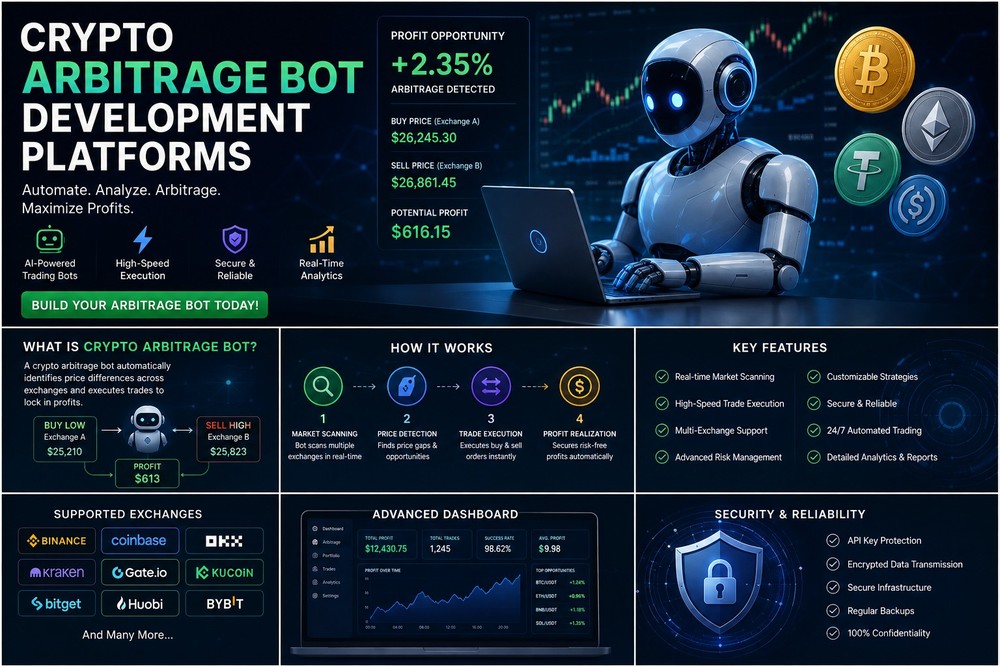
Not everyone who wants to run an arbitrage strategy wants to hire a development team or write code from scratch. That's where a crypto arbitrage bot development platform comes in a piece of software, often cloud-based, that gives traders the tools to build, test, and deploy arbitrage bots without starting from a blank codebase. These platforms have grown quickly in popularity as more traders look for ways to act on crossexchange price gaps without needing a computer science degree to get there.
But "platform" can mean very different things depending on the provider. Some are closer to no-code builders aimed at beginners. Others are sophisticated frameworks meant for developers who want infrastructure handled for them while retaining full control over strategy logic. Understanding the differences matters a lot before committing time or money to one.
What a Development Platform Actually Provides
At its core, a crypto arbitrage bot development platform typically handles the repetitive, technically demanding groundwork that every arbitrage bot needs: connections to exchange APIs, real-time price data aggregation, order execution modules, and often some form of risk management tooling. Instead of building these components individually, users configure or customize them within the platform's existing framework.
Most platforms fall somewhere on a spectrum. On one end are highly visual, drag-and-drop or template-based tools, where users select a strategy type, plug in their exchange accounts, set parameters like minimum profit thresholds, and let the bot run. On the other end are developer-focused platforms that provide SDKs, APIs, and coding environments, giving experienced traders and engineers more flexibility to build custom logic while still relying on the platform's underlying infrastructure for exchange connectivity and execution.
Neither approach is inherently better; it depends entirely on the user's technical background and how much control they want over the strategy itself.
Why These Platforms Have Grown in Popularity
A few years ago, running an arbitrage bot generally meant either hiring developers or having strong coding skills yourself. Development platforms have lowered that barrier significantly, letting traders test strategies without the upfront cost and time investment of a fully custom build. This has been especially appealing to smaller traders and firms who want to explore arbitrage opportunities without committing to a large engineering budget before knowing whether the strategy fits their goals.
There's also a practical advantage in speed. Since much of the underlying infrastructure exchange integrations, data feeds, execution engines already exist on the platform, users can go from idea to a working bot in a fraction of the time it would take to build everything independently.
Key Features Worth Evaluating
Not all platforms are built with the same level of rigor, and the differences often show up exactly when they matter most during periods of high volatility or unusual market conditions. A few features are worth paying close attention to when comparing options.
Exchange coverage is one of the most basic but important factors. A platform is only useful if it connects to the exchanges relevant to your strategy, with reliable, low-latency data feeds rather than delayed or occasionally dropped connections.
Execution speed and reliability matter just as much. Arbitrage opportunities often exist for only a few seconds, so a platform with slow order execution or inconsistent uptime can turn a theoretically profitable strategy into one that consistently misses its window.
Risk management tools separate more serious platforms from bare-bones ones. Features like maximum position limits, automatic shutoffs during abnormal price movements, and accurate fee/slippage calculations before execution all help prevent a bot from executing trades that look profitable on the surface but lose money once real costs are factored in.
Backtesting and paper trading capabilities allow users to test strategies against historical data or in real-time simulated conditions before committing real funds, an essential step that shouldn't be skipped regardless of how polished the platform's interface looks.
Security practices deserve particular scrutiny, since these platforms typically require API access to exchange accounts. Look for encrypted credential storage, properly scoped permissions (ideally restricting withdrawal access), and a track record without major security incidents.
Build vs. Buy: When a Platform Makes Sense
For many traders, using an existing crypto arbitrage bot development platform is a more practical starting point than commissioning a fully custom build. It's generally faster, less expensive upfront, and lets traders validate whether a strategy is worth pursuing before investing heavily in custom infrastructure.
That said, platforms do come with tradeoffs. Users are often limited to the strategies and exchange integrations the platform supports, and highly specific or unconventional approaches may not fit neatly into an existing framework. Larger firms or traders with substantial capital and unique strategy requirements sometimes eventually outgrow platform-based solutions and move toward fully custom development, where every component can be tailored precisely to their needs.
A reasonable approach for many traders is to start on a platform to test and refine a strategy, then consider custom development once the strategy has proven itself and the scale justifies the additional investment.
Questions Worth Asking Before Committing
Before choosing a platform, it's worth digging into a few specifics rather than relying on marketing claims alone. What exchanges does it actually support, and how reliable has that connectivity been historically? What does the fee structure look like: flat subscription, percentage of profits, or some combination? How transparent is the platform about past performance, and does it avoid making unrealistic promises about guaranteed returns?
It's also worth checking what kind of support is available if something goes wrong. A platform with no responsive support team can leave traders stuck during exactly the moments when a bot misbehaves and needs immediate attention.
Finding the Right Fit
A crypto arbitrage bot development platform can be a genuinely useful entry point into arbitrage trading, offering speed and accessibility that fully custom development can't match for smaller or newer traders. But the quality of these platforms varies significantly, and the features that matter most are reliable execution, solid risk controls, and real security practices that aren't always obvious from a slick landing page.
Taking the time to evaluate a platform carefully, rather than choosing based on convenience or price alone, makes it far more likely that the bot built on top of it will actually perform the way it's supposed to when real capital is on the line.