What Is String Quartet Sheet Music? A Beginner's Guide
-

- Published Updated
- 3,242 views
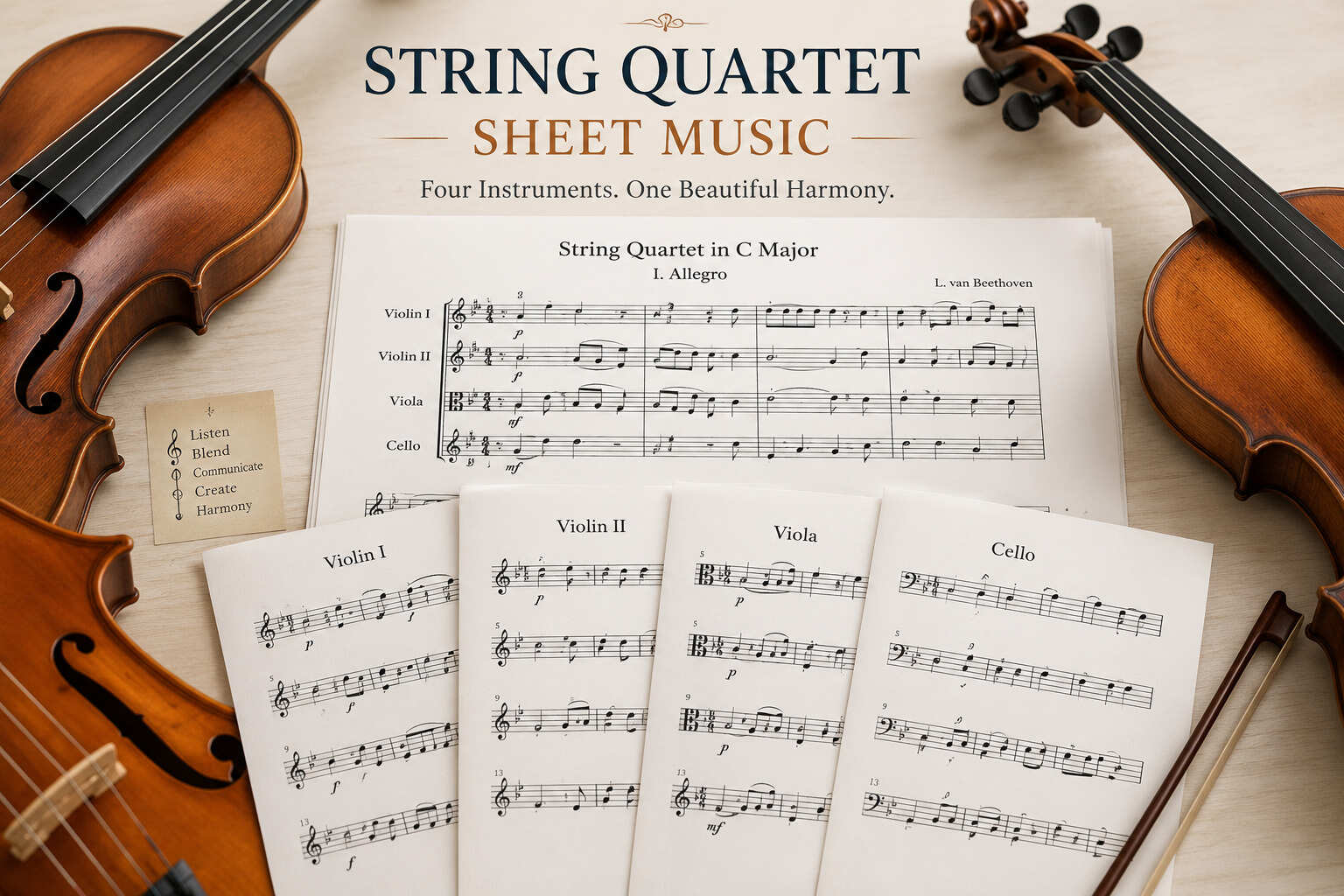
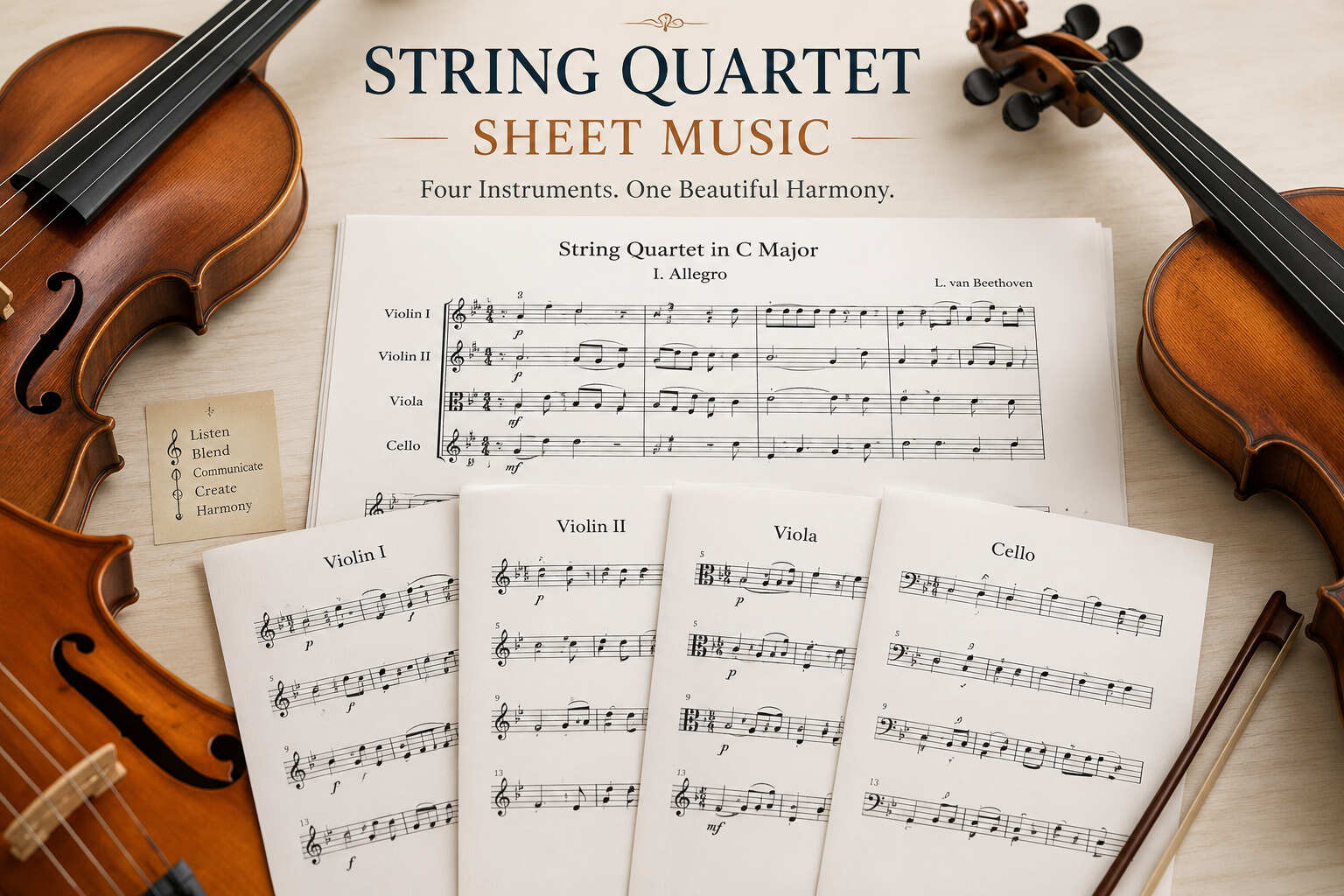
String quartet sheet music is written music for four instruments: two violins, a viola, and a cello. Instead of one shared page, each musician reads their own individual part, while a full score shows all four lines together. The parts are written to fit like puzzle pieces, with melody, harmony, and rhythm shared across the ensemble rather than carried by a single player. For beginners, quartet music can feel demanding at first because it asks players to keep their own line steady while listening closely to three others. Learning to read the score, and understanding how the parts relate, is what makes rehearsal and performance possible.
What Is String Quartet Sheet Music?
String quartet sheet music is the written notation used by an ensemble of two violins, a viola, and a cello. It typically exists in two forms: the full score, which stacks all four instrumental lines on top of each other so a conductor, arranger, or coach can see how they interact, and individual parts, which give each player only their own line to read. Each part includes the notes, rhythms, dynamics, and bowings that instrument needs to perform. Because the four instruments depend on each other for balance and timing, sheet music for a string quartet is written with careful attention to how the lines fit together, not just how each one sounds on its own.
What Is String Quartet Music?
String quartet music is a form of chamber music, meaning it is written for a small group of instruments performing one player per part, without a conductor. This is different from solo music, where one musician carries the entire piece. In a quartet, musical ideas are distributed: one instrument might carry a melody while another provides harmony, a third fills in rhythm, and a fourth supports the foundation. Repertoire can be classical, contemporary, folk, sacred, or arranged from other traditions. What defines the genre is not the style of music but the way four independent parts are written to work as one ensemble, requiring intonation, balance, and communication between players.
What Instruments Are in a String Quartet?
A standard string quartet has four instruments, each with a typical role that can shift depending on the piece.
| Instrument | Typical Role | Clef |
|---|---|---|
| First Violin | Melody and higher lines | Treble |
| Second Violin | Melody, harmony, inner lines | Treble |
| Viola | Inner harmony and connecting lines | Alto |
| Cello | Bass, harmony, and melodic material | Bass |
These roles are common but not fixed. Composers and arrangers often shift the melody to the cello or viola, so no part should be assumed less important than another.
How Is String Quartet Sheet Music Organized?
Quartet sheet music uses standard staff notation: five lines and four spaces, organized into measures separated by bar lines. Each part carries a clef (treble, alto, or bass), a key signature, and a time signature at the start. From there, the notation includes notes and rests, dynamic markings, articulations, tempo indications, and rehearsal marks that help musicians find their place during practice. Reading your individual part tells you what to play. Following the full score tells you how your part fits with everyone else's, which is why many players study the score even when they only perform from their own part.
What Are the Different Parts of a String Quartet?
- First violin often carries melodic material in a higher register, though not always.
- Second violin supports the melody, adds harmony, or plays independent rhythmic figures.
- Viola frequently connects the upper and lower instruments, filling the middle register.
- Cello commonly provides bass support and harmonic foundation, but also takes melodic lines in many pieces.
Can I Teach Myself to Read Sheet Music?
Yes, many musicians learn the basics of reading music on their own, especially with consistent, structured practice. A simple starting path looks like this:
- Learn the musical staff and your instrument's clef.
- Learn note names and basic rhythms.
- Understand time signatures and key signatures.
- Practice counting rhythms aloud.
- Start with simple, familiar melodies.
- Read slowly while playing, then gradually add ensemble music.
These same skills transfer directly to reading a string quartet part, since the notation fundamentals do not change with ensemble size.
How Do You Read String Quartet Sheet Music?
Before playing: confirm your instrument's clef, check the key and time signature, find the tempo marking, and note any dynamics or articulations. Mark passages that look difficult.
During practice: work slowly through tricky sections, count carefully, mark your entrances, and use a metronome. Practice intonation and rhythm as separate steps before combining them.
During rehearsal: listen across the group, watch for ensemble cues, keep a consistent tempo, and balance your volume against the other three players.
What Are Some Good Pieces for a Beginner String Quartet?
Suitable beginner repertoire generally has manageable rhythms, comfortable ranges, limited technical demands, and individual parts that are not overly dense. A simplified arrangement of a familiar melody is often a better starting point than the original concert version, since arrangements are typically written with playability in mind. When choosing a piece, look at the length, the availability of all four parts, and whether the bowing and technical requirements match your group's current level.
How Difficult Is String Quartet Music for Beginners?
The challenge is rarely about playing hard notes. It is about staying in tune, keeping a steady tempo, counting rests accurately, entering on time, and listening to three other musicians while still managing your own part. Quartet playing takes both individual preparation at home and group rehearsal time, since ensemble skills like balance and timing can only be built together.
How Do String Quartets Rehearse?
A typical rehearsal process starts with each player preparing their part individually, then identifying difficult passages as a group. From there, the quartet plays sections slowly, fixes rhythm and intonation issues, coordinates bowing and articulation, balances dynamics, and rehearses transitions before running the full piece. Arriving prepared matters, since rehearsal time is best used solving ensemble problems rather than learning individual notes.
Where Can I Find String Quartet Sheet Music?
Look for sources with clear notation, complete individual parts, a full score option, accurate instrumentation, and stated difficulty levels. Digital formats make it easier to print parts for every player. At Dozan World, our chamber and ensemble collection includes string quartet and string trio sheet music alongside Middle Eastern instrumental sheet music, giving quartets access to repertoire outside the standard Western catalog. Dozan World was founded by Shireen Abu Khader, a composer and educator whose work centers on Levantine and Middle Eastern musical traditions, and our catalog is built with input from working musicians and educators.
String Quartet Sheet Music at Dozan World
Alongside string quartet arrangements, our catalog includes string trio music, broader instrumental and vocal sheet music, and choral works for ensembles that pair strings with voices. Many pieces draw on Levantine and Arabic melodic material arranged for Western string instruments, so a quartet can add repertoire with a different cultural voice without moving outside standard notation. Difficulty and instrumentation are listed on each product page, which makes it easier for a beginner group to find a piece that fits their level.
How Much Does a String Quartet Cost for 1 Hour?
Hiring a quartet to perform is a separate question from buying quartet sheet music. Performance pricing depends on location, event type, the experience of the musicians, repertoire, travel, and the length of the performance. There is no single universal rate, so it is best to request quotes directly from ensembles in your area.
Common Mistakes to Avoid
- Practicing only your own part without listening to the others
- Ignoring rests or losing the pulse
- Skipping the key signature check before playing
- Reading notes without counting rhythm
- Starting a piece before individual parts are prepared
FAQs
What is string quartet sheet music?
It is written music for two violins, viola, and cello, available as individual parts or a full score showing all four lines together.
What is string quartet music?
A chamber music genre for four independent players, one per part, without a conductor, spanning classical, contemporary, and arranged repertoire.
What instruments are in a string quartet?
First violin, second violin, viola, and cello.
What are some good pieces for a beginner string quartet?
Pieces with manageable rhythms, comfortable ranges, and accessible individual parts, often simplified arrangements rather than original concert versions.
Can I teach myself to read sheet music?
Yes, with consistent practice covering the staff, clefs, rhythms, and key and time signatures, then applying those skills to ensemble parts.
How do you read string quartet sheet music?
Prepare your part before rehearsal, practice slowly with a metronome, then focus on listening and balance once you rehearse with the group.
Is string quartet music difficult for beginners?
The difficulty usually comes from ensemble skills like timing and listening rather than the notes themselves.
What is the difference between a full score and an individual part?
A full score shows all four instruments together for study and rehearsal preparation. An individual part shows only one musician's line for personal practice.
Where can I find string quartet sheet music?
Look for publishers offering complete parts, a full score, and clear difficulty ratings, such as Dozan World's chamber and ensemble collection.
How much does a string quartet cost for 1 hour?
Rates vary by location, musician experience, and event type, so it is best to request a quote directly from the ensemble.
Whether you are a student picking up your first quartet part or an educator building a chamber music program, understanding how string quartet sheet music is organized makes rehearsal far less intimidating. Once you can tell the difference between a full score and your own part, and you know what to check before you start playing, the rest comes with practice and listening.
Browse Dozan World's chamber and ensemble collection for string quartet and small-ensemble arrangements, or see our full sheet music catalog for vocal, instrumental, and Middle Eastern repertoire.