How much does it cost to start a supermarket franchise?
-

- Published Updated
- 4,995 views
A supermarket franchise in India costs anywhere from ₹10 lakh to ₹2.5 crore. That's a wide range, and if you've been searching for a single number, you already know it doesn't exist. The real answer depends on the format you pick, the city you open in, and which brand's name goes above your door.
What you can pin down is the structure behind that number. Every supermarket franchise, big or small, is built from the same five cost buckets. Once you understand what sits in each one, the total stops looking random and starts looking like a budget you can actually plan around.
What the total investment is actually made of
The franchise fee is the one-time payment to the brand for its name, its operating playbook, and its supplier network. For a smaller regional brand this can sit as low as ₹2 lakh to ₹3 lakh. National names with hundreds of stores charge more, often ₹10 lakh to ₹20 lakh, because they're also handing you a proven customer base.
Store setup covers interiors, shelving, refrigeration, billing counters, and signage. Budget ₹5 lakh to ₹25 lakh here, with the low end fitting a compact 500 square foot outlet and the high end matching a full-size supermarket format.
Inventory is your opening stock: packaged goods, staples, produce, dairy. This is usually the single biggest line item because grocery is a volume business with thin margins. Expect ₹5 lakh to ₹40 lakh depending on store size and how wide a product range the brand requires you to stock.
Equipment and licenses add up faster than most first-time franchisees expect. Weighing scales, POS systems, CCTV, an FSSAI license, GST registration, a trade license, and fire safety clearance together run ₹1.5 lakh to ₹5 lakh.
Working capital is the cash you hold back to cover rent, salaries, and restocking before the store starts generating steady revenue. Most brands ask you to keep three to six months of operating costs in reserve, which for a mid-size store means another ₹5 lakh to ₹15 lakh sitting untouched on day one.
What it costs by store format
| Format | Typical size | Total investment |
|---|---|---|
| Mini supermarket | 300 to 1,500 sq ft | ₹10 lakh to ₹35 lakh |
| Supermarket | 500 to 3,000 sq ft | ₹20 lakh to ₹90 lakh |
| Hypermarket | 4,000 to 10,000 sq ft | ₹90 lakh to ₹2.5 crore |
A mini supermarket is the entry point most first-time franchisees choose. It needs less capital, a smaller team, and a shorter lease commitment, which makes the early months easier to manage while you learn the operational side of grocery retail.
A full supermarket format sits in the middle. It carries a wider product range and pulls in more daily footfall, but it also demands more staff and a bigger opening inventory spend to keep shelves stocked across categories.
A hypermarket is a different scale of commitment entirely. These formats compete on breadth, often stocking electronics and apparel alongside groceries, and the investment reflects that reach.
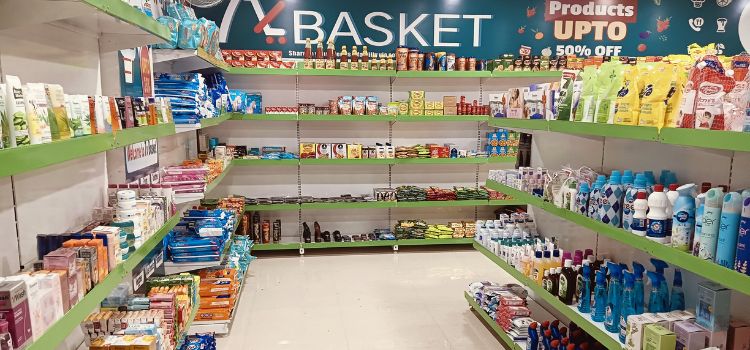
7x Basket is a useful example of how one brand maps its own pricing to these formats. Its Mini Store starts at ₹13 lakh, the Super Store at ₹23 lakh, and the Hyper Store at ₹63 lakh, with the full process from application to launch running about 45 days. The brand also waives royalty for the first two years of operation, which is unusual in Indian organized grocery and worth asking about when you compare offers, since a zero-royalty window changes your early cash flow more than a lower franchise fee does. As of 2026 it runs 150+ franchise partners across 25+ states, which gives you a reasonable pool of existing franchisees to actually talk to before signing anything.
What pushes the number up or down
City tier matters more than most people assume. A store in Mumbai or Delhi pays premium rent and higher setup costs than the same format in a Tier 2 city like Jaipur or Indore, where real estate runs 30% to 50% cheaper.
Brand strength cuts both ways. A well-known national chain charges a higher franchise fee, but it also brings supplier relationships and buying power you can't replicate on your own. A newer or regional brand costs less upfront but leaves more of the customer-acquisition work to you.
Whether you own or lease your property changes your math substantially. Leasing keeps your initial outlay lower but adds a recurring rent line for as long as you operate. Owning the property removes that monthly cost but ties up capital you could have put into inventory or a second location.
Royalty structure is worth checking before you sign anything. Some brands charge 6% to 10% of monthly revenue as an ongoing royalty. Others, mostly newer entrants competing for franchisees, have dropped royalty fees entirely and instead earn through supply chain margins.
The costs that keep coming after you open
Rent, staff salaries, and utilities are your fixed monthly costs, and for a mid-size supermarket these typically total ₹2 lakh to ₹6 lakh depending on city and headcount. Restocking is a recurring cost too, since grocery inventory turns over fast and needs constant replenishment to avoid empty shelves.
If your brand charges royalty, that comes out of monthly revenue rather than as a flat fee, so it scales with how well the store performs. Marketing support from the franchisor sometimes offsets part of your local advertising spend, but confirm this in writing before you count on it.
How long until you break even
Most supermarket franchises in India report a break-even window of 12 to 30 months, with gross margins in the 8% to 25% range depending on product mix and how much of your stock is high-margin private label versus lower-margin branded goods. Net margins after rent, staff, and royalty typically land between 1% and 4%, which is why volume, not markup, is what makes grocery retail profitable.
FAQs
What is the minimum amount needed to start a supermarket franchise in India?
A mini supermarket format can be started with ₹10 lakh to ₹15 lakh, covering a small franchise fee, basic interiors, opening inventory, and required licenses.
Do all supermarket franchises charge royalty?
No. Several newer brands have moved to a zero-royalty model and earn instead through supply and inventory margins, while established chains typically charge 6% to 10% of monthly revenue.
Is it cheaper to open in a smaller city?
Usually, yes. Rent and setup costs in Tier 2 and Tier 3 cities run 30% to 50% lower than in metro cities, though revenue per store also tends to be lower, so the comparison isn't purely one-directional.
What licenses do I need before opening?
At minimum, an FSSAI food license, GST registration, a local trade license, and fire safety clearance. Larger formats selling packaged food and fresh produce may need additional state-level approvals.
How long does it take to open a store after signing the franchise agreement? Most brands quote 30 to 60 days from signing to opening, covering site approval, interior fit-out, staff hiring, and initial stock delivery.
If you're comparing options right now, the smartest move is to shortlist two or three brands and request their exact franchise disclosure documents before committing capital. Line up the fee structure, royalty terms, and support you'd get from each grocery store franchise side by side, and the right choice tends to become obvious fast.