How Telecom Billing Software Simplifies Usage-Based and Recurring Billing
-
- Published Updated
- 1,493 views
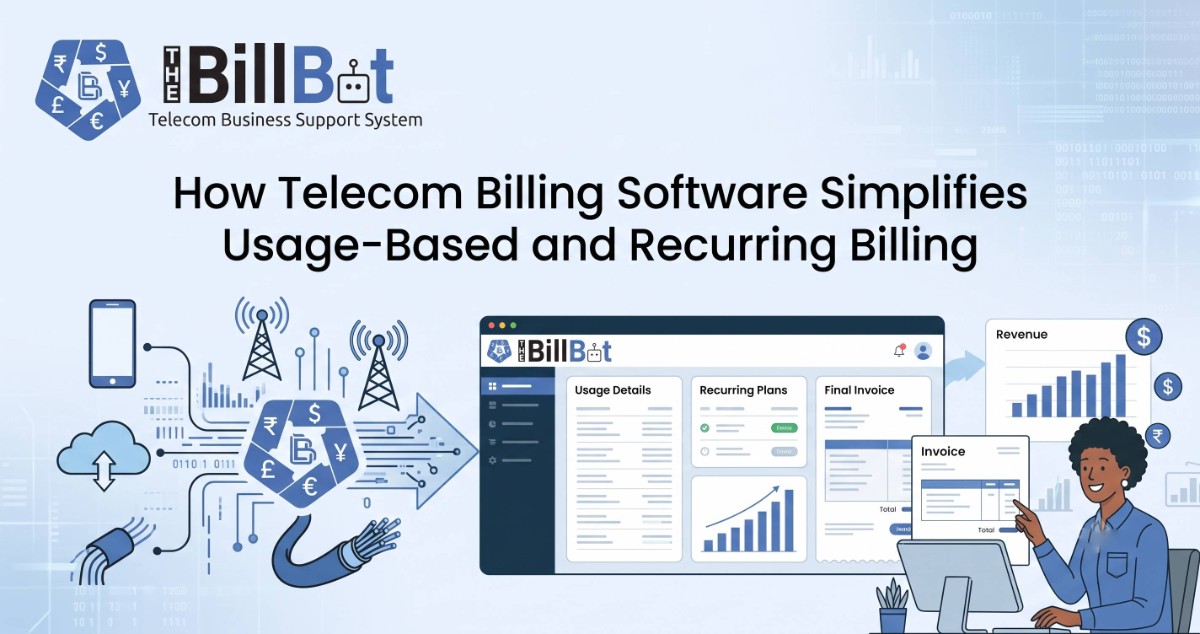
Telecom businesses often have to manage complicated billing processes. Customers may subscribe to monthly plans, use services based on consumption, purchase additional products, or combine several services under one account. As the number of customers and transactions increases, handling these billing models manually can become time-consuming and difficult to maintain accurately.
This is where Telecom Billing Software can make a significant difference. Instead of relying on spreadsheets, disconnected systems, or manual calculations, telecom providers can use dedicated billing software to automate the process of collecting usage data, applying pricing rules, generating invoices, and tracking payments.
Two common billing models in the telecom industry are usage-based billing and recurring billing. Understanding how these models work and how software can simplify them is important for ITSPs, VoIP providers, MSPs, and other communication service providers.
What Is Telecom Billing Software?
Telecom Billing Software is a system designed to help communication service providers manage the financial side of their services. It can connect customer accounts, products, pricing, usage, invoices, payments, and reporting within a structured billing workflow.
Depending on the platform, telecom billing software can support:
Recurring subscriptions
Usage-based charges
Call Detail Records (CDRs)
Product and package pricing
One-time charges
Discounts and adjustments
Automated invoice generation
Payment tracking
Payment reminders
Billing reports
Revenue reporting
The main objective is to make billing more consistent, automated, and easier to manage as the business grows.
Understanding Usage-Based Billing
Usage-based billing charges customers according to how much of a service they consume. Instead of paying only a fixed monthly amount, the customer's bill may depend on factors such as call duration, number of calls, data usage, messages, or other measurable services.
For example, a telecom provider could charge customers according to:
Minutes used
Number of calls
Data consumed
SMS usage
International calls
Premium destinations
Additional services
This model can provide flexibility for customers, but it also creates more complexity for the provider.
A billing system needs to accurately collect usage information, apply the correct rates, calculate charges, and include the results on the customer's invoice.
Understanding Recurring Billing
Recurring billing is commonly used for subscription-based telecom services. Customers are charged automatically on a predefined schedule, such as monthly, quarterly, or annually.
For example, a provider may offer:
Monthly VoIP plans
Business phone packages
Broadband subscriptions
Hosted communication services
Managed IT services
Monthly support packages
Instead of manually creating an invoice for every customer each billing cycle, recurring billing can automate the process based on the customer's subscription and billing terms.
Why Managing Both Billing Models Can Be Challenging
The challenge becomes greater when a telecom provider uses both recurring and usage-based billing.
Consider a customer who has a monthly business communication package with a fixed subscription fee but also makes international calls during the month. Their final invoice could include:
Monthly subscription + usage charges + additional services - discounts + taxes
Calculating this manually for hundreds or thousands of customers can create significant administrative work.
Even a small pricing or usage error can result in an incorrect invoice, payment dispute, or customer complaint.
This is one of the areas where Telecom Billing Software can simplify operations.
How Telecom Billing Software Simplifies Usage-Based Billing
1. Automated Usage Data Collection
Telecom providers generate large amounts of usage data. For voice services, this can include Call Detail Records containing information about calls and related usage.
Billing software can receive and process usage information so that it can be associated with the correct customer or account.
This reduces the need for employees to manually enter usage information and helps create a more consistent billing process.
2. Flexible Rating and Pricing
Different services may have different pricing rules. A provider might charge different rates based on destination, duration, service type, package, or customer plan.
A capable billing system can apply predefined pricing rules to usage records and calculate the corresponding charges.
This makes it easier to manage complex pricing structures without manually calculating every customer's usage.
3. Accurate Usage Calculations
Usage-based billing requires accurate calculations. Even small discrepancies can affect the final invoice.
Automated billing software can process large volumes of usage records consistently according to configured rules.
This can reduce calculation errors and minimize the amount of manual checking required by billing teams.
4. Support for Different Customer Plans
Not every customer needs to have the same pricing model.
One customer might have unlimited calls, while another may pay per minute. A third customer might have a monthly package with discounted rates for specific destinations.
Telecom billing software can support different plans and pricing structures, allowing providers to manage multiple customer billing models within the same system.
How Telecom Billing Software Simplifies Recurring Billing
1. Automated Billing Cycles
Recurring billing can be scheduled according to predefined billing dates.
When the billing cycle arrives, the system can generate invoices based on the customer's active subscription, recurring charges, and applicable adjustments.
This reduces repetitive administrative work and helps ensure invoices are generated consistently.
2. Automatic Invoice Generation
Manually creating hundreds of invoices every month is inefficient and increases the possibility of mistakes.
With automated billing, invoices can be generated based on configured customer accounts and billing rules.
This allows billing teams to spend less time on repetitive invoice preparation.
3. Automated Invoice Delivery
Once an invoice is generated, the billing system can support automated invoice delivery through email or other configured communication channels.
Customers can receive their invoices without requiring an employee to manually send each document.
This can also create a more predictable billing experience.
4. Payment Tracking and Reminders
Billing does not end when an invoice is created. Providers also need to know whether invoices have been paid.
Telecom billing software can help track outstanding balances and payment status. Depending on the system, automated reminders can also be used to notify customers about upcoming or overdue payments.
This can help billing teams maintain better visibility over receivables.
Combining Usage-Based and Recurring Billing
One of the biggest advantages of a dedicated telecom billing platform is the ability to combine different billing models.
For example, a customer could have:
£50 monthly subscription
£15 in additional usage
£10 in extra services
£5 promotional discount
The billing system can bring these charges together into a single invoice according to the configured billing rules.
This creates a more streamlined process for both the provider and the customer.
Benefits for Telecom Providers
Implementing Telecom Billing Software can provide several operational benefits.
Reduced Manual Work
Automating data processing, calculations, invoice creation, and notifications can reduce repetitive administrative tasks.
Improved Billing Accuracy
Automated calculations can help reduce errors associated with manual data entry and spreadsheet-based billing.
Faster Invoice Processing
Invoices can be generated according to predefined billing schedules instead of requiring manual preparation.
Better Payment Visibility
Billing teams can monitor invoice status, outstanding balances, and payment activity from a centralized system.
Easier Business Scaling
As customer numbers increase, automated billing can help providers manage larger transaction volumes without increasing manual billing work at the same rate.
Better Customer Experience
Accurate invoices, timely notifications, and clear billing information can make it easier for customers to understand and manage their services.
What to Look for in Telecom Billing Software
Before selecting a billing platform, telecom providers should consider their current and future requirements.
Important capabilities may include:
Usage-based billing
Recurring billing
CDR processing
Flexible rating
Product and package management
Automated invoicing
Payment integration
Payment reminders
Customer account management
Billing reports
Revenue reporting
API and third-party integrations
Scalable architecture
The right solution should fit the provider's business model rather than forcing the business to completely change its billing processes.
Final Thoughts
Managing usage-based and recurring billing can become increasingly complex as a telecom business grows. Multiple customers, services, pricing models, usage records, billing cycles, and payment arrangements can quickly create a large administrative workload.
Telecom Billing Software helps simplify this process by bringing usage processing, pricing, recurring charges, invoice generation, payment tracking, and reporting into a more connected workflow.
For telecom providers, the goal is not simply to automate invoice creation. A well-designed billing system can help create a more reliable billing operation that supports accuracy, efficiency, scalability, and a better customer experience.
As telecom services continue to evolve, having a flexible billing system that can handle both recurring and usage-based models can give providers a stronger foundation for managing their day-to-day financial operations.
Frequently Asked Questions
What is Telecom Billing Software?
Telecom Billing Software is a system that helps telecom and communication service providers manage billing-related processes such as usage calculation, recurring charges, invoicing, payments, and reporting.
Can Telecom Billing Software handle usage-based billing?
Yes. Telecom billing platforms can be designed to process usage information and apply configured pricing or rating rules to calculate usage-based charges.
What is recurring billing in telecom?
Recurring billing is a billing model where customers are charged a fixed amount at regular intervals, such as monthly, quarterly, or annually, based on their active subscription or service plan.
Can usage-based and recurring billing be combined?
Yes. A customer can have a recurring subscription fee along with additional usage-based charges. A suitable billing platform can combine these charges into a single invoice.
How does telecom billing automation help providers?
Billing automation can reduce manual work, improve calculation consistency, speed up invoice processing, support payment tracking, and help providers manage larger customer volumes more efficiently.
Visit the website: https://thebillbot.com/