Travel and Expense Management: The Complete Guide for Growing Businesses
-

- September 25th, 2026
- 3,408 views
If you've ever spent an entire weekend chasing crumpled receipts, cross-checking cab bills, and waiting on a manager to approve a claim that was submitted three weeks ago - you already know why travel and expense management deserves more attention than most companies give it.
Here's the honest truth: T&E is one of the hardest business costs to control. Nearly half of all companies don't even track their expense reports closely enough to understand where the money is really going. That's not a small gap - it's a blind spot that quietly eats into your budget every single month.
The good news? It doesn't have to stay that way. A well-structured travel and expense management system can turn this chaotic, paper-heavy process into something fast, transparent, and almost effortless for both employees and finance teams. Let's break down exactly how.
What Is Travel and Expense Management?
Travel and expense management (T&E) is the process organizations use to capture, record, track, and reimburse expenses that employees incur while traveling for business - flights, hotels, cabs, client meals, and everything in between.
Sounds simple on paper. In reality, it involves several moving parts: travel requests, approvals, receipt collection, policy checks, reimbursements, and reporting. When any one of these steps is handled manually, the whole chain slows down.
Why Travel and Expense Management Actually Matters
A lot of companies assume their "current process works well enough." But ask yourself a few honest questions:
Do your employees dread filing expense reports after a trip?
Does your finance team spend hours reconciling receipts and chasing approvals?
Do you actually know how much you're spending on travel this quarter - right now, without pulling a report?
If any of those made you pause, that's your answer. Unpredictable expenses, slow reimbursements, and poor visibility aren't just annoyances - they're signs of a process that's costing you more than it should, in both money and employee goodwill.
Automation has changed the game here. Companies that still rely on manual spreadsheets and paper trails are leaving productivity - and often accuracy - on the table.
The 5 Stages of the Travel and Expense Management Process
Understanding the full T&E lifecycle helps you spot exactly where your current process is breaking down. Here's how it typically unfolds.
1. Placing a Travel Request
Traditionally, employees submit a travel request and wait for approval before booking anything. With an automated system, requests and approvals happen almost simultaneously - a manager can approve, ask a quick question, or reject directly from a web dashboard or mobile app.
Many modern platforms also let employees book flights and cabs directly within the system, checking each booking against company travel policy in real time.
2. Travel Approval
Post-trip approvals are one of the biggest reasons reimbursements get delayed. A good system secures approval before or as the expense happens, not weeks later. Managers get full visibility into what's being spent, and approvals can happen in a couple of taps instead of a back-and-forth email thread.
3. Building the Expense Report
Nobody enjoys assembling receipts after a long business trip. With a digital system, employees simply scan receipts on the go using a mobile app, and the report builds itself in real time as the trip progresses. By the time the employee is back at their desk, the report is often already submitted - and sometimes already approved.
4. Expense Claim Approvals
A large share of businesses say improving their approval workflow is a top priority. A few questions can tell you where your process stands:
How easy is it for employees to submit proof of expense?
How many approval layers does a single claim need to pass through?
Are you still manually cross-checking receipts against claims?
The fewer manual touchpoints, the faster (and more accurate) your approvals become.
5. Reimbursement
This is the final, and arguably most important, step from an employee's point of view. Direct bank transfers save time for everyone and remove the awkward wait for a physical cheque. It's also worth collecting feedback after every trip - small tweaks based on real employee experience go a long way in keeping the process smooth.
Manual T&E Management: A Ticking Time Bomb
Here's a number worth sitting with: only about a quarter of finance professionals say their systems automatically flag out-of-policy expenses. That means, in most companies, either non-compliant claims are slipping through unnoticed, or someone is spending hours manually reviewing every single report.
In a traditional setup, an employee files a report after returning from a trip, attaches physical receipts (flight stubs, hotel bills, cab slips), and sends it to HR or finance for verification. Only after that does settlement happen. The time this takes depends entirely on the volume of claims and how quickly approvals move - which, without automation, is rarely quick.
Common Pain Points of Manual Travel and Expense Processes
Disorganized and Inefficient Workflows
High transaction volumes lead to oversight, missed entries, and general mismanagement - all of which quietly slow down growth.
It's Genuinely Expensive
Processing a single manual expense report costs a company real time and money - often around 20 minutes and roughly $58 per report. Correcting errors in that report adds even more time and cost on top.
Poor Employee Experience
Delayed reimbursements are consistently one of the biggest frustrations for employees, especially frequent travelers juggling multiple unsettled claims while heading out on their next trip. Unclear policies only make this worse.
Lack of Visibility
By the time spend data reaches decision-makers in a manual system, it's often outdated. This forces companies into reactive decision-making instead of proactive budgeting.
Weak Policy Enforcement
Even with a documented travel policy, manually verifying every claim against it is tedious and error-prone - which means violations often go unnoticed until it's too late.
Complicated Approval Chains
The larger the organization, the more layers a claim typically has to pass through, and the longer employees wait for their money.
Risk of Fraud
This might be the most serious issue on the list. A meaningful share of expense fraud comes through reimbursement claims, and it can take almost two years for some organizations to catch non-compliant or fraudulent transactions in a manual system.
What Is a Travel and Expense Policy?
Think of a travel and expense policy as a map for a hiking trip - without it, employees won't know what's "in bounds" and what isn't.
A solid policy should clearly:
Define what counts as a reimbursable (and non-reimbursable) expense
Educate employees on their responsibilities while traveling
Lay out the exact workflow for submitting and approving claims
When designing one, decide how employees should travel (flight, train, cab) and set spend limits based on role or seniority. Make accountability clear so employees understand the consequences of policy violations. And treat the policy as a living document - it should evolve as your business does.
Why T&E Automation Is Worth Investing In
If processing one manual expense report costs around $58, imagine the number for a team of 50 or 100 employees submitting reports every month. That adds up fast - and that's before you factor in the hours lost to corrections and follow-ups.
Here's what automation actually fixes:
1. Stronger Compliance
Once your policies are built into the system, it automatically flags anything outside the rules - no manual policing required. This alone eliminates a huge chunk of avoidable fraud and error.
2. Faster Reimbursements and Reconciliation
When receipts, advances, and compliance checks are tagged automatically, reconciliation stops being a multi-day chore and becomes something that happens almost instantly.
3. Smarter Travel Booking
Many platforms come with built-in booking tools that automatically apply company travel policies and limits, so employees get compliant options without extra effort.
4. Real-Time Visibility
Instead of waiting for month-end reports, you get a live dashboard of company-wide spend - which makes cash flow planning and forecasting far more accurate.
5. Meaningful Analytics
A good system can tell you which expense category is your biggest cost driver, which vendors or airlines are used most, which regions your team travels to most often, and where non-compliance tends to happen. That's the kind of insight that helps you negotiate better vendor deals and tighten your budget.
6. Easy Storage and Audit-Readiness
Digitized receipts and reports mean you're never digging through boxes of paper during an audit. Most systems also retain years of data, helping you stay compliant with regulatory requirements.
Best Practices to Improve Your T&E Process
Prioritize visibility. A 360-degree view of spend - by employee, category, or vendor - helps you catch issues before they become expensive.
Improve the employee travel experience. Employees are far more likely to follow policy when the process itself isn't painful. Self-booking tools go a long way here.
Offer employee-friendly payment options. Corporate cards reduce the need for employees to use personal money for business trips.
Go paperless. Digital claims are easier to file, easier to track, and easier to audit.
Design faster approval workflows. Auto-approve small, low-risk expenses (like meals under a set limit) so approvers can focus on the exceptions that actually need review.
Choosing the Right Travel and Expense Management System
Not every business has the same needs, so it's worth evaluating a few things before you commit to a platform:
Business needs and features - Understand your current pain points first; that will tell you exactly what features matter most.
Budget - Compare providers that fit your feature requirements at a reasonable price point.
Customization - Your travel policies are unique to your company, so the software should be flexible enough to reflect them - and adapt as they change.
Ease of use - A clean, intuitive interface (ideally across web and mobile) makes adoption far easier for employees.
Support - 24/7 support matters, especially for employees traveling across time zones.
Integration - The system should connect smoothly with your existing HRMS, payroll, and accounting tools so data flows without manual re-entry.
Why SavvyHRMS Is a Smart Choice for T&E Management
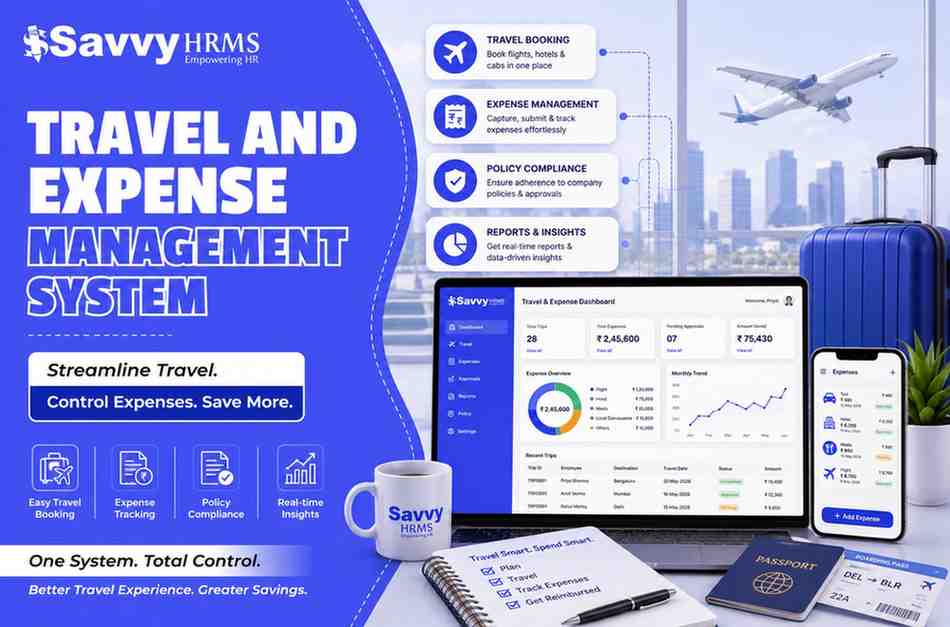
This is exactly where SavvyHRMS fits in. As an all-in-one HR platform, SavvyHRMS brings travel and expense management directly into the same system you already use for attendance, payroll, and employee records - so there's no juggling between disconnected tools.
With SavvyHRMS, businesses get:
Simplified travel requests and approvals - managed on one unified dashboard
Real-time expense capture - employees log expenses as they happen, not days later
Built-in policy compliance checks - so out-of-policy claims get flagged automatically
Faster approval workflows - cutting down reimbursement turnaround time significantly
Seamless integration with payroll and HR data - since it's all part of the same HRMS ecosystem
For growing businesses that want to stop managing travel expenses through spreadsheets and email threads, SavvyHRMS offers a genuinely simpler way to bring structure, speed, and visibility to the entire T&E process.
Conclusion
Managing travel and expenses doesn't have to be the stressful, paperwork-heavy process it's been for most companies. When you automate the journey - from the moment a travel request is placed to the moment reimbursement lands in an employee's account - you get better compliance, faster turnaround times, and a much clearer picture of where your company's money is actually going.
The businesses that get this right aren't necessarily spending more; they're just spending smarter, with the right system doing the heavy lifting in the background.
If you're ready to move away from manual expense chaos, SavvyHRMS brings travel and expense management together with the rest of your HR operations - making it easier for employees to file claims and easier for finance teams to stay on top of company spend, all from one platform.
Frequently Asked Questions
1. What is a travel and expense management system?
It's software that helps organizations capture, track, approve, and reimburse business travel expenses - replacing manual paperwork with automated workflows, policy checks, and real-time reporting.
2. Why is travel and expense management important for businesses?
It gives companies visibility into travel spend, reduces reimbursement delays, minimizes the risk of fraud, and saves significant time for both employees and finance teams.
3. What is a travel and expense audit?
It's a review process where a company matches actual travel expenses - like airfare, lodging, and meals - against the receipts and proof submitted by employees to ensure everything is accurate and policy-compliant.
4. What are the biggest challenges in manual travel and expense management?
Common issues include lost receipts, delayed approvals, poor visibility into spend, inconsistent policy enforcement, and a higher risk of fraudulent or duplicate claims.
5. How does automation improve the T&E process?
Automation speeds up approvals, flags policy violations instantly, digitizes receipts, and gives real-time visibility into company-wide travel spend - cutting down both cost and processing time.
6. What should a good travel and expense policy include?
It should clearly define reimbursable and non-reimbursable expenses, spending limits by role, the approval workflow, and employee responsibilities during business travel.
7. How is a travel and expense management system different from a travel management system?
A travel management system mainly helps plan and book business travel, while a travel and expense management system covers the full cycle - including expense capture, approvals, compliance checks, and reimbursement.