What Are the Different Types of Pharmacists? Roles & Career Paths
-

- Published Updated
- 78 views
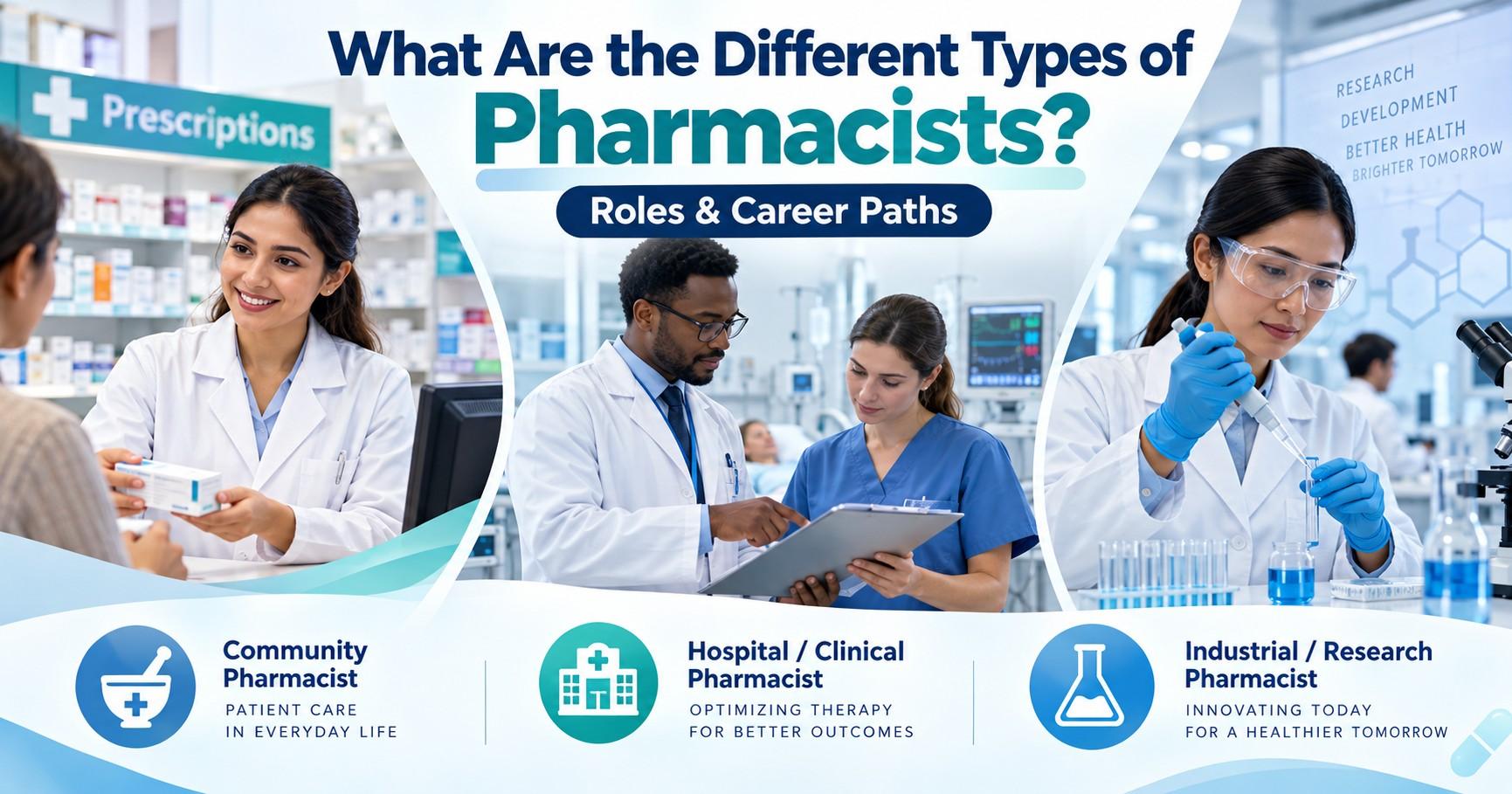
When someone mentions a pharmacist, most people imagine a professional standing behind a pharmacy counter, dispensing medicines. However, the pharmacy profession offers far more career opportunities than working in a medical store.
From helping patients manage complex medications to developing new drugs and ensuring pharmaceutical quality, pharmacists contribute to nearly every stage of healthcare.
For students pursuing D.Pharm, B.Pharm, M.Pharm, or Pharm.D, understanding the different types of pharmacists can help them make informed career decisions.
Whether you prefer direct patient interaction, pharmaceutical research, or working in the healthcare industry, there are several pharmacy career paths worth exploring.
What Are the Different Types of Pharmacists?
Pharmacists can be classified according to their workplace, responsibilities, and areas of specialization. Some focus on dispensing medications and patient counselling, while others work in hospitals, research institutions, pharmaceutical companies, or government organizations.
Here are ten important types of pharmacists and pharmacy-related career paths.
1. Community Pharmacist
A community pharmacist is one of the most familiar healthcare professionals. They typically work in retail pharmacies, independent medical stores, or pharmacy chains.
Key responsibilities:
Dispensing prescription medications accurately.
Explaining dosage instructions and possible side effects.
Identifying potential drug interactions.
Managing medicine inventory and storage.
Providing guidance on the responsible use of over-the-counter medicines.
Career opportunities: Retail pharmacies, pharmacy chains, and independent medical stores.
Qualifications: D.Pharm or B.Pharm with appropriate State Pharmacy Council registration.
Community pharmacy can be an excellent starting point for graduates who enjoy patient interaction and want to develop practical medication-management skills.
2. Hospital Pharmacist
Hospital pharmacists work in government hospitals, private hospitals, medical colleges, and specialty healthcare institutions.
Unlike community pharmacists, they often deal with complex medication requirements involving hospitalized patients.
Key responsibilities:
Reviewing prescriptions for dispensing accuracy.
Maintaining hospital medicine inventories.
Managing high-alert medicines and controlled-drug records.
Supporting safe medication distribution.
Coordinating with doctors and nursing teams.
Career opportunities: Government hospitals, multispecialty hospitals, medical colleges, and healthcare institutions.
Qualifications: D.Pharm or B.Pharm with registration, subject to employer and recruitment requirements.
With experience, hospital pharmacists may progress into senior pharmacist, pharmacy supervisor, or pharmacy management positions.
3. Clinical Pharmacist
Clinical pharmacy is a patient-focused specialization involving the safe and effective use of medicines.
Clinical pharmacists work closely with healthcare professionals to support appropriate medication therapy.
Key responsibilities:
Reviewing medication regimens for potential problems.
Identifying drug interactions and adverse reactions.
Supporting appropriate medication dosing.
Providing medication counselling.
Participating in medication safety and therapeutic monitoring activities.
Career opportunities: Multispecialty hospitals, clinical pharmacy departments, and specialized healthcare centers.
Qualifications: Pharm.D is particularly relevant to clinical pharmacy roles. Some positions may also consider B.Pharm or M.Pharm graduates with suitable training and experience.
Clinical pharmacy can be suitable for individuals interested in pharmacotherapy, patient safety, and evidence-based healthcare.
4. Industrial Pharmacist
Industrial pharmacists and pharmaceutical professionals work in organizations involved in manufacturing medicines and healthcare products.
Their responsibilities focus on ensuring medicines are produced consistently and meet established quality standards.
Key responsibilities:
Supporting pharmaceutical manufacturing processes.
Monitoring production procedures.
Ensuring compliance with Good Manufacturing Practices (GMP).
Reviewing manufacturing documentation.
Supporting product quality and process improvement.
Career opportunities: Pharmaceutical manufacturing companies, formulation units, and biotechnology organizations.
Qualifications: B.Pharm or M.Pharm, depending on the position.
This career path is particularly suitable for graduates interested in pharmaceutical technology, production operations, and industrial processes.
5. Regulatory Affairs Pharmacist
Regulatory affairs professionals help pharmaceutical companies comply with the rules governing medicine development, registration, manufacturing, and marketing.
Their work involves understanding regulatory requirements and preparing accurate documentation.
Key responsibilities:
Preparing drug registration and submission documents.
Supporting regulatory approvals.
Maintaining product compliance records.
Monitoring changes in pharmaceutical regulations.
Coordinating with internal departments on regulatory requirements.
Career opportunities: Pharmaceutical companies, biotechnology firms, regulatory consulting organizations, and contract research organizations.
Qualifications: B.Pharm or M.Pharm is commonly relevant, alongside knowledge of pharmaceutical regulations.
Regulatory affairs can be a promising option for pharmacy graduates who prefer documentation, scientific analysis, and compliance-focused work.
6. Research and Development Pharmacist
Research and development (R&D) professionals contribute to discovering, designing, formulating, and improving pharmaceutical products.
They may work on new drug formulations, analytical methods, or drug delivery technologies.
Key responsibilities:
Conducting pharmaceutical formulation experiments.
Investigating drug stability and compatibility.
Developing or optimizing dosage forms.
Maintaining laboratory records.
Supporting pharmaceutical research projects.
Career opportunities: Pharmaceutical R&D laboratories, biotechnology companies, academic institutions, and research organizations.
Qualifications: B.Pharm may provide entry-level opportunities, while M.Pharm or a PhD is often preferred for specialized research positions.
This field suits individuals who enjoy laboratory work, experimentation, and scientific problem-solving.
7. Government Pharmacist
Government pharmacists work in public healthcare institutions and contribute to medicine accessibility and healthcare delivery.
Recruitment opportunities may be available through state health departments, public hospitals, government medical colleges, and central healthcare institutions.
Key responsibilities:
Dispensing medicines in government healthcare facilities.
Managing pharmaceutical supplies.
Maintaining medicine inventory records.
Supporting public healthcare services.
Following government pharmacy procedures and applicable regulations.
Qualifications: D.Pharm or B.Pharm with valid registration, depending on the recruitment notification.
Government pharmacist jobs are popular among graduates seeking structured career progression, public-sector employment benefits, and opportunities to serve communities.
However, eligibility, examinations, age limits, and selection procedures vary between organizations.
8. Oncology Pharmacist
Oncology pharmacists specialize in medication management for cancer treatment.
They may work in cancer hospitals and specialized oncology departments, where medicines often require careful handling and monitoring.
Key responsibilities:
Supporting safe preparation and handling of anticancer medicines.
Reviewing chemotherapy medication orders.
Monitoring potential treatment-related medication problems.
Educating patients about prescribed medicines.
Collaborating with oncology healthcare teams.
Career opportunities: Cancer hospitals, oncology centers, and specialized hospital pharmacy departments.
Qualifications: Relevant pharmacy qualifications, clinical training, and oncology-specific experience are generally important.
This specialization requires detailed knowledge of anticancer therapies and medication safety procedures.
9. Pharmacovigilance and Drug Safety Professional
Pharmacovigilance focuses on identifying, assessing, understanding, and preventing adverse effects and other medicine-related safety problems.
Pharmacy graduates can enter this field through drug safety associate and related positions.
Key responsibilities:
Collecting and reviewing adverse drug reaction reports.
Processing individual case safety reports.
Supporting drug safety database activities.
Reviewing medical and medication-related information.
Following applicable pharmacovigilance procedures.
Career opportunities: Pharmaceutical companies, contract research organizations, and drug safety service providers.
Qualifications: B.Pharm, M.Pharm, or Pharm.D, depending on the employer.
This non-dispensing career option is suitable for graduates interested in medication safety, medical documentation, and pharmaceutical industry operations.
10. Academic and Teaching Pharmacist
Pharmacy graduates interested in education can pursue careers in pharmacy colleges, universities, and academic research institutions.
Academic professionals help prepare future pharmacists through classroom teaching, laboratory instruction, and research.
Key responsibilities:
Teaching pharmaceutical subjects.
Supervising laboratory practicals.
Guiding student research projects.
Developing academic materials.
Participating in research and educational activities.
Career opportunities: Pharmacy colleges, universities, and research institutions.
Qualifications: M.Pharm or higher qualifications are commonly required for faculty positions, according to applicable recruitment and regulatory norms.
Academic pharmacy is particularly suitable for individuals passionate about teaching and scientific research.
How to Choose the Right Pharmacy Career Path
Choosing among the different types of pharmacists depends on your interests, qualifications, and long-term goals.
If you enjoy communicating with patients, community pharmacy, hospital pharmacy, or clinical pharmacy may be suitable.
If you prefer laboratory environments, pharmaceutical manufacturing or research and development could be better options.
Graduates interested in documentation and compliance can explore regulatory affairs, while those interested in medicine safety may consider pharmacovigilance.
With the growing range of healthcare jobs available across hospitals, pharmaceutical companies, research organizations, and healthcare institutions, pharmacy graduates can explore opportunities beyond traditional dispensing roles.
Before selecting a specialization, consider the skills employers expect, available training opportunities, working conditions, and potential career growth.
You can also explore current Pharmacist jobs in India to understand which pharmacy qualifications, responsibilities, and practical skills employers commonly request.
Qualifications Required to Become a Pharmacist in India
The Pharmacy Council of India (PCI) recognizes specific pharmacy qualifications for professional registration.
The primary entry qualifications include:
D.Pharm: A two-year diploma programme, along with prescribed practical training and applicable examination requirements.
B.Pharm: A four-year undergraduate pharmacy degree.
Pharm.D: A six-year professional doctoral programme focused on pharmacy practice and clinical learning.
M.Pharm provides further specialization after B.Pharm and can support career progression in research, industry, and academia.
To practise as a registered pharmacist in India, eligible candidates must satisfy the applicable requirements of their State Pharmacy Council.
Importantly, completing a pharmacy degree does not automatically provide registration, and industry job eligibility is not always the same as eligibility to practise as a pharmacist.
Frequently Asked Questions
Which type of pharmacist is best for freshers?
Community pharmacy and hospital dispensing roles are common entry-level options. B.Pharm graduates can also explore pharmaceutical production, quality assurance, regulatory affairs, and drug safety trainee positions.
Which pharmacy career has the highest salary?
Specialized positions in clinical pharmacy, pharmaceutical research, regulatory affairs, and industry management can offer strong earning potential. Actual salaries depend on experience, qualifications, employer, and location.
Can B.Pharm graduates work in clinical research?
Yes. B.Pharm graduates can apply for relevant entry-level clinical research positions, although some roles require additional training, experience, or specialized qualifications.
Is Pharm.D better than B.Pharm?
Neither qualification is universally better. Pharm.D emphasizes clinical pharmacy practice, while B.Pharm provides broader undergraduate preparation for pharmacy practice and pharmaceutical industry careers.
Conclusion
Pharmacy is a diverse profession offering opportunities in patient care, pharmaceutical manufacturing, research, medication safety, education, and healthcare administration.
Understanding the different types of pharmacists helps students identify career paths that match their academic background, strengths, and professional interests.
Whether you aim to work in a hospital, join a pharmaceutical company, pursue research, or enter public healthcare, developing relevant skills and gaining practical experience are essential steps toward building a successful pharmacy career.
The right pharmacy career is not simply the most popular option. It is the one that aligns with your interests, qualifications, and long-term professional goals.