UK Innovator Founder Visa Endorsement: What Do Endorsing Bodies Look For?
-

- Published Updated
- 83 views
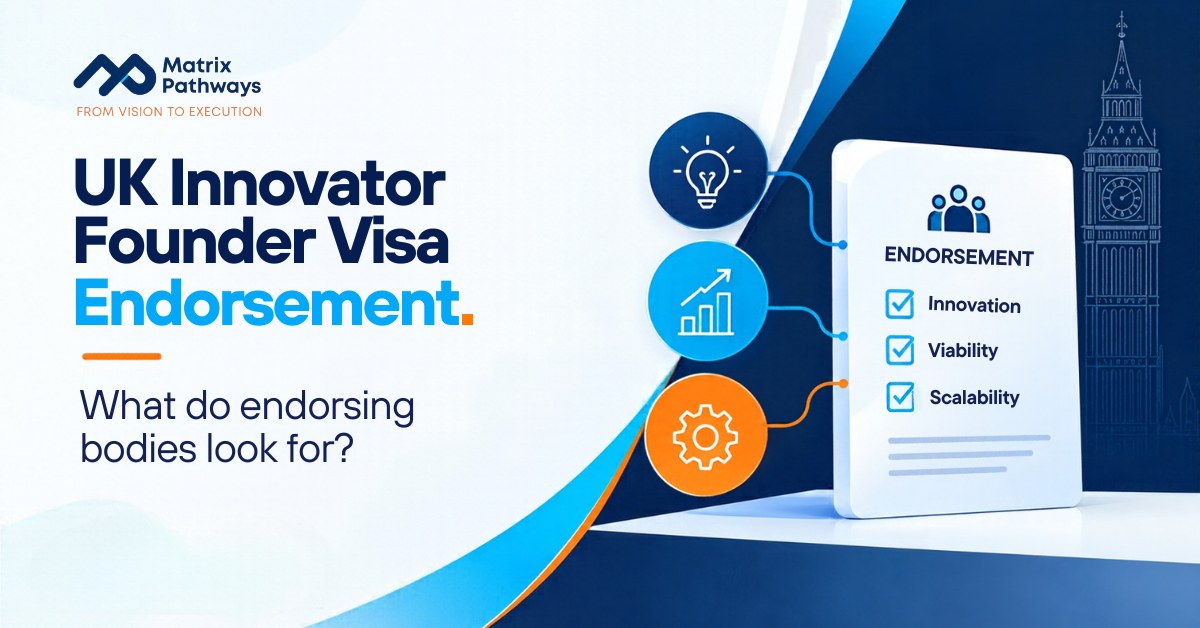
The UK Innovator Founder Visa offers a potential route for entrepreneurs who want to establish and develop an innovative business in the United Kingdom. However, having a promising business idea is only one part of the process. Applicants seeking to establish a new business must also demonstrate that their proposal meets the expectations of an approved endorsing body.
Endorsement is an important stage of the UK Innovator Founder Visa application process because it involves assessing the proposed business against key criteria, including innovation, viability and scalability.
Understanding what endorsing bodies look for can help entrepreneurs prepare a stronger business proposal, identify potential weaknesses and present their plans more effectively.
This article explains the main endorsement criteria, the importance of business planning and the practical steps entrepreneurs can take before seeking endorsement.
1. What Is an Endorsing Body for the UK Innovator Founder Visa?
An endorsing body is an organisation authorised under the UK immigration system to assess applicants and their business proposals for the Innovator Founder route.
For entrepreneurs applying to establish a new business, endorsement provides an independent assessment of whether the proposed venture meets the relevant requirements.
Applicants considering this pathway should first understand the UK Innovator Founder Visa requirements, including the relationship between endorsement, business eligibility and the immigration application itself.
An endorsing body typically considers whether the applicant has developed a credible business concept and whether the proposed venture demonstrates the potential to succeed in the UK market.
Importantly, receiving an endorsement does not automatically mean that a visa will be granted. The endorsement assessment and the Home Office's immigration decision are separate stages.
Entrepreneurs should also confirm that the organisation they intend to approach is authorised to provide the relevant endorsement.
2. Innovation: What Makes a Business Idea Different?
Innovation is one of the central considerations in the endorsement process.
An innovative business proposal should demonstrate more than an intention to enter an existing market. It should explain how the business introduces something original or creates a meaningful competitive advantage.
This does not necessarily mean developing a completely new technology or inventing a product that has never existed before.
Innovation may involve a distinctive product, service, business model or approach to solving an identifiable market problem.
For example, an entrepreneur proposing a digital service should be able to explain what makes the solution different from existing alternatives and why customers would find that difference valuable.
Endorsing bodies may examine several important questions:
What specific problem does the business solve?
How is the proposed solution different from existing competitors?
What evidence supports the claimed innovation?
Is the innovation central to the business rather than an additional feature?
Can the applicant explain their own contribution to developing the concept?
A business idea should therefore communicate its innovative characteristics clearly and support them with credible reasoning or evidence.
3. Viability: Can the Proposed Business Realistically Succeed?
An innovative idea also needs a realistic commercial foundation.
Viability refers to whether the proposed business has a credible prospect of operating successfully, given its market, resources, financial assumptions and the applicant's capabilities.
Endorsing bodies assess more than the attractiveness of the concept. They also consider whether the entrepreneur has thought carefully about the practical requirements of launching and managing the business.
Understanding the target market
A viable proposal should identify the customers it intends to serve and explain why those customers may be interested in the product or service.
Market research can help demonstrate customer needs, purchasing behaviour, competitor activity and potential demand.
Demonstrating financial readiness
Financial planning is another important consideration.
Entrepreneurs should understand their expected startup costs, operating expenses, potential revenue sources and funding requirements.
Although the UK Innovator Founder Visa does not impose a universal fixed £50,000 minimum investment requirement, this does not mean a business can operate without adequate financial resources.
Applicants should demonstrate that their funding plans and financial assumptions are realistic for the proposed venture.
Showing relevant skills and experience
An endorsing body may also consider whether the applicant has the knowledge, skills, experience and market awareness required to deliver the business plan.
Relevant professional experience, technical expertise or previous entrepreneurial activity may help demonstrate the applicant's ability to execute the proposal.
4. Scalability: Does the Business Have Genuine Growth Potential?
Scalability is another essential aspect of the Innovator Founder endorsement assessment.
A scalable business should demonstrate the potential to grow beyond its initial operations.
This may involve increasing revenue, expanding into additional markets, developing new products or services, or creating employment opportunities.
However, simply stating that a business will expand rapidly is not enough.
Endorsing bodies look for credible evidence that the proposed growth strategy is achievable.
A scalability assessment may consider:
Whether the business model can support increasing customer demand.
How the company intends to enter new markets.
Whether the proposed operational structure can support expansion.
The potential for skilled job creation.
Opportunities for growth into national or international markets.
For example, a startup planning to offer specialised business software may demonstrate scalability by explaining how its platform could serve a growing number of customers without requiring a proportionate increase in operating costs.
A convincing growth strategy should connect the business's market opportunity with realistic operational and financial plans.
5. Why Is a Strong Business Plan Important for Endorsement?
A business plan brings together the different elements of the proposed venture and explains how the entrepreneur intends to turn an idea into a functioning business.
It helps an endorsing body understand the business concept, commercial strategy and applicant's ability to implement the proposal.
A well-prepared business plan generally addresses the problem being solved, the proposed solution, target customers, competitive positioning, revenue model, marketing strategy and financial projections.
It should also explain the founder's responsibilities and the resources required to launch and develop the venture.
The quality of the underlying analysis matters more than the appearance or length of the document.
Entrepreneurs exploring professional business immigration preparation and planning support may benefit from reviewing their business model, financial assumptions and endorsement readiness before submitting a proposal.
A business plan should remain realistic, consistent and supported by evidence wherever possible.
Unsubstantiated revenue projections or exaggerated market opportunities may raise questions rather than strengthen the application.
6. What Supporting Evidence Can Strengthen an Endorsement Application?
A business proposal becomes more persuasive when its claims are supported by relevant evidence.
The documents and information requested will depend on the endorsing body, the business model and the applicant's circumstances.
Useful supporting materials may include market research, competitor analysis, financial forecasts, product demonstrations, technical documentation or evidence of customer interest.
For example, a founder developing a new software solution might provide a working prototype or a detailed product development plan.
An entrepreneur introducing a specialised service could provide evidence of market demand, relevant industry experience or a clearly defined customer acquisition strategy.
Supporting evidence should be genuine, relevant and consistent with the information presented in the business plan.
Applicants should avoid presenting speculative assumptions as confirmed achievements.
It is also important to distinguish between a business that is still being developed and one that already has customers, revenue or operational activity.
Clear documentation helps an endorsing body assess the proposal on its actual merits.
7. Common Mistakes Entrepreneurs Should Avoid
Even promising business ideas can be difficult to assess when their supporting proposals contain gaps or inconsistencies.
One common mistake is focusing heavily on innovation while giving insufficient attention to commercial viability.
A business may introduce an interesting concept but still lack a realistic customer acquisition strategy or financial plan.
Another mistake is making ambitious growth predictions without explaining how the business will achieve them.
Entrepreneurs should also avoid relying on generic market research that does not directly support their proposed business.
Other potential weaknesses include unclear founder responsibilities, inconsistent financial projections and insufficient explanation of the business's competitive advantage.
Applicants should ensure that their proposal demonstrates their own meaningful contribution to the business idea and its implementation.
Before approaching an endorsing body, it can be helpful to review the proposal from three perspectives: Is the business genuinely innovative? Is it commercially realistic? Can it grow sustainably?
Addressing these questions early can improve the clarity and credibility of the submission.
Conclusion
Securing endorsement for the UK Innovator Founder Visa requires more than presenting an attractive business idea.
Entrepreneurs must demonstrate that their proposed venture meets the relevant innovation, viability and scalability criteria while showing that they have a credible plan to develop the business.
Market research, realistic financial forecasts, a clear growth strategy and appropriate supporting evidence can all contribute to a well-prepared endorsement proposal.
Understanding the assessment process also helps applicants identify areas that may require further development before submission.
Ultimately, careful preparation can help entrepreneurs present their business proposals more clearly, although endorsement and visa approval remain subject to the applicable requirements and individual assessment.
Frequently Asked Questions
1. Is endorsement mandatory for the UK Innovator Founder Visa?
Yes. Applicants must obtain an endorsement from an authorised endorsing body under the applicable route requirements. The endorsement is an important part of the application, but applicants must also satisfy the relevant Home Office immigration requirements.
2. Does a business idea need to be completely new to qualify?
A business does not necessarily need to involve a completely new invention. However, it must meet the applicable innovation requirements and demonstrate a genuine competitive advantage. Simply replicating an existing business without meaningful differentiation may not satisfy the criteria.
3. Is £50,000 required to obtain Innovator Founder Visa endorsement?
There is no universal fixed £50,000 minimum investment requirement under the Innovator Founder route. However, applicants establishing a new business must demonstrate that their funding and resource plans are appropriate for the venture. Separate personal maintenance requirements may also apply.
4. Can an endorsing body reject a business proposal?
Yes. An endorsing body may decline to endorse a proposal if it does not satisfy the relevant criteria or if the applicant fails to provide sufficient supporting information. Applicants should check the organisation's assessment process and any available review procedures.
5. Does endorsement guarantee approval of the UK Innovator Founder Visa?
No. Endorsement and visa approval are separate decisions. An applicant must still meet the applicable immigration requirements, and the Home Office makes the final visa decision.