7 Mistakes That Sink VCAP-VCF Administrator (3V0-11.26) Candidates, and the Fix for Each
-
- Published Updated
- 71 views
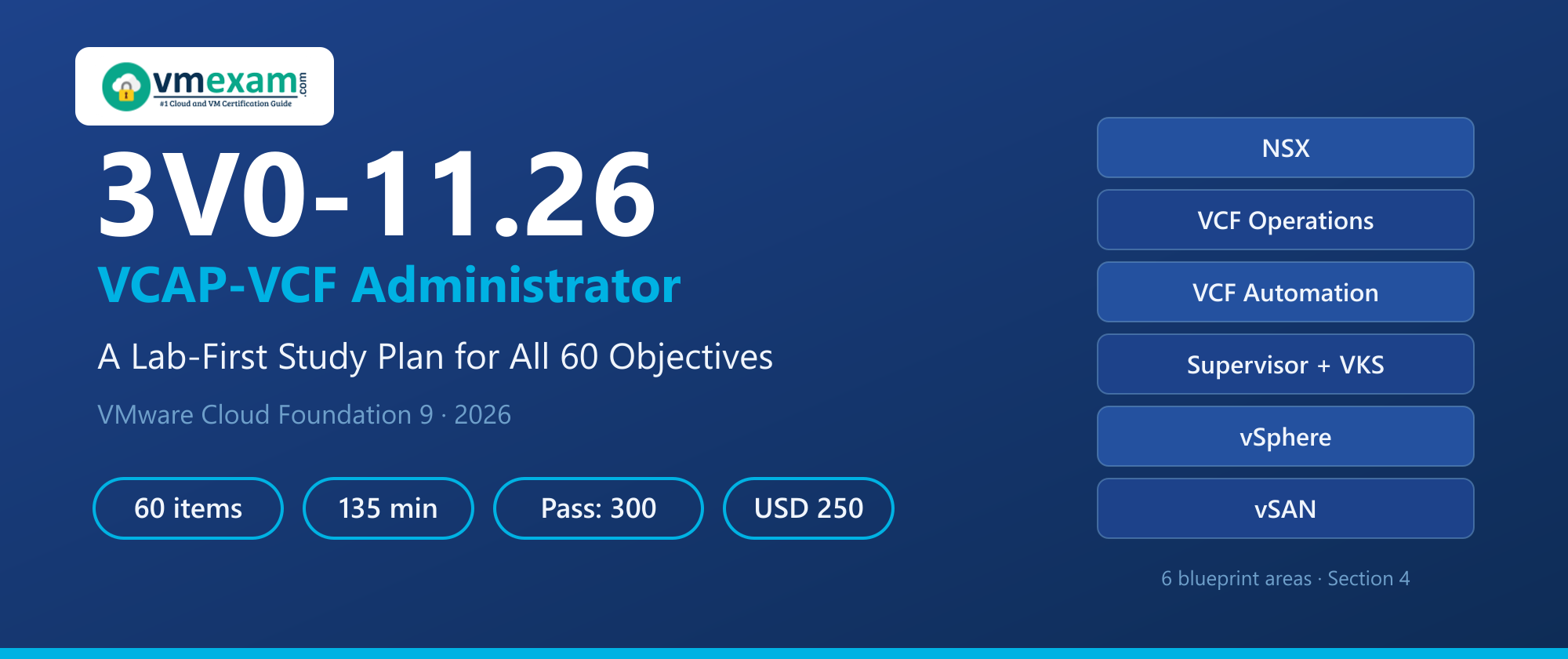
The 3V0-11.26 exam guide is only five pages long, and candidates still misread it. The result is a predictable set of failures: people who know vSphere well but have never built an NSX Tier-0 gateway, people who studied VCF 5 material for a VCF 9 exam, and people who expected 60 multiple-choice questions and met build-lists and hot-areas instead.
Below are the seven mistakes that most often sink VCAP-VCF Administrator candidates, with a fix for each. Every exam figure comes from Broadcom's official exam guide, last updated August 18, 2026.
Mistake 1: Are you studying 3V0-11.26 like a theory exam?
The fix: study every objective as a task you perform, because all 60 objectives sit in the "Install, Configure, Administrate" section and most begin with "Given a scenario."
VMware blueprints have five standard sections. On 3V0-11.26, Sections 1 (IT architectures), 2 (VMware products), 3 (plan and design) and 5 (troubleshoot and optimise) have no testable objectives. Everything is in Section 4.
That means the exam isn't asking you to define VCF components. It's asking what you would do, in a specific situation, inside VCF 9. Candidates who revise from slide decks and product overviews get caught out by items that require ordering real workflow steps.
What to do: rewrite each objective as a concrete lab task before you study it. "Given a scenario, configure vSAN Encryption" becomes "enable data-at-rest encryption on an existing workload domain cluster using a native key provider." Then do it.
Mistake 2: Are you skipping NSX because you're "a compute person"?
The fix: give NSX at least a quarter of your study time. Thirteen of the 60 objectives are NSX tasks, the joint-largest area on the blueprint.
Objectives 4.48 to 4.60 cover NSX Federation, NSX components, Edge clusters, Tier-0 and Tier-1 gateways, VRF, segments, VPCs, DHCP, NAT, projects and tenancy, advanced integrations, and operational tasks such as syslog and backup/restore.
Bart Peeters, a vExpert who sat the beta in July 2026, welcomed the networking weight: "For me, it was really good to see that NSX is covered. Advanced networking absolutely should be a core part of a VCF platform exam." If you've administered vSphere without ever touching NSX Manager, this area is where your gap is.
What to do: in a lab, build the full chain in order: Edge cluster, Tier-0, Tier-1, segment, VPC, then DHCP and NAT. Finish with an NSX backup and restore. Repeat until it's routine.
Mistake 3: Have you ignored VCF Operations, the other 13 objectives?
The fix: learn the VCF Operations features most administrators never touch at work, because objectives 4.35 to 4.47 test them directly.
VCF Operations is the second joint-largest area. It covers Day 2 operational tasks, reclaiming resources, rightsizing workloads, what-if capacity forecasting, cost management configuration, policies, Business Intent versus Operational Intent, business applications, alerts, fleet lifecycle scaling, fleet upgrades, VCF SSO and configuration drift monitoring.
Cost settings and intents are the usual blind spots. Plenty of VCF administrators monitor capacity but have never configured cost management or defined a business intent, so these objectives become guesswork on exam day.
What to do: in VCF Operations, create a policy, configure an alert, run a what-if scenario, set up cost management, define both a business intent and an operational intent, and set a configuration-drift baseline. Objective 4.41 specifically asks you to differentiate the two intent types.
Mistake 4: Are you studying VCF 5.x content for a VCF 9 exam?
The fix: use only VCF 9 material, and read the VCF 9 release notes, which the exam guide names as a source for item writers.
The exam is titled Advanced VMware Cloud Foundation 9 Administrator. Several heavily tested concepts either didn't exist or worked differently in earlier versions: Provider and Organization structures in VCF Automation, the Provider Consumption Organization, VCF Identity Broker, Fleet Management and the way VCF Operations consolidates Logs and Networks.
Eleven objectives (4.19 to 4.29) cover the VCF Automation provider and organization layer alone: identity providers for the Provider Management portal, provider content libraries, access control, creating Organizations, enabling the Provider Consumption Organization, and then projects, governance policies, namespace classes and VPCs inside a VCF All Apps Organization.
What to do: check the version on every guide, blog and course you use. The exam guide's own reference list is short: VMware's private cloud topic pages, Broadcom TechDocs and broadcom.com, plus the instruction to "review all release notes and material for features and functions."
Mistake 5: Are you expecting multiple choice only?
The fix: practise interactive item formats, because the guide lists seven item types.
The official list is multiple-choice, multiple-selection multiple-choice, build-list, matching, drag-and-drop, point-and-click and hot-area. Build-list items ask you to put workflow steps in order. Point-and-click and hot-area items ask you to identify the right place in an interface.
These formats reward people who have performed the task themselves. Memorised answers don't help when the question is "which of these steps comes third?"
The other arithmetic to remember: 60 items in a 135-minute appointment, which is about 2 minutes 15 seconds each. That's comfortable if you've practised and tight if you reason through every item from first principles.
What to do: while working through your lab, write down the exact click path for each task. Those sequences are what build-list and point-and-click items test.
Mistake 6: Are you waiting for a VCP you don't need, or booking with no experience?
The fix: understand that there's no prerequisite certification, but there is an expected experience level.
Older VMware tracks required a VCP before a VCAP. The VCF 9 lineup doesn't. Eric Sloof, founder of NTPRO.NL, described the eight VCF 9 VCAP exams this way in September 2026: "All eight exams are independent. There is no prerequisite chain between the pillar exams and the role-based exams."
Some candidates read that and book immediately with mostly vSphere experience. The exam guide's "minimally acceptable candidate" can manage, maintain and scale a multi-region or multi-organization VCF private cloud, and administer, optimise and scale software-defined storage and networking. That's the bar, prerequisite or not.
What to do: if you came up through the VCP-CMA or automation track, this IndiBlogHub guide to preparing for the VMware 2V0-31.23 exam shows how a lab-first VCP routine translates to the VCAP level. If your experience is thin in two or more of the six objective areas, delay the booking.
Mistake 7: Are you relying on question banks?
The fix: build a 60-objective tracker and practise under time, rather than memorising answers.
Beyond breaking Broadcom's exam policies, braindumps fail on this exam for a practical reason: the interactive item types don't reward recall. Peeters described the beta questions as "fair—not too difficult, but definitely good and appropriate for a VCAP-level exam." Fair means that preparing properly works, and shortcuts don't.
What to do: list all 60 objectives with three columns: done in lab, can explain, confident under time. Work the six areas in dependency order: vSAN and storage (9 objectives), vSphere performance and security (9), NSX (13), Supervisor and VKS (5), VCF Automation (11), VCF Operations (13). Then run timed sets at about 2 minutes per item, and send every miss back to the lab.
This short video from the VMExam channel covers three further things that catch 3V0-11.26 candidates out:
What's at stake if you fail 3V0-11.26, and why does the exam matter?
Each attempt costs USD 250, and the skills it certifies are tied to a measurable shift back toward private cloud.
A failed attempt costs USD 250 and several more weeks. Pass first time and you hold the only Broadcom credential that covers the full VCF 9 operations stack: vCenter, ESX, vSAN, NSX, VCF Automation, VCF Operations and the vSphere Kubernetes Service.
Demand context comes from Broadcom's Private Cloud Outlook 2025, a survey of 1,800 senior IT leaders conducted by Illuminas: 53% rate private cloud as their top priority for new workloads over the next three years, and 69% are considering repatriating workloads from public cloud, with 35% having already done so. Broadcom sells VCF, so read those as a vendor's figures, but they match what many infrastructure teams report.
On pay, ZipRecruiter's September 2026 figure for a US VMware Administrator averages about USD 107,214 a year. There is no VCAP-specific salary data yet; the credential's value is in qualifying for VCF platform roles rather than vSphere-only ones.
Quick answers: 3V0-11.26 FAQ
How many questions are on the VCAP-VCF Administrator exam?
60 items in a 135-minute appointment.
What is the 3V0-11.26 passing score?
300, on a scaled scoring method.
How much does the exam cost?
USD 250 per attempt, delivered through Pearson VUE.
Is VCP-VCF required before VCAP-VCF Administrator?
No. The VCF 9 VCAP exams have no prerequisite chain.
Which VCF version does the exam cover?
VMware Cloud Foundation 9.
What are the biggest objective areas?
NSX and VCF Operations, with 13 objectives each, followed by VCF Automation with 11.
Which courses does Broadcom recommend?
VCF Storage, Automation, Operation, Networking and Compute: Advanced Configuration, plus vSphere Kubernetes Service: Advanced Configuration.
How long should I prepare?
Six to eight weeks for an experienced VCF administrator; longer if NSX or VCF Automation is new.
Before you book
Avoid the seven mistakes above and 3V0-11.26 becomes what it was designed to be: a fair test of whether you can run VCF 9 in production. If you're earlier on the VMware ladder, the step-by-step VCP-CMA 2V0-31.23 guide on IndiBlogHub is a reasonable place to build the lab habit first.
When you're ready to check your coverage of all six objective areas, this VCAP-VCF Administrator exam prep guide brings the domains, practice resources and timeline together in one place.
Exam details verified against Broadcom's official 3V0-11.26 exam guide (updated August 18, 2026). Always confirm current requirements on Broadcom's certification site before booking.