Voice AI Agent Development In India: Why Containment Isn't the Same as Resolution
-

- Published Updated
- 3,312 views
Why Resolution Matters More Than Containment
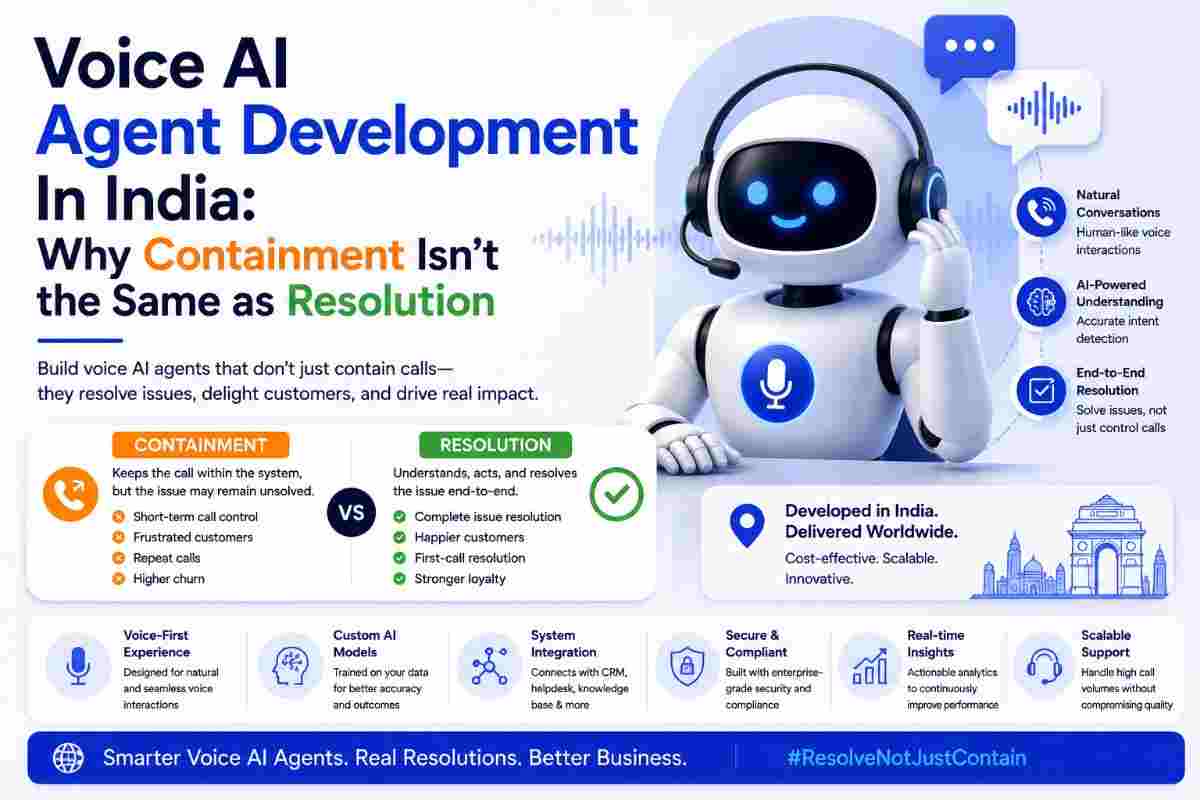
Containment is an attractive metric because it appears to show how many calls an AI system handles without involving a human agent. However, a caller who becomes frustrated, abandons the conversation, or hangs up without receiving a solution may still be counted as contained. This makes containment unreliable when it is treated as the primary measure of voice AI performance. A more meaningful approach is to determine whether the customer's original issue was actually resolved and whether they needed to contact the business again within the following 72 hours. For businesses evaluating voice AI agent development in india, this shift from containment to resolution changes how the entire system should be designed and measured. The objective should be completing legitimate customer requests, not simply preventing calls from reaching employees. Resolution-focused measurement gives contact center leaders a much clearer picture of whether automation is genuinely improving customer experience and operational efficiency.
The Real Economics Behind Voice AI Calls
Cost per call is another metric that can create an incomplete picture of voice automation economics. A voice AI interaction involves multiple cost layers, including telephony, speech-to-text processing, language-model inference, text-to-speech generation, integrations, monitoring, and infrastructure. These costs need to be considered alongside the broader operational expense of human-handled calls, which can commonly fall around the $7–$12 range depending on the contact center and complexity of the interaction. However, simply comparing the AI cost per minute with the human cost per call can overlook whether the AI actually completed the requested task. A cheaper call that generates a repeat contact can become more expensive than a slightly higher-cost interaction that resolves the issue completely. Businesses should therefore evaluate total resolution cost, repeat-contact rates, escalation rates, and customer satisfaction rather than optimizing only for the lowest possible AI call cost. This creates a more realistic financial model for determining where voice automation can deliver measurable ROI.
What Separates a Voice AI Agent from a Smarter IVR
A properly engineered voice AI agent should do considerably more than understand natural language better than a traditional IVR. The system needs access to relevant business systems so it can retrieve information, update records, complete approved transactions, and resolve customer requests during the conversation. Response latency is equally important because long pauses can make an otherwise intelligent system feel broken or unnatural to callers. Well-designed systems aim for responsive interactions while managing the complexity of real-time speech processing and backend operations. When a situation requires human involvement, a warm transfer should preserve the conversation history and relevant customer context so the caller does not have to repeat everything from the beginning. This distinction is critical because the real value of voice AI comes from completing workflows, not merely routing conversations. A voice system that combines telephony, backend resolution, contextual memory, and intelligent escalation can provide a substantially better experience than an IVR with more conversational language.
Grounding and Escalation Protect the Customer Experience
Voice AI needs reliable access to current information because incorrect answers can quickly damage customer trust. Policies, account information, product availability, pricing, and eligibility rules may change frequently, making grounded retrieval essential for accurate conversations. A customer support AI agent in india follows the same fundamental principle by connecting the AI system to trusted business data instead of relying solely on information embedded in a model. However, grounding alone is not enough because some requests will always require human judgment or authority. The system needs clear escalation rules that identify situations where confidence is low, the request falls outside its permissions, or the customer's circumstances require human intervention. AI Agent Development in india should therefore treat human handoff as a core capability rather than a sign that the automation has failed. When escalation preserves conversation context and explains why the transfer occurred, customers can move from AI to human support without experiencing unnecessary friction.
Compliance and Security Must Be Designed from the Beginning
Voice AI systems process conversations that may contain names, account details, payment information, personal identifiers, and other sensitive data. Compliance, disclosure, access control, recording policies, data retention, and security therefore need to be considered before the system enters production. Businesses looking to hire AI developers in india should evaluate whether their development partner understands these operational requirements alongside conversational AI technology. A responsible architecture can define which information the agent is allowed to access, which actions it can perform, and when explicit human approval is required. Call recordings and transcripts should also be handled according to appropriate security and data-governance requirements rather than treated as ordinary application data. Monitoring and audit trails can help organizations investigate failures and understand how the system handled individual interactions. Building these controls into AI Agent Development in india from the beginning reduces the risk of expensive redesigns when a successful pilot needs to scale across customers, regions, or higher-risk workflows.
Measure Resolution, Not Containment
The future of voice AI should not be judged by how many calls disappear from a contact center's human queue. The stronger question is how many customer problems the system resolves accurately, efficiently, and without requiring another interaction. Meritorious CodeCrafters focuses on building voice AI agents around backend resolution, reliable retrieval, intelligent escalation, and transparent performance measurement. Its ISO-certified approach emphasizes structured development, security, quality, and operational reliability throughout the delivery process. Businesses can use voice AI to automate repetitive call volumes while preserving human expertise for situations where empathy, judgment, or complex decision-making matters most. By measuring resolution and repeat contacts rather than celebrating containment alone, organizations can build automation that improves both economics and customer experience. A free consultation with Meritorious CodeCrafters can help businesses assess where voice AI can genuinely resolve customer workflows and where human involvement should remain part of the process.