Top 10 Weakest Currencies in the World
-

- Published Updated
- 8,815 views
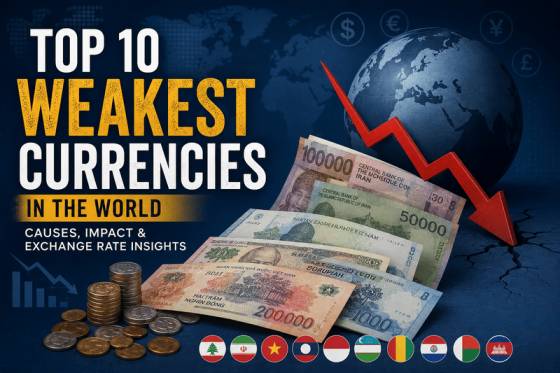
There are a few currencies in the world that are quite low in value, to the point that individuals are unable to rely on them for their basic needs. Once, these felt like a decent amount of money, but now they have lost their value. You may ask yourself why these currencies are so weak. The reason is quite simple. High inflation, unstable governments or economies that depend too much on imports are the major reasons for such weak currencies.
Read the blog below to know more about weak currencies and the top 10 weakest currencies in the world.
What does the term "Weak Currency" mean?
A weak currency is a currency that does not hold much value compared to other strong currencies globally. For instance, in such cases, individuals require a large amount of local money just to get a small amount of dollars, euros or other major world currencies.
How do these Currencies become weak?
There are many reasons for these currencies to become weak. A few of these reasons are listed below.
- Weak industries or limited exports reduce the money flow coming into a country.
- Countries that mostly depend on imports spend more than they earn.
- Prices are constantly rising, so money buys less over time.
- Foreign currency reserves running low make it difficult to trade internationally.
- Political problems and poor leadership affect a country's economy.
Top 10 Weakest Currencies of the World
The table below outlines the 10 weakest currencies of the world
| Rank | Currency | Symbol |
| 1 | Lebanese Pound | LBP |
| 2 | Iranian Rial | IRR |
| 3 | Vietnamese Dong | VND |
| 4 | Laotian Kip | LAK |
| 5 | Indonesian Rupiah | IDR |
| 6 | Uzbekistani Som | UZS |
| 7 | Guinean Franc | GNF |
| 8 | Paraguayan Guarani | PYG |
| 9 | Malagasy Ariary | MGA |
| 10 | Cambodian Riel | KHR |
1. Lebanese Pound (Exchange Rate- Approx 89,000-90,000 LBP=1 USD)
In the past years, the Lebanese Pound has lost much of its value. This is mainly due to poor economic management, political deadlock and a deep banking crisis.
- Inflation has also increased, which is cutting into the population's purchasing power and making everyday items more expensive.
- The situation has only worsened with foreign currency reserves running low and investor confidence fading.
- Because of this, the living standards have also dropped drastically, while access to essential healthcare and imported medicines has become difficult.
2. Iranian Rial (Exchange Rate- Approx 1,100,000)-1,200,000 IRR=1 USD)
It is one of the weakest currencies in the world. This is mostly due to high inflation, limits on international trade and the country's economic isolation.
- The value of the currency keeps falling due to less foreign investment and pressure on local industries.
- Daily necessities like food, fuel and medicine have become much more expensive, making everyday life for families harder.
3. Vietnamese Dong (Exchange Rate- Approx 26,000-26,500 VND = 1 USD)
This has a low value compared to the major currencies of the world. It is mostly due to past inflation and the currency's structure.
- Vietnam's economy did not suffer from any collapse.
- The Government allows the currency to lose value slowly to help exports.
- However, imported goods such as medical equipment and special medicines are still expensive. This affects healthcare costs and household budgets.
4. Laotian Kip (Exchange Rate- Approx 21,000-22,000 LAK =1 USD)
The main reasons for the Laotian Kip to lose its value are rising prices, limited local industries and heavy reliance on imports.
- The economy has become more fragile due to high foreign debt and a lack of diverse exports.
- Since the prices keep spiking, people are unable to afford healthcare, good nutrition and other basic needs.
- The existing weakness in the currency continues to put pressure on household budgets and overall living standards.
5. Indonesian Rupiah (Exchange Rate- Approx 16,500-17,000 IDR =1 USD)
The Indonesian Rupiah is relatively weak, even though the economy of Indonesia is still growing. Inflation and global market changes are putting pressure on the currency.
- The value of the currency often shifts since the country depends on imported fuel and raw materials.
- These shifts affect food prices, healthcare and daily living expenses.
6. Uzbekistani Som (Exchange Rate- Approx 11,500-12,000 UZS =1 USD)
The currency of Uzbekistan has been weak for several years due to inflation and economic changes.
- When the government introduced reforms and allowed the currency to float, its value dropped sharply.
- The situation is much better now, but the Uzbekistani Som is still weak.
- Due to this, imported goods such as medical supplies put extra pressure on household budgets.
7. Guinean Franc (Exchange Rate- Approx 8,500-9,000 GNF =1 USD)
This currency suffers mostly due to political problems, inflation and a lack of economic variety.
- Guinea has plenty of natural resources, but poor infrastructure and limited industry hold back growth.
- Because of this, the cost of imported goods, such as healthcare equipment and medicines, keeps rising.
8. Paraguayan Guarani (Exchange Rate- Approx 6,500-6,800 PYG =1 USD)
This currency has low value because the country mostly relies on farming and has little manufacturing.
- The stability of the currency has also been affected by inflation and changes in global commodity prices.
- Although the currency is fairly stable compared to its neighbours, imported goods and healthcare remain costly for people.
9. Malagasy Ariary (Exchange Rate- Approx 4,400-4,600 MGA =1 USD)
This currency displays the country's ongoing economic struggles, such as political instability, inflation and dependence on imports.
- Poor infrastructure and limited exports have weakened the currency.
- Because of this, everyday essentials and medical care are expensive. This impacts the citizens' health and quality of life.
- This persistent weakness also discourages foreign investment and makes economic recovery even more challenging.
10. Cambodian Riel (Exchange Rate- Approx 4,000-4,100 KHR =1 USD)
This currency is weak because people often use foreign currency instead of their local currency. Since the demand for Riel is less, its value remains low.
- The economy of Cambodia is growing, yet it relies mostly on imports, which makes medicines and healthcare services more expensive for ordinary people.
- Everyday transactions continue to depend on the US dollar, limiting the Riel's role in the economy.
Conclusion
Weak currencies are actual problems that are affecting these countries even as we speak. They signal economic difficulties and affect daily life. The world's weakest currencies are struggling against the stronger currencies of the world, such as the US dollar or the Euro, but each of them has its own economic story and numbers behind it. These currencies may or may not affect travel expenses and the risks of unexpected disruptions abroad.