Zero Gravity Massage Chairs: Separating the Science From the Marketing in 2026
-

- May 28th, 2026
- 4,484 views

FREE SEO Topical Map Generator: Find Your Next Content Ideas
The wellness industry has a credibility problem.
Terms borrowed from legitimate science get attached to products that deliver a fraction of what the science implies. Features that sound technically impressive turn out to mean something considerably less significant in practice. And buyers who cannot distinguish between genuine scientific grounding and marketing appropriation of scientific language end up making decisions based on impressions rather than evidence.
Zero gravity is one of the terms most at risk of this problem in the massage chair category. It sounds impressive. It has a genuine scientific origin. And it is applied inconsistently — to chairs where the implementation is genuinely therapeutic and to chairs where it is little more than a recline function with a more impressive name.
This guide separates what zero gravity actually does from what it is sometimes claimed to do. It examines the genuine science, identifies the claims that hold up under scrutiny, flags the ones that are exaggerated, and explains what specific features actually determine whether a zero gravity system delivers real therapeutic value.
The Claim That Is Completely True: The NASA Origin
The most commonly cited fact about zero gravity positioning — that it originated in NASA aerospace research — is entirely accurate and specifically documented.
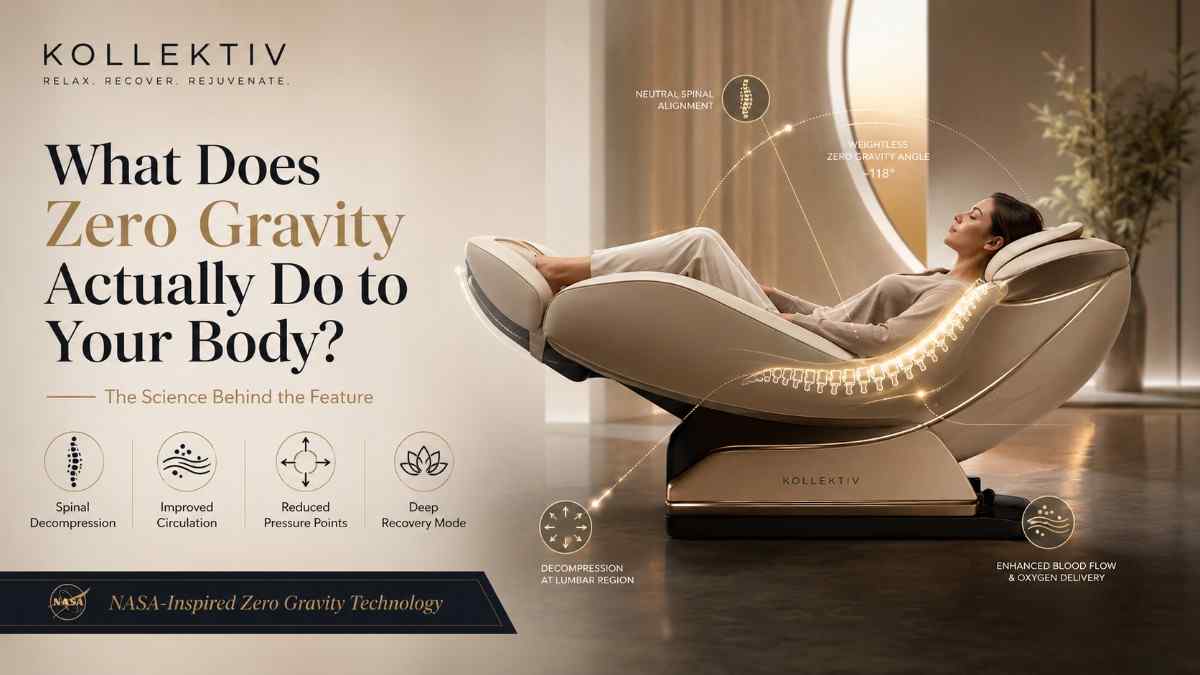
In the 1970s, NASA engineers studying the physiological demands of rocket launches identified the body position that minimised compressive forces on astronauts during liftoff — the moment of peak gravitational stress on the human body. Their research identified a specific geometry: thighs roughly parallel to the ground, calves elevated above heart level, torso reclined at approximately 120 to 128 degrees relative to the legs.
In this position, compressive forces on the musculoskeletal system dropped to a measurable minimum. Cardiovascular strain decreased. Muscle tension throughout the body reduced passively. The position protected astronauts during the most physically demanding moment of spaceflight — and the same principles apply with equal validity to a body under the ordinary gravitational stress of daily life.
Massage chair engineers adopted this positioning principle because the physiological benefits it produces are directly relevant to recovery — not because the NASA association improves marketing. The science is real, the origin is documented, and the effects are measurable in the recovery context as clearly as they were in the aerospace one.
The Kollecktiv 301 flagship features demonstrate how zero gravity and track design need to work together — the 59-inch SL-track maintains full roller coverage from the cervical spine through the hamstrings even at the deepest zero gravity stage, a design requirement that shorter tracks fail to meet when the chair is fully reclined.
The Claim That Is True: Spinal Decompression Is Real and Measurable
The claim that zero gravity positioning decompresses the spine is not marketing language. It is a direct mechanical consequence of the positional geometry and is supported by research in spinal biomechanics.
In standard seated posture, the lumbar vertebrae support the compressive weight of the entire upper body — research estimates between 120 and 180 pounds of force concentrated at the L4 and L5 discs during normal seated posture. In zero gravity, this compressive load redistributes across the full back surface in contact with the chair. Intradiscal pressure at the lumbar levels drops significantly. The space between vertebrae increases.
For disc-related sciatica, this space creation directly reduces pressure on compressed nerve roots. For chronic lower back pain driven by muscular compensation for disc compression, the positional relief removes the mechanical stimulus that drives the compensatory tension. For healthy users accumulating daily spinal compression from desk work, zero gravity provides consistent decompressive relief that counteracts the daily load.
The claim that holds up is that zero gravity reduces spinal compression — measurably, mechanically, and in direct proportion to the accuracy of the positional geometry. The claim that needs qualification is that it treats or cures spinal conditions — it provides positional relief, not clinical treatment. The distinction matters and the latter claim is the kind of overreach that creates the credibility problem described in the introduction.
The Claim That Is True: Venous Return Improves With Leg Elevation
The cardiovascular benefit of zero gravity positioning — improved venous return through leg elevation above heart level — is one of the most straightforwardly supported physiological effects and requires the least qualification.
Venous return is the process by which deoxygenated blood from the lower extremities returns to the heart. In upright posture, this flow works against gravity — requiring cardiovascular effort and maintaining elevated venous pressure in the lower limbs. When the legs rise above heart level, gravity assists venous return rather than resisting it. Lower limb venous pressure drops. Accumulated fluid redistributes. The heart's workload decreases.
This is the same principle underlying medical leg elevation recommendations for edema, the same principle behind compression stockings that assist venous return, and the same principle that makes zero gravity positioning immediately effective for users with chronic leg fatigue or fluid retention from prolonged standing.
The qualification is that leg elevation alone is not a medical treatment for venous insufficiency — it is a positioning intervention that provides relief and supports normal circulation without replacing medical management of genuine vascular conditions. Zero gravity chairs are wellness devices, not medical devices, and the circulation benefit they provide is proportionate to that category.
Every chair in the Kollecktiv massage chair collection includes zero gravity as a standard integrated feature across the range — the leg elevation component is present in every model as part of the core therapeutic design rather than being offered only in premium tiers.
The Claim That Is True: Zero Gravity Changes Massage Quality
The claim that zero gravity improves massage quality — that the same intensity setting produces deeper, more effective results in zero gravity than in upright — is one of the most consistently supported by user experience and the most clearly explained by the underlying mechanics.
In upright posture, the back muscles maintain baseline contraction to stabilise the torso against gravitational load. Massage rollers engaging contracted tissue encounter resistance that limits penetration depth and produces inconsistent pressure as the mechanism moves across areas of different baseline tone. In zero gravity, the postural muscles disengage. The tissue softens and lengthens passively. The back is in full, even contact with the backrest surface. The same roller intensity produces deeper, more even, more therapeutically effective pressure because the tissue is no longer working against the intervention.
The practical consequence is that medium intensity in zero gravity routinely delivers the therapeutic equivalent of high intensity upright. This is not a marginal improvement. It is the difference between surface massage and genuine deep tissue work at the same intensity dial setting.
The Kollecktiv 202's adjustable 3-stage zero gravity system pairs this positional tissue release with AI body scanning and graphene lumbar heat — the chair adapts its recline position, roller depth, and heat output to the individual user's physiology, maximising the synergy between zero gravity tissue release and active massage intervention for each specific person.
The Claim That Is True With Qualification: Stress Reduction Through Parasympathetic Activation
The claim that zero gravity reduces stress through parasympathetic nervous system activation is physiologically grounded — but the mechanism requires explanation rather than simple assertion.
The autonomic nervous system operates in two competing states. Sympathetic activation maintains elevated cortisol, increased muscle tone, and heightened alertness — the physiological readiness for threat response. Parasympathetic activation — the rest and recovery state — reduces cortisol, lowers heart rate, and creates the conditions for cellular repair.
Horizontal positioning with leg elevation is a reliable trigger for parasympathetic activation. The vagus nerve responds to the mechanical signals of supine positioning with a measurable shift in tone. Zero gravity approximates supine positioning more closely than any seated posture, producing a faster and more complete parasympathetic shift — and therefore a more meaningful cortisol reduction — than standard recline achieves.
The qualification is that zero gravity is not a stress treatment. It is a positional intervention that facilitates a nervous system state conducive to recovery. For users managing clinically significant anxiety or stress-related conditions, it is a complement to appropriate treatment rather than a substitute for it.
For buyers comparing models to find the right zero gravity implementation for their specific use case and budget, the Kollecktiv buying guide provides a structured breakdown of the full lineup by feature set, therapeutic focus, and price tier — a direct path to the right chair without requiring individual research across every product page.
The Claims That Require Scrutiny
Not every claim made about zero gravity in the massage chair category holds up under examination. Identifying the ones that do not is as important as confirming the ones that do.
The claim that all zero gravity chairs are equivalent is false. The positional geometry varies between chairs. Single-stage systems offer one fixed preset that may or may not match a specific user's optimal decompressive angle. Two-stage systems offer meaningful flexibility. Three-stage systems offer the personalisation required to maximise decompressive benefit for individual body proportions and conditions. The stage count is a real therapeutic differentiator, not a marketing increment.
The claim that zero gravity treats medical conditions is an overreach. It provides positional relief that complements medical management — it does not replace physiotherapy, chiropractic care, or medical treatment for diagnosed spinal conditions. Buyers with diagnosed disc conditions, stenosis, or significant cardiovascular conditions should consult their healthcare providers before relying on zero gravity chair use as a primary management strategy.
The claim that any reclined chair provides zero gravity benefits is incorrect. The specific relationship between torso angle and leg elevation — not just recline — is what drives the physiological effects. A chair that reclines without raising the legs above heart level produces comfort but not the cardiovascular or full spinal decompressive benefits of genuine zero gravity positioning.
What Actually Determines Whether a Zero Gravity System Delivers Value
Having separated the legitimate science from the overreach, the practical question is what specific features determine whether a zero gravity chair delivers genuine therapeutic value.
The stage count matters because personalisation of the recline angle to individual anatomy produces better decompressive outcomes than a single preset regardless of how accurate that preset is for an average body. Three stages is the specification worth insisting on for serious therapeutic applications.
The track design matters because zero gravity positioning only delivers full-body massage benefit if the roller system maintains consistent contact throughout the posterior chain at the deepest recline stage. A short track that loses coverage in the lumbar and gluteal region when the chair is fully reclined negates the enhanced tissue receptiveness that zero gravity produces in exactly the areas where most therapeutic benefit is needed.
The integration of zero gravity with other therapeutic features — heat therapy that loosens the tissue the rollers will work through, airbag compression that addresses circulatory recovery while the position maintains venous return, and roller systems with sufficient intensity range to utilise the enhanced tissue receptiveness that zero gravity enables — determines whether the feature operates as part of a coherent therapeutic system or as an isolated recline function.
Explore the full range of luxury zero gravity massage chairs at Kollecktiv — every model ships free across the continental US with a 30-day return policy, no sales tax, and up to a 6-year warranty.
originally published on :
https://kollecktiv.com/zero-gravity-massage-chair-benefits-science/