5G in Healthcare Market: Innovation, Market Dynamics, and Long-Term Growth Prospects
-
- Published Updated
- 6,625 views
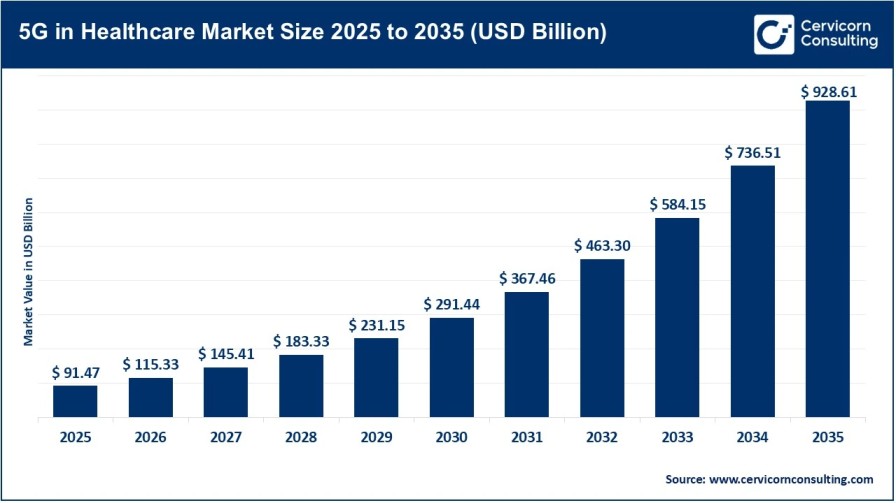
5G in Healthcare Market Size
The global 5G in healthcare market is expanding rapidly as healthcare organizations increasingly adopt advanced wireless technologies to improve patient outcomes, streamline operations, and strengthen healthcare accessibility. The market was estimated at approximately USD 91.47 billion in 2025 and is projected to achieve nearly USD 928.61 billion by 2035, registering a robust CAGR of 26.1% from 2026 to 2035. Market expansion is being supported by rising investments in digital healthcare infrastructure, growing utilization of connected medical technologies, and increasing demand for high-speed, low-latency communication networks capable of supporting mission-critical healthcare applications.
Read Full Report: https://www.cervicornconsulting.com/5g-in-healthcare-market
What is the 5G in Healthcare Market?
The 5G in healthcare market encompasses the deployment of fifth-generation mobile communication technology across healthcare environments and services. Applications span hospitals, diagnostic centers, telemedicine platforms, wearable health devices, connected ambulances, remote patient monitoring systems, robotic-assisted surgery technologies, and Internet of Medical Things (IoMT) ecosystems.
Compared with previous wireless generations, 5G offers significantly faster connectivity, enhanced bandwidth capacity, ultra-low latency, and support for a larger number of simultaneously connected devices. These capabilities enable healthcare providers to transfer large medical datasets, share diagnostic imaging in real time, conduct virtual consultations, support AI-based healthcare analytics, and perform remote medical procedures with improved accuracy and reliability.
As healthcare systems continue to modernize, 5G is emerging as a foundational technology that supports more connected, efficient, and patient-centric healthcare services.
Get a Free Sample Report: https://www.cervicornconsulting.com/sample/2962
Why 5G is Revolutionizing Healthcare
Healthcare organizations generate enormous volumes of clinical and patient data every day. Traditional communication infrastructure often struggles to support real-time healthcare operations, particularly in emergency response scenarios and critical care environments.
5G technology addresses these challenges through:
High-speed data transmission capabilities
Reliable connectivity across medical devices and systems
Enhanced telehealth and virtual healthcare experiences
Continuous remote patient monitoring
Support for AI-powered healthcare applications
Faster emergency care coordination
Seamless integration of connected healthcare ecosystems
The technology is particularly beneficial for rural and underserved populations, enabling patients to access specialist consultations remotely through advanced telemedicine platforms.
Healthcare institutions are also utilizing 5G-enabled infrastructure to automate workflows, improve patient safety, enhance clinical decision-making, and optimize operational performance.
Key Factors Accelerating Market Growth
Growth in the 5G healthcare market is being driven by several interconnected factors, including increasing adoption of telemedicine services, rising deployment of remote patient monitoring solutions, expanding use of IoMT devices, and growing investments in digital healthcare transformation. Additional growth drivers include advances in artificial intelligence, cloud computing integration, increasing prevalence of chronic diseases requiring continuous monitoring, demand for real-time healthcare data exchange, deployment of connected emergency medical services, expansion of smart hospitals, supportive government initiatives, and rising adoption of robotic-assisted surgical technologies.
Collectively, these developments are creating strong demand for scalable, secure, and low-latency communication infrastructure capable of supporting next-generation healthcare delivery.
Leading Industry Participants
Verizon Communications
Verizon continues to expand its healthcare capabilities through private 5G networks, edge computing technologies, and advanced healthcare connectivity solutions. Its extensive 5G Ultra Wideband infrastructure supports numerous digital healthcare applications.
AT&T Inc.
AT&T provides connected healthcare services, telemedicine infrastructure, and IoT-enabled healthcare solutions designed to enhance healthcare communication and operational efficiency.
T-Mobile US Inc.
T-Mobile leverages its nationwide standalone 5G network to support telehealth services, remote patient monitoring programs, and other advanced healthcare applications across North America.
Huawei Technologies Co. Ltd.
Huawei remains a major supplier of global 5G infrastructure, supporting smart hospitals, connected healthcare ecosystems, and medical IoT deployments worldwide.
Ericsson
Ericsson provides advanced network infrastructure, network slicing technologies, and healthcare-focused connectivity solutions that help organizations build resilient digital healthcare ecosystems.
Market positioning reflects broader telecommunications and network infrastructure leadership rather than healthcare-specific 5G revenue contributions.
Major Trends Influencing the Market
Expansion of Telemedicine and Virtual Healthcare Services
Telemedicine has become a central component of healthcare delivery. The capabilities of 5G networks enable high-quality virtual consultations, real-time diagnostic assessments, and seamless communication between healthcare providers and patients.
Impact:
Improved healthcare accessibility
Reduced reliance on physical visits
Greater patient convenience
Increased access to specialist care
Growth of Remote Patient Monitoring
The use of connected health devices, wearable sensors, and monitoring platforms continues to increase as healthcare providers seek to improve chronic disease management and preventive care.
Impact:
Earlier identification of health issues
Reduced hospital readmissions
Better chronic disease management
Continuous monitoring of patient health
Emergence of Smart Hospitals
Healthcare facilities are increasingly adopting connected infrastructure where medical equipment, healthcare professionals, and digital systems communicate seamlessly through advanced networks.
Impact:
Higher operational efficiency
Improved patient safety
Faster emergency response
More effective resource utilization
Increasing Adoption of AI-Powered Diagnostics
Artificial intelligence applications require rapid access to vast amounts of healthcare data. The speed and responsiveness of 5G networks support faster analysis and more accurate clinical decision-making.
Impact:
Faster diagnoses
Improved treatment effectiveness
Reduced diagnostic inaccuracies
Personalized healthcare approaches
Advancement of Robotic and Remote Surgery
Remote robotic surgery is becoming one of the most transformative applications of 5G technology, allowing highly skilled surgeons to perform procedures from distant locations with remarkable precision.
Impact:
Greater access to specialist surgical expertise
Reduced geographic limitations
Improved procedural accuracy
Expanded healthcare availability
Edge Computing Integration
The combination of edge computing and 5G enables healthcare data processing closer to the source of generation, minimizing delays associated with centralized cloud processing.
Impact:
Reduced latency
Enhanced data security
Faster clinical decision-making
Improved emergency healthcare response
Global Examples of Successful 5G Healthcare Adoption
China: Pioneering Remote Surgery
China has emerged as a global leader in 5G-enabled healthcare innovation, successfully conducting remote neurological and orthopedic surgical procedures across long distances.
Benefits:
Greater access to specialist care
Reduced patient travel requirements
Demonstration of ultra-low-latency healthcare applications
United States: Connected Emergency Ambulances
Healthcare providers in the United States have deployed 5G-connected ambulances capable of transmitting patient data and medical imaging to hospitals before arrival.
Benefits:
Faster emergency preparedness
Improved treatment planning
Better clinical outcomes
South Korea: Smart Healthcare Infrastructure
South Korea continues to lead the development of smart hospitals powered by 5G connectivity, AI-driven diagnostics, and connected medical technologies.
Benefits:
Improved hospital productivity
Enhanced patient monitoring
Faster diagnosis and treatment delivery
United Kingdom: Rural Healthcare Connectivity
Healthcare organizations throughout the UK are using 5G-enabled telehealth solutions to improve healthcare accessibility in rural and underserved communities.
Benefits:
Shorter waiting times
Greater healthcare access
Higher patient satisfaction
Japan: Healthcare Solutions for Aging Populations
Japan is leveraging 5G-powered healthcare innovations to address the challenges associated with a rapidly aging population.
Benefits:
Continuous elderly health monitoring
Increased adoption of smart healthcare devices
Reduced pressure on caregivers
Regional Landscape and Government Initiatives
North America
North America remains a leading market due to its advanced telecommunications infrastructure, strong healthcare expenditure, and widespread adoption of digital health technologies.
Government Initiatives:
Broadband expansion programs, telehealth support initiatives, and healthcare modernization strategies continue to encourage adoption of 5G-enabled healthcare solutions.
Europe
Europe is accelerating the development of digital healthcare ecosystems through advanced connectivity investments and healthcare modernization programs.
Government Initiatives:
The European Union's Digital Decade framework promotes extensive 5G deployment and healthcare digitalization across member countries.
Asia-Pacific
Asia-Pacific is expected to experience the fastest market growth during the forecast period due to large populations, rapid urbanization, and expanding healthcare infrastructure.
Government Initiatives:
China's New Infrastructure strategy, South Korea's Digital New Deal, Japan's healthcare technology investments, and India's Digital Health Mission are supporting widespread adoption of 5G healthcare technologies.
Latin America
The region is steadily embracing digital healthcare solutions as telecommunications infrastructure continues to improve.
Government Initiatives:
Brazil, Mexico, and Chile are implementing national digital transformation initiatives designed to support healthcare modernization and connectivity expansion.
Middle East & Africa
The Middle East and Africa region is emerging as a promising market for connected healthcare technologies.
Government Initiatives:
National development programs across Saudi Arabia, the UAE, and Qatar emphasize smart healthcare systems, digital transformation, and advanced communication infrastructure.
Future Outlook
The future of the 5G healthcare market will be shaped by the continued convergence of artificial intelligence, cloud computing, IoMT platforms, robotics, and advanced communication technologies. As healthcare providers increasingly prioritize digital transformation, 5G will serve as a critical foundation supporting future healthcare delivery models.
Investments in smart hospitals, connected medical devices, virtual healthcare platforms, precision medicine, and remote diagnostic solutions are expected to sustain strong market growth over the coming decade. Through continued collaboration among governments, healthcare providers, and technology companies, 5G is expected to play a central role in creating more connected, efficient, and patient-focused healthcare systems worldwide.
For Detailed Market Insights and Customized Research Services: https://www.cervicornconsulting.com/contact-us