Digital Twin in Healthcare Market Witnesses Rising Adoption Across Hospitals
-

- Published Updated
- 5,854 views

The global healthcare industry is undergoing a significant digital transformation, with digital twin technology emerging as one of the most disruptive innovations in modern medicine. By enabling the creation of virtual replicas of patients, medical devices, healthcare systems, and clinical workflows, digital twins are helping healthcare providers improve treatment outcomes, streamline operations, and accelerate medical innovation.
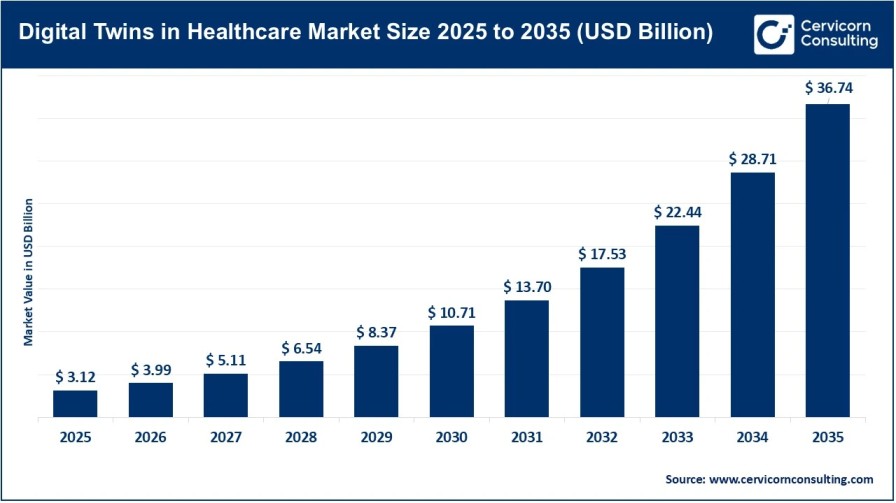
According to recent market analysis, the global Digital Twin in Healthcare Market is likely to be valued at US$ 7.6 billion in 2026 and is expected to reach US$ 73.2 billion by 2033, registering an impressive CAGR of 38.2% during the forecast period from 2026 to 2033. The rapid adoption of artificial intelligence, predictive analytics, cloud computing, and connected healthcare technologies is creating substantial opportunities for market expansion worldwide.
For More Industry Insights Read: https://www.persistencemarketresearch.com/market-research/digital-twin-in-healthcare-market.asp
Digital Twin Technology Reshaping the Future of Healthcare
Digital twin technology refers to the creation of dynamic virtual models that replicate real-world healthcare entities. These models continuously integrate data from various sources, including electronic health records, medical imaging systems, wearable devices, sensors, and laboratory results. The resulting digital representation allows healthcare professionals to monitor conditions, simulate treatments, and predict future outcomes with greater accuracy.
As healthcare organizations increasingly prioritize data-driven decision-making, digital twins are becoming essential tools for improving operational efficiency and patient care. Hospitals, research institutions, pharmaceutical companies, and medical device manufacturers are embracing the technology to enhance performance while reducing costs and risks.
The growing focus on precision medicine and personalized healthcare is further driving investment in digital twin solutions. By enabling clinicians to understand how individual patients may respond to specific treatments, digital twins support more targeted and effective interventions.
Personalized Medicine Emerges as a Key Growth Driver
One of the most promising applications of digital twin technology is personalized medicine. Traditional treatment approaches often rely on generalized protocols that may not account for individual patient differences. Digital twins address this challenge by creating personalized virtual models that reflect a patient’s unique biological characteristics, medical history, and health conditions.
Healthcare professionals can use these models to simulate treatment scenarios, predict responses to medications, and identify the most effective care strategies before implementing them in real-world settings. This capability improves clinical decision-making while minimizing the risk of adverse outcomes.
As healthcare systems worldwide continue transitioning toward patient-centered care models, demand for personalized treatment solutions is expected to rise significantly. This trend is creating strong growth opportunities for digital twin technology providers and healthcare organizations seeking to enhance treatment precision.
Artificial Intelligence and Big Data Fuel Market Expansion
The rapid advancement of artificial intelligence and big data analytics is accelerating the adoption of digital twin platforms across healthcare environments. AI-powered algorithms can process enormous volumes of clinical and operational data, enabling digital twins to generate highly accurate predictions and recommendations.
Machine learning capabilities allow digital twins to continuously improve their performance as new information becomes available. This enables healthcare providers to identify emerging health risks, optimize treatment pathways, and improve resource allocation.
The increasing deployment of connected medical devices and wearable technologies is also contributing to market growth. Real-time patient monitoring data can be integrated into digital twin platforms, allowing clinicians to track health conditions continuously and respond proactively to potential complications.
Healthcare organizations are increasingly recognizing the value of predictive healthcare management, creating favorable conditions for widespread adoption of digital twin solutions.
Pharmaceutical and Medical Device Industries Unlock New Opportunities
Digital twin technology is transforming drug discovery and medical device development by reducing development timelines and improving research efficiency. Pharmaceutical companies are leveraging digital twins to simulate biological processes, assess drug interactions, and evaluate treatment effectiveness in virtual environments.
These capabilities help researchers identify promising therapies more quickly while reducing reliance on costly and time-consuming traditional testing methods. As a result, pharmaceutical organizations are increasingly investing in digital twin platforms to accelerate innovation and improve research outcomes.
Medical device manufacturers are also benefiting from digital twin applications. Virtual simulations enable companies to test product designs, evaluate performance, and identify potential issues before manufacturing begins. This approach supports faster product development cycles, enhanced product quality, and improved regulatory compliance.
As healthcare innovation continues to accelerate, digital twin technology is expected to play a crucial role in supporting next-generation medical advancements.
Regional Markets Witness Strong Adoption Trends
North America is expected to maintain a dominant position in the digital twin in healthcare market throughout the forecast period. The region benefits from advanced healthcare infrastructure, strong technology adoption, significant healthcare spending, and a robust ecosystem of healthcare technology companies.
Europe is also witnessing increasing adoption of digital twin solutions, supported by growing investments in healthcare digitization and research initiatives focused on improving patient outcomes.
Meanwhile, East Asia and South Asia & Oceania are emerging as high-growth regions due to expanding healthcare infrastructure, increasing digital health investments, and rising awareness of advanced healthcare technologies. Growing collaborations between technology providers and healthcare organizations are expected to further support market expansion across these regions.
Competitive Landscape Focuses on Innovation and Strategic Collaborations
The competitive landscape of the digital twin in healthcare market is characterized by continuous technological innovation and strategic partnerships. Market participants are investing heavily in research and development activities to enhance platform capabilities and expand application areas.
Companies are focusing on integrating artificial intelligence, cloud computing, simulation technologies, and predictive analytics into their solutions to deliver greater value to healthcare providers. Strategic collaborations with hospitals, research institutions, and pharmaceutical companies are also helping accelerate adoption and commercialization efforts.
As demand for intelligent healthcare solutions continues to rise, industry leaders are expected to strengthen their market positions through innovation, partnerships, and expanded digital healthcare offerings.
Companies Covered in Digital Twin in Healthcare Market
- Siemens Healthineers AG
- GE HealthCare
- Philips N.V.
- IBM Watson Health
- Microsoft
- Medtronic
- Oracle
- Honeywell
- GE Digital
- ANSYS
Market Segmentation
By Component
- Software
- Services
By Application
- Personalized Medicine
- Surgical Planning & Medical Education
- Drug Discovery & Development
- Medical Device Design & Testing
- Healthcare Workflow Optimization & Asset Management
- Others
By End-user
- Medical Device Companies
- Pharma & Biopharma Companies
- Academic & Research Institutes
- Healthcare Providers
- Others
By Region
- North America
- Europe
- East Asia
- South Asia & Oceania
- Latin America
- Middle East & Africa