Agentic AI Course – Master Autonomous AI & Intelligent Automation
-

- September 25th, 2026
- 93 views
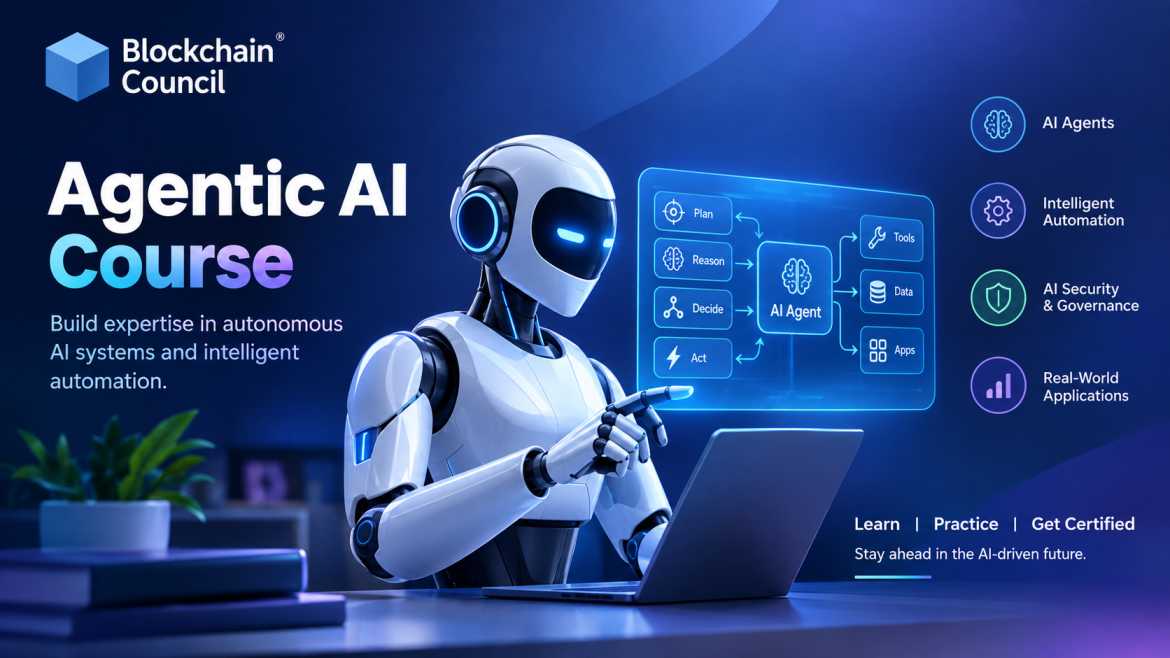
The Agentic AI Course is designed for professionals, developers, technology enthusiasts, and learners who want to understand the next generation of artificial intelligence and autonomous systems. Agentic AI is transforming how intelligent systems interact with information, make decisions, use tools, and complete complex tasks with greater autonomy. By learning the fundamentals and applications of Agentic AI, individuals can develop future-ready skills and gain a deeper understanding of how AI-powered agents are being used across modern businesses and technology environments.
Unlike traditional AI systems that primarily respond to individual prompts or predefined instructions, Agentic AI systems are designed to work toward specific objectives. They can analyze information, plan tasks, make decisions, interact with tools, execute multiple steps, and adjust their actions based on changing circumstances. This ability makes agentic systems valuable for applications that require more than simple automation or content generation.
What Is Agentic AI?
Agentic AI refers to artificial intelligence systems that can operate with a certain level of autonomy to achieve defined goals. These systems can combine reasoning, planning, memory, tool usage, and decision-making capabilities to perform tasks across multiple steps.
For example, instead of simply answering a question, an AI agent may identify the objective, collect relevant information, analyze the available data, determine the appropriate steps, and execute actions using connected tools. This approach enables AI systems to support more complex workflows and business processes.
Understanding these concepts is an important part of an Agentic AI Course, helping learners explore how autonomous AI agents are designed, managed, and applied in practical environments.
What You Can Learn
An Agentic AI Course can provide learners with a structured understanding of autonomous AI systems and their underlying concepts. Key areas may include AI agents, agent architectures, intelligent automation, planning, reasoning, workflow optimization, AI security, governance, and real-world applications.
Learners can explore how AI agents interact with users, external tools, software applications, and data sources. They can also understand how multiple steps can be coordinated to complete complex objectives.
Another important aspect is understanding the limitations and risks associated with autonomous AI. Topics such as responsible AI, security, reliability, privacy, governance, human oversight, and effective deployment are essential when working with systems that can make decisions and take actions.
Why Learn Agentic AI?
Artificial intelligence is rapidly evolving, and organizations are increasingly exploring systems that can automate complex workflows and support employees in completing tasks more efficiently. Agentic AI represents an important development in this evolution because it focuses on goal-oriented systems rather than simple prompt-based interactions.
Learning Agentic AI can help professionals understand how intelligent agents may be used to improve productivity, automate repetitive processes, support decision-making, and optimize business operations. These skills can be valuable for individuals working in artificial intelligence, software development, automation, technology management, digital transformation, and related fields.
For businesses, agentic systems can potentially support workflows involving customer service, research, data analysis, software development, content operations, and business process automation.
Applications of Agentic AI
Agentic AI has applications across a wide range of industries and professional environments. Organizations can use AI agents to support customer interactions, automate business processes, analyze information, assist with research, manage workflows, and improve operational efficiency.
In software development, AI agents can assist with tasks such as analyzing requirements, generating code, identifying issues, and supporting testing workflows. In business environments, agents can help organize information, automate repetitive activities, and support employees with data-driven tasks.
Agentic AI can also be applied to research and analysis. An AI agent may gather information from different sources, process the data, identify relevant insights, and organize the findings according to a defined objective.
As the technology develops, organizations are exploring increasingly sophisticated ways to integrate autonomous AI into their existing workflows.
Build Future-Ready AI Skills
The Agentic AI Course offers an opportunity to develop knowledge in an emerging area of artificial intelligence. By understanding autonomous agents, intelligent automation, AI workflows, decision-making, security, and governance, learners can build a strong foundation for working with modern AI technologies.
A professional certification can also help demonstrate your knowledge and commitment to learning Agentic AI concepts. Whether you are an AI enthusiast, developer, technology professional, entrepreneur, student, or business leader, understanding agentic systems can help you stay informed about the changing AI landscape.
As AI continues to move toward more autonomous and goal-oriented systems, professionals who understand how these technologies work can better evaluate their potential applications and challenges. Developing knowledge through an Agentic AI Course can therefore support continuous learning and professional growth in the evolving artificial intelligence ecosystem.
Explore the world of Agentic AI, understand how autonomous systems operate, and develop the knowledge needed to work with intelligent agents, automation, and next-generation AI solutions.