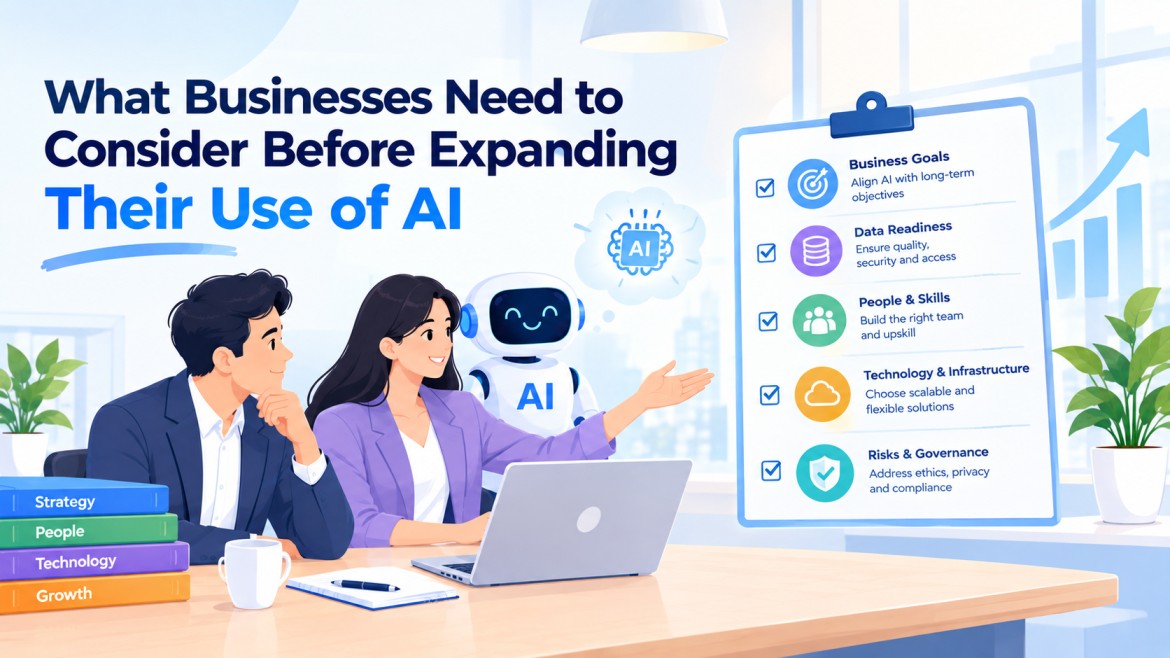
What Businesses Need to Consider Before Expanding Their Use of AI
-

- Published Updated
- 75 views
Introduction
Many businesses start their AI journey with one small experiment. It could be an internal assistant, an automated support workflow, a forecasting system, or a tool that helps employees work with large amounts of information. If the first project performs well, the next question usually comes quickly: where else can AI be used?
This is where things can become more complicated.
Expanding AI across a business is not simply a matter of adding more tools. Different departments have different workflows, data sources, security needs, and expectations. A system that works well for one team may not be suitable for another without significant changes.
Before expanding AI adoption, businesses need to look at the bigger picture. They need to understand their processes, prepare their teams, establish clear governance, and make sure their technology environment can support growth.
Look at Processes Before Buying More Tools
When businesses become excited about AI, it is easy to start collecting applications. One team may use an AI writing tool, another may introduce an assistant, and another may experiment with automation.
Over time, this can create a disconnected technology environment.
A better approach is to first map important business processes. Look at how work moves from one step to another, where employees spend the most time, and where delays or repeated manual tasks occur.
This exercise often reveals that the biggest opportunity is not always where people first expect it.
For example, a company may think it needs AI for customer communication when the real problem is fragmented customer information. Fixing the underlying process may create more value than simply adding another AI interface.
Build an AI Strategy Around Business Priorities
AI should support the broader direction of the business. That sounds obvious, but it is easy to lose sight of it when new technologies appear every few months.
A company focused on improving customer service may have different priorities from a manufacturer trying to improve operational efficiency. A software company may be more interested in developer productivity, while a financial organization may focus on information analysis and risk controls.
The strategy should therefore begin with business priorities.
AI Development Companies can help translate those priorities into technical opportunities, but the business should decide what outcomes matter most. This keeps the project connected to real objectives rather than making technology adoption the goal by itself.
Prepare Employees for Changes in Their Work
AI adoption can change job responsibilities even when the intention is not to replace jobs.
A customer service representative may spend less time writing routine replies and more time handling complex cases. A developer may use AI for certain coding tasks and spend more time reviewing outputs. An analyst may spend less time collecting information and more time interpreting it.
These changes require adjustment.
Employees need to understand why AI is being introduced, how it will affect their work, and what they are still expected to do themselves. Without this clarity, even useful tools can create frustration or resistance.
Training should focus on practical usage. Employees should know how to interact with the system, how to check outputs, and when human judgment is still necessary.
Create Clear Rules for AI Use
As AI becomes part of normal business activity, organizations need clear internal policies.
Employees may use public AI tools for writing, research, coding, or brainstorming. But what happens when they are working with customer information, confidential documents, or proprietary business data?
Clear rules can reduce confusion.
Businesses should define what information can be entered into AI systems, which tools are approved, who can access internal AI applications, and when outputs require human verification.
The NIST AI Risk Management Framework is one useful reference for organizations developing a structured approach to managing AI-related risks.
The objective is not to create unnecessary bureaucracy. It is to make responsible AI use easier for employees to understand and follow.
Think About the Total Cost, Not Just Development
The cost of an AI project does not end when the first version is launched.
Businesses may also need to budget for infrastructure, data management, model usage, monitoring, security, integrations, maintenance, employee training, and future improvements.
This becomes especially important when an AI application is expected to handle a growing number of users or transactions.
A solution that works economically during a small pilot may have different operating requirements when rolled out across the organization.
Cost planning should therefore include both the initial development investment and the ongoing expense of running and maintaining the system.
Avoid Building Systems That Cannot Scale
A successful pilot can create a new problem: demand.
Once employees see that an AI tool is useful, more teams may want access to it. New use cases may appear, and the system may suddenly need to handle far more information or users than originally expected.
This is why scalability should be considered early.
Businesses need to think about application architecture, data storage, integration capacity, monitoring, and access controls. They should also consider what happens when the underlying AI model changes or when a different model becomes more appropriate.
A scalable design does not mean building the biggest system from day one. It means avoiding design choices that make future expansion unnecessarily difficult.
Keep Business Data Organized
AI projects often expose existing data problems.
A business may discover that customer records are inconsistent across systems, important documents are difficult to locate, or departments use different definitions for the same business terms.
These problems can become more visible when AI is introduced because intelligent systems depend on access to useful and reliable information.
Rather than seeing this only as an AI challenge, organizations can use the opportunity to improve their broader data practices.
Better data organization can support not only AI systems but also analytics, reporting, automation, and day-to-day decision-making.
Evaluate External Partners Carefully
Businesses do not always have the internal resources to design and implement every AI capability themselves. External development teams can provide experience in architecture, application development, integration, data engineering, and deployment.
However, choosing a provider should involve more than checking a portfolio.
Businesses should understand how the team handles requirements, technical discovery, security, testing, documentation, and post-launch support.
For companies evaluating AI Development Companies In USA, the selection process can include questions about enterprise application experience, integration capabilities, development practices, communication, and the team's approach to maintaining AI systems after launch.
A good conversation with a potential partner should focus on the business problem and expected outcome, not just on which models or frameworks the provider uses.
Give Governance a Clear Owner
AI governance can become ineffective when nobody clearly owns it.
Businesses should determine who is responsible for approving AI use cases, reviewing risks, managing access, monitoring performance, and updating internal policies.
This does not necessarily mean creating a large new department. Depending on the organization, responsibilities may be shared between technology, security, legal, compliance, and business teams.
What matters is accountability.
Someone should know what AI systems are being used, why they are being used, what information they handle, and whether they continue to perform as expected.
Do Not Assume Every Task Needs AI
One of the easiest mistakes is using AI where a simpler solution would work better.
Some workflows can be handled through standard automation, database queries, search systems, or straightforward business rules. Adding AI to these processes may increase cost and complexity without creating additional value.
The right question is not, “Where can we add AI?”
A better question is, “Where does intelligent capability solve a problem that existing tools cannot handle efficiently?”
That distinction can help businesses keep their technology environment simpler and more manageable.
Build Feedback Into the System
AI implementations improve when businesses actively collect feedback.
Employees can identify situations where the system produces poor results. Customers may reveal where interactions are confusing. Technical teams may discover performance problems that are not visible to ordinary users.
Feedback should not only be collected during the first few weeks after launch. It should become part of the normal management process.
Regular reviews can help teams identify where the system should be retrained, redesigned, integrated with another system, or restricted to a narrower use case.
Consider Responsible Use From the Start
Businesses also need to think about how AI decisions and outputs affect people.
Questions around accuracy, transparency, privacy, bias, accountability, and human oversight may become more important as systems are used in more sensitive processes. The OECD AI Principles provide an international reference for areas such as responsible development, transparency, robustness, and accountability.
This does not mean every business needs the same policies. The appropriate approach depends on the technology, industry, users, and level of risk involved.
The key is to think about these issues before the system becomes deeply embedded in business operations.
Create a Long-Term AI Roadmap
Businesses do not need to predict exactly what AI will look like several years from now. Technology changes too quickly for that.
Instead, they can create a flexible roadmap.
The roadmap can define which business areas are priorities, which projects are being tested, what capabilities need to be developed internally, and which systems may require external support.
This helps prevent AI initiatives from becoming disconnected experiments.
A roadmap can also make it easier to review investments over time. Some projects may expand because they deliver measurable value, while others may be stopped because the expected outcome does not materialize.
Conclusion
Expanding AI across a business requires more thought than simply introducing additional tools. Organizations need to understand their processes, align AI initiatives with business priorities, prepare employees, establish clear governance, organize data, and plan for the ongoing cost of operating intelligent systems.
It is also important to keep the technology practical. Not every business challenge requires an advanced AI application, and not every successful pilot should immediately become a company-wide deployment.
AI Development Companies can provide technical support during this process, but businesses should remain focused on the outcomes they want to achieve. When evaluating AI Development Companies In USA, organizations can also look beyond development skills and consider integration experience, security, communication, scalability, and long-term support.
The most sustainable AI strategy is one that grows with the business. Instead of chasing every new capability, companies can focus on solving meaningful problems, learning from real-world use, and improving their systems over time. That approach gives AI a practical role in the organization rather than making it another short-lived technology initiative.