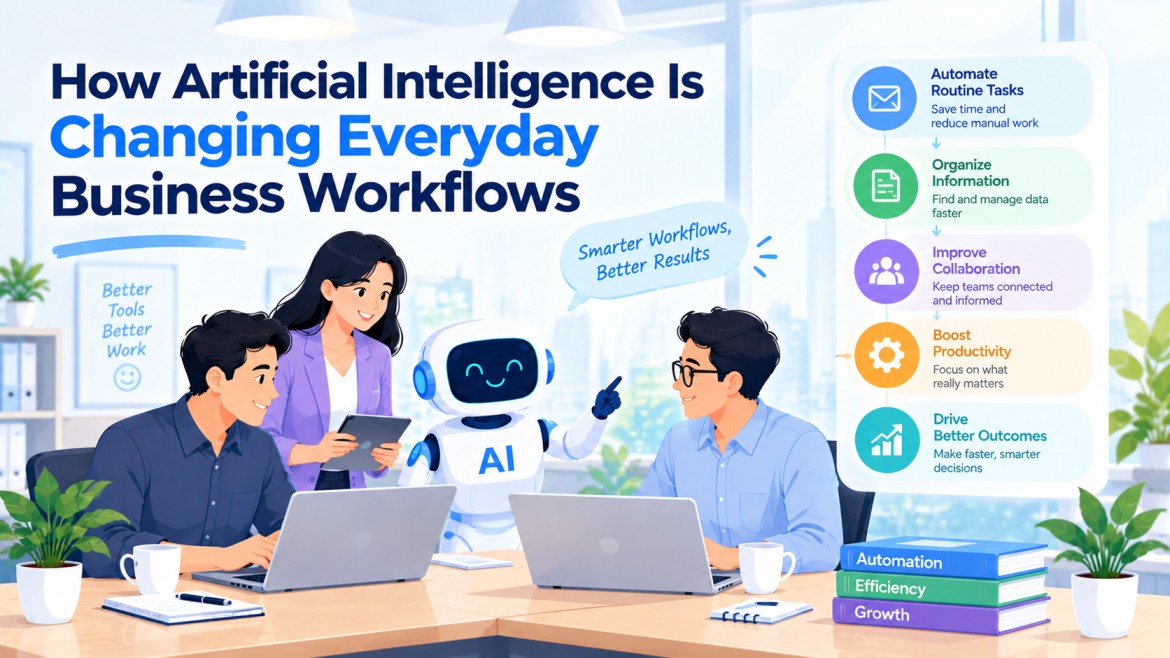
How Artificial Intelligence Is Changing Everyday Business Workflows
-

- Published Updated
- 65 views
Introduction
For many businesses, AI is no longer something that belongs only to research teams or large technology projects. It is gradually becoming part of everyday work.
An employee may use AI to summarize a long document in minutes. A support team may use it to organize customer requests. A sales department may rely on intelligent tools to prepare account insights. Operations teams can also use AI to identify patterns across large amounts of information that would be difficult to review manually.
What makes this shift interesting is that AI is changing ordinary workflows rather than only creating completely new ones.
The biggest opportunity for businesses is not simply adding another AI tool. It is finding better ways to complete work that already happens every day. That requires a clear understanding of current processes, employee needs, business data, and the level of automation that actually makes sense.
AI Starts With Small Changes
When people think about AI transformation, they often imagine a complete business overhaul. In reality, meaningful improvements can start with much smaller changes.
A business might begin by automating one repetitive process. Another company may introduce an AI assistant for internal knowledge. A third may use machine learning to identify unusual activity in operational data.
These smaller applications can make a visible difference without requiring every department to change at once.
The benefit of this approach is that businesses can learn from actual usage. Employees can point out what works and what does not. Management can see whether the system is producing measurable improvements. Technical teams can also identify integration or performance issues before the project becomes larger.
Small wins can therefore become the foundation for broader AI adoption.
Understand How Work Moves Through the Business
Every business process has a sequence.
Information comes in, someone reviews it, a decision is made, an action takes place, and the result moves to another person or system. Some steps are fast, while others create delays.
AI can be useful when it supports the steps that consume the most time.
For instance, imagine a company where employees receive hundreds of documents each week. Staff members need to read each document, identify important details, enter information into a database, and send the record to another team.
AI may help extract information, classify the documents, or prepare the data for review.
The improvement does not come from using AI everywhere. It comes from improving a specific part of the workflow.
This way of thinking makes AI projects easier to justify because the business can connect the technology to a real operational problem.
Employees Are Often the Best Source of AI Ideas
Business leaders may have a broad understanding of operations, but employees usually know where the daily friction exists.
They know which tasks are repetitive. They know where information gets lost. They know which software creates unnecessary steps. They also know when a supposedly simple process becomes difficult because of exceptions and manual checks.
These insights can be extremely useful when identifying AI opportunities.
Instead of asking teams whether they want AI, businesses can ask them which parts of their work are slowing them down.
That conversation can reveal practical use cases much faster.
The role of AI Development Companies can then be to translate those business problems into technically realistic solutions, rather than starting with a predetermined technology and trying to force it into the workflow.
Generative AI Is Making Business Information Easier to Work With
One reason AI adoption is accelerating is that businesses now have more ways to interact with information.
Large language models can help people search, summarize, classify, rewrite, and extract information from different forms of business content. This can be useful when employees work with long reports, internal documentation, emails, product information, or customer conversations.
For example, an employee could ask a question about a large collection of approved company documents instead of manually searching through them.
Businesses exploring these capabilities may evaluate Generative AI Development Companies when they need help building knowledge assistants, document workflows, conversational applications, or content-focused AI solutions.
At the same time, organizations that specifically need custom generative systems may also consider Generative Ai Development Companies based on factors such as model expertise, data integration, security, application architecture, and ongoing support.
But the model itself is only part of the solution.
The system still needs reliable data sources, access controls, retrieval logic, testing, monitoring, and a clear understanding of what the user is actually trying to accomplish.
AI Agents Can Connect Multiple Tasks
Traditional software usually performs specific functions based on defined instructions. AI agents introduce a different approach by allowing a system to coordinate several steps toward a goal.
Imagine a service workflow where the system receives a request, identifies its category, retrieves relevant account information, checks internal documentation, prepares a suggested response, and sends the case to a human employee for approval.
That involves several connected actions rather than one simple AI response.
AI Agent Development Companies can help businesses design these multi-step workflows, connect agents to approved tools, establish permission boundaries, and create monitoring processes.
The important part is deciding whether the workflow actually benefits from agent-based automation.
If a straightforward automation can complete the task reliably, adding an agent may not provide enough additional value to justify the complexity.
Data Quality Can Determine the Outcome
AI often reveals a problem that businesses already have but may not have noticed.
Data can exist in multiple systems with different formats, naming conventions, and levels of accuracy. Customer records may be duplicated. Documents may be outdated. Different departments may define the same business term differently.
When an AI solution depends on this information, these issues become more obvious.
That is why businesses should assess their data before expecting an AI system to produce dependable results.
The work may involve cleaning records, consolidating information, improving metadata, establishing data ownership, and controlling which sources the AI application can access.
A better data foundation can benefit more than the AI project itself. It can also improve reporting, analytics, search, automation, and general business operations.
Integration Is What Makes AI Useful
An AI tool can work perfectly in isolation and still have limited business value.
Suppose a customer support employee needs to copy information from a CRM into a separate AI application and then manually paste the result back into the CRM. The technology may be intelligent, but the workflow remains inefficient.
Integration solves this problem.
AI becomes much more practical when it can work with the systems employees already use. APIs, databases, enterprise applications, document repositories, and identity systems can all become part of the overall architecture.
This is also where development experience becomes important.
Businesses need to think about how information moves between systems, what the AI is allowed to access, and how errors should be handled when connected services are unavailable.
Choosing a Development Team Requires More Than a Portfolio
A provider's website may show impressive AI projects, but businesses need to look deeper before starting a partnership.
It is worth discussing how the team handles requirements, architecture, testing, security, deployment, documentation, and post-launch maintenance.
Technical communication is also important.
A strong development discussion should explain what the system will do, what data it needs, how it will integrate with existing applications, and where human review remains necessary.
Organizations researching AI Development Companies In India may compare providers based on software engineering experience, AI expertise, cloud capabilities, integration knowledge, communication, and long-term support.
The same evaluation approach can be used when considering teams in other markets.
Consider Different Development Models
Businesses do not all need the same type of implementation partner.
Some may need a team for a short proof of concept. Others may require a long-term engineering partner. Some organizations may already have an internal development team and only need support with specific AI components.
The right model depends on the project's size, internal expertise, timeline, and complexity.
A small experiment may not require a large external team. A company-wide AI platform may need ongoing support across data engineering, application development, infrastructure, security, and monitoring.
Understanding this before starting can make the partnership more efficient and reduce confusion about responsibilities.
Security Needs to Be Part of the Workflow
AI applications often work with information that should not be freely accessible.
An internal assistant, for example, may need access to company documents. A customer service application may use account information. An AI coding system may interact with source code or development environments.
Businesses need to define access carefully.
Who can use the system? What information can it retrieve? What actions can it perform? What gets logged? What happens when a user requests something outside their permissions?
A practical security approach should be designed into the application rather than treated as a final project stage.
The NIST AI Risk Management Framework can serve as one reference for organizations thinking about AI-related risk management.
For systems involving large language models, security teams may also review resources such as the OWASP Top 10 for LLM Applications.
AI Should Support People, Not Confuse Them
Employees do not need more technology for its own sake. They need tools that make their work easier.
If an AI system adds additional steps, produces confusing output, or requires people to constantly correct it, adoption can quickly decline.
The user experience therefore matters just as much as the model.
Employees should know what the system is intended to do and what they are responsible for checking. Training should focus on real tasks rather than technical theory.
A useful AI system often feels less like a separate application and more like a capability built into an existing workflow.
Measure What Actually Changes
AI projects need measurable outcomes.
A business should know what was happening before the system was introduced and what has changed afterward.
For a document-processing workflow, the measurement might involve time spent per document. For customer service, it might involve response times or the amount of repetitive work supported by the system. For an internal assistant, the business could examine how quickly employees can find approved information.
The right metric depends on the problem.
What matters is that the measurement connects the technology to a business outcome rather than simply counting how many times people used the AI application.
AI Adoption Is a Continuous Process
Businesses often think about AI as a project with a start date and a launch date.
In practice, it is more useful to think of AI adoption as an ongoing process.
After launch, employees may identify new use cases. Business processes may change. Data sources may expand. AI models may be replaced or improved. Security requirements may also evolve.
This means businesses need a process for monitoring and maintaining their AI systems.
Regular reviews can help teams decide whether a feature should be improved, expanded, restricted, or removed.
That mindset also prevents businesses from becoming dependent on a system simply because they have already invested in it.
What the Next Few Years May Look Like
The future of business AI may be less about standalone applications and more about intelligence becoming part of everyday software.
Employees may not open a separate AI tool at all. Instead, AI capabilities could appear inside CRM systems, analytics platforms, communication tools, project management software, and internal portals.
Some workflows may use AI only for assistance. Others may allow agents to perform selected actions automatically under controlled conditions.
This suggests that businesses should focus less on predicting exactly which AI technology will dominate and more on building systems that can adapt as technology changes.
Flexible architecture, organized data, strong security, and clear governance can make that transition easier.
Conclusion
AI is changing business workflows by improving how people handle information, repetitive tasks, customer interactions, and operational processes. But the most useful implementations usually begin with a simple question: What part of the business needs to work better?
From there, organizations can identify practical use cases, involve employees, prepare their data, choose suitable technology, and connect AI with the systems already in use.
AI Development Companies can help turn those requirements into working applications. Businesses interested in content-focused and knowledge-based AI can also evaluate Generative AI Development Companies and Generative Ai Development Companies based on their expertise in model integration, data handling, application architecture, security, and long-term support.
Companies considering AI Development Companies In India can evaluate partners based on technical expertise, integration skills, security, communication, and ongoing support. For complex multi-step workflows, AI Agent Development Companies may provide the specialized capabilities needed to design and manage agent-based automation.
The strongest AI strategy is not about adopting the most technology. It is about making everyday work more useful, efficient, and manageable. When businesses focus on real problems and build around the people who use the system, AI becomes a practical part of operations rather than just another technology experiment.