How AI Is Impacting Hollywood And Filmmaking In 2026
-

- Published Updated
- 4,339 views
Artificial Intelligence (AI) is no longer a futuristic concept in Hollywood—it has become an integral part of modern filmmaking. From planning productions and creating visual effects to enhancing post-production workflows and personalizing marketing campaigns, AI is transforming how movies are made and distributed. While the technology offers exciting opportunities to improve efficiency and unlock creative possibilities, it has also sparked widespread discussions about copyright, consent, employment, and artistic ownership.
The entertainment industry has experienced several technological revolutions over the past century, including the transition to sound, color, CGI, digital filmmaking, and streaming. Each innovation changed how stories were told without replacing the creative professionals behind them. AI is following a similar path, but with one important difference—it can imitate certain aspects of creativity itself. As a result, filmmakers, actors, writers, and studios are trying to determine where AI should assist production and where human creativity must remain irreplaceable.
The conversation surrounding AI is no longer limited to experimental software or research labs. It has become a practical business issue affecting studios, production companies, unions, technology providers, and audiences alike. Questions surrounding ethical AI adoption, intellectual property, fair compensation, and transparency have become central to Hollywood's future. These evolving developments are explored in greater detail in Hollywood And Filmmaking, which examines how artificial intelligence is changing every stage of movie production.
AI In Hollywood Is Transforming Every Stage Of Filmmaking
Contrary to popular belief, AI is not independently creating blockbuster films from beginning to end. Instead, studios use AI as a collection of specialized tools that improve productivity across the filmmaking process while leaving major creative decisions to directors, producers, writers, and artists.
AI In Script Development And Pre-Production
The earliest phase of filmmaking has become significantly more efficient through AI-assisted planning tools. Production teams use machine learning to analyze scripts, identify locations, estimate budgets, organize shooting schedules, generate production breakdowns, and create preliminary concept art.
Storyboarding has also become faster. AI image-generation tools can produce visual references based on screenplay descriptions, allowing directors to communicate ideas more effectively before production begins. These systems accelerate brainstorming rather than replacing professional storyboard artists.
By reducing administrative work, AI enables creative teams to spend more time refining stories and less time handling repetitive planning tasks.
AI Is Revolutionizing Visual Effects And Production
Visual effects represent one of the most mature applications of AI in Hollywood today.
Modern machine learning systems assist artists with:
- Object tracking
- Camera stabilization
- Rotoscoping
- Facial enhancement
- Background replacement
- Image cleanup
- Motion analysis
- Digital compositing
Rather than manually editing thousands of individual frames, artists increasingly rely on AI to automate repetitive work while retaining complete creative control.
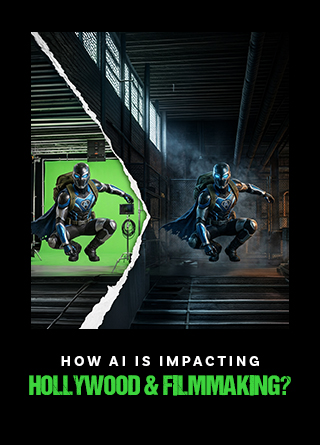
Virtual production has also evolved significantly through AI-assisted workflows. Productions can now combine LED stages, real-time rendering, machine learning, and digital environments to create immersive cinematic experiences more efficiently than traditional green-screen techniques.
AI also enables filmmakers to complete visually complex scenes with smaller budgets, making high-quality filmmaking more accessible to independent creators.
Digital Crowd Generation Changed Large-Scale Filmmaking
One of AI's earliest successes in Hollywood involved digital crowd simulation.
In 2001, The Lord of the Rings: The Fellowship of the Ring introduced Massive software, allowing thousands of virtual soldiers to behave independently during battle scenes. Instead of manually animating every character, artists programmed behavioral rules that enabled digital agents to react intelligently to changing environments.
Although today's generative AI models are far more sophisticated, Massive demonstrated that intelligent software could dramatically reduce production complexity while producing realistic cinematic results.
Crowd simulation remains one of the clearest examples of AI enhancing filmmaking without replacing human artists.
AI Is Streamlining Post-Production
Post-production has become another area where AI delivers substantial productivity gains.
Editors increasingly use AI-powered software for:
- Automatic transcription
- Dialogue cleanup
- Noise reduction
- Subtitle generation
- Voice enhancement
- Lip synchronization
- Scene organization
- Multilingual localization
Localization has become especially valuable for global distribution. AI-assisted dubbing and translation allow studios to release films in multiple languages more quickly while preserving lip movements and emotional tone.
Although human editors still oversee final quality, AI dramatically reduces the time required to prepare international releases.
AI Is Improving Movie Marketing
Marketing departments are also embracing artificial intelligence.
Studios now analyze audience preferences, viewing behavior, social media engagement, and trailer performance using machine learning models.
These insights help marketers:
- Test promotional campaigns
- Personalize advertisements
- Optimize trailers
- Predict audience interest
- Improve content recommendations
Rather than replacing creative marketing teams, AI provides data-driven insights that improve campaign performance and audience engagement.
When Did AI First Enter Hollywood?
Many people associate AI in filmmaking with generative video models, but Hollywood has experimented with intelligent software for decades.
One of the earliest landmarks came in 2001 with Weta Digital's Massive software, which generated autonomous digital armies for The Lord of the Rings trilogy. Each virtual character could make limited behavioral decisions based on nearby activity, making battle sequences appear far more realistic than traditional duplicated CGI crowds.
Another notable milestone arrived in 2016 with Sunspring, a short film whose screenplay was generated using a recurrent neural network. While unconventional, the project demonstrated AI's ability to participate in storytelling itself.
These early innovations laid the foundation for today's generative AI tools that can create images, videos, voices, and digital characters.
Why Tilly Norwood Has Become A Symbol Of AI In Hollywood
Few developments have attracted as much attention as Tilly Norwood.
Created by AI talent studio Xicoia under Particle6 founder Eline Van der Velden, Tilly is a synthetic performer promoted similarly to a human celebrity. She has appeared across social media, promotional campaigns, and public discussions while being positioned as a legitimate entertainment personality.
The conversation intensified when Particle6 announced that Tilly would lead Misaligned, an AI-focused feature film.
Although virtual humans have existed for years, Tilly represents something different. She is not simply a digital visual effect but a synthetic performer marketed through Hollywood's traditional talent ecosystem.
Her emergence has raised important questions regarding whether AI-generated performers should receive recognition comparable to human actors.
Labor Unions Continue Raising Ethical Concerns
Hollywood's creative unions remain cautious about AI's rapid adoption.
SAG-AFTRA has emphasized that synthetic performers raise significant concerns regarding consent, compensation, and training data. The organization argues that performers whose work contributes to AI training should receive proper authorization and compensation.
Similarly, the Writers Guild of America maintains that generative AI cannot receive writing credit or replace professional screenwriters. Current agreements ensure that human authors retain ownership, credit, and creative authority over their work.
These protections aim to ensure AI functions as an assistive technology rather than a substitute for creative professionals.
AI Could Reshape Entertainment Employment
Economic research suggests AI may significantly change employment across Hollywood.
Industry studies estimate that more than 200,000 entertainment jobs could experience disruption through automation, workflow changes, and evolving production methods.
Positions most likely to experience transformation include:
- Background actors
- Assistant editors
- Localization specialists
- Voice performers
- Entry-level visual effects artists
However, technological change also creates entirely new careers.
Studios increasingly require specialists in AI ethics, synthetic media, machine learning, prompt engineering, digital asset management, and AI governance.
Rather than eliminating creativity, AI appears more likely to redefine how creative professionals work.
Benefits Of AI In Hollywood
Despite ongoing concerns, AI offers substantial advantages for filmmakers.
Faster Production
AI automates repetitive tasks, reducing production timelines while allowing artists to focus on storytelling.
Lower Costs
Independent filmmakers gain access to sophisticated editing, visual effects, and production capabilities previously available only to large studios.
Greater Accessibility
Automated subtitles, multilingual dubbing, and improved localization help films reach global audiences more efficiently.
Enhanced Creativity
AI enables rapid experimentation with visual concepts, scene layouts, character designs, and editing styles before committing resources to production.
These benefits make filmmaking more accessible while encouraging creative experimentation.
Challenges AI Still Cannot Solve
Although AI continues improving rapidly, important limitations remain.
Current systems often struggle with:
- Long-form narrative consistency
- Emotional authenticity
- Character continuity
- Realistic physical interactions
- Complex acting performances
- Creative intuition
AI-generated outputs also raise legal concerns regarding copyrighted material, unauthorized likenesses, and unclear training datasets.
For these reasons, professional oversight remains essential throughout production.
Human Creativity Remains Essential
Hollywood's leading organizations continue emphasizing that AI should support—not replace—human creativity.
The Academy of Motion Picture Arts and Sciences has clarified that films using AI remain eligible for awards provided meaningful human authorship remains central.
Similarly, acting and writing categories continue requiring genuine human creative contributions.
These guidelines reflect an industry-wide understanding that storytelling depends on emotion, experience, empathy, and artistic judgment—qualities AI cannot fully replicate.
What The Future Of AI In Hollywood Looks Like
AI will almost certainly become a permanent part of filmmaking.
Studios are expected to expand AI usage across production planning, visual effects, localization, marketing, and post-production while developing stronger ethical frameworks governing transparency, consent, licensing, and compensation.
Future regulations will likely require clearer disclosure of AI-generated content, responsible training practices, and stronger protections for performers and creators whose work contributes to machine learning systems.
Rather than replacing filmmakers, AI will become another production tool alongside cameras, editing software, CGI, and virtual production technologies.
Conclusion
Artificial Intelligence is reshaping Hollywood faster than any filmmaking technology in recent decades. From script analysis and visual effects to multilingual localization and digital performers, AI is changing how movies are planned, produced, marketed, and distributed.
However, technological capability alone will not determine AI's future in entertainment. The industry's success will depend on establishing ethical standards that protect creative professionals, respect intellectual property, ensure informed consent, and preserve human authorship.
Hollywood has successfully adapted to every major technological revolution throughout its history. AI represents the next chapter in that evolution—not as a replacement for filmmakers, actors, or writers, but as a powerful creative assistant capable of expanding what human storytellers can achieve.
The future of Hollywood will not be defined by AI alone. It will be shaped by how responsibly filmmakers, studios, technology companies, and audiences choose to use it. When guided by transparency, fairness, and human creativity, AI has the potential to become one of the most valuable tools the entertainment industry has ever embraced.