The AI Governance Checklist Every Enterprise Needs in 2026
-

- Published Updated
- 259 views
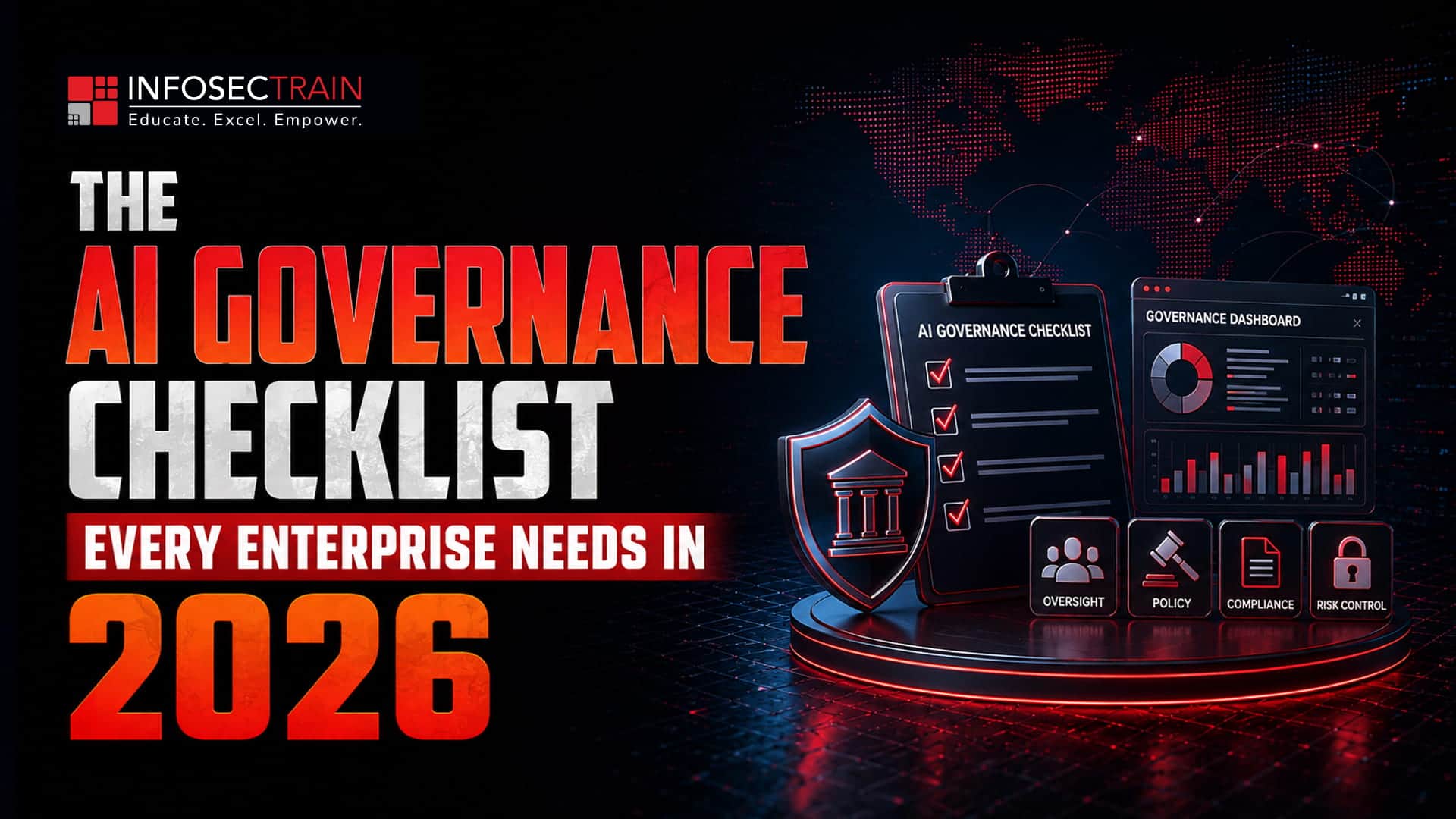
AI now touches customer service, HR, analytics, cybersecurity, product development, and plenty of decisions that used to sit entirely with people. Governance, in most organizations, is still catching up to that reality instead of shaping it ahead of time. A published ethics statement doesn't cover what's actually needed anymore. Enterprises have to know which AI systems they run, who owns each one, what data feeds them, what risk they carry, which regulations apply, and how each system gets tested, monitored, audited, and eventually retired.
That's a lot to hold in someone's head. A working checklist turns AI governance into a repeatable operational discipline instead of a document that gets written once and never opened again.
The Enterprise AI Governance Checklist for 2026
1. Build and Maintain an AI Inventory
Nobody can govern AI systems they don't know exist, and that gap is more common than most leadership teams assume.
Every AI system in use needs to be identified, including tools individual teams have adopted quietly without formal sign-off; shadow AI is a real governance risk here, not a hypothetical one
Whether a system is built in-house, bought from a vendor, or embedded inside another product changes how it should be governed
The business purpose behind each system is worth recording alongside it, not assumed later from context
A named owner, not a department label, should sit against every entry
2. Assign Clear Ownership and Accountability
An AI system without a named owner tends to stay ungoverned no matter how good the policy looks on paper.
Business, technical, and risk owners belong on every system, not just the ones that feel high-stakes at the time
A governance committee that meets on a real schedule does more than one that exists only in an org chart
Escalation paths work best defined before an incident forces the question
Accountability for AI-driven decisions has to be explicit somewhere on paper, since assumed accountability rarely survives a real dispute
3. Classify AI Risk and Run Impact Assessments
This is usually where a governance program proves whether it's functional or just decorative.
A risk register covering every inventoried system is the baseline most programs still lack
Formal AI impact assessments belong before deployment. Running them afterward defeats most of the purpose
Frameworks like NIST's AI RMF or the EU AI Act's tiering give risk classification a structure worth borrowing rather than reinventing
Potential harm to individuals, the organization, and, where relevant, the public all deserve a look, not just financial exposure
Bias, privacy gaps, security weaknesses, reliability, and legal risk each need their own check, since a system can clear one and still fail another
4. Establish Policy Across the Full AI Lifecycle
Governance that only addresses deployment is covering one stage out of eight.
Design, data collection, development, testing, deployment, monitoring, change, and retirement each need their own expectations spelled out
Data quality checks and documented human oversight matter at more points in that chain than most policies currently cover
Model validation before anything goes live isn't optional, even when a launch date is close
Documentation has to stay current, not just accurate on the day it was written
5. Put Security, Privacy, and Responsible AI Controls in Place
Older security policies typically weren't written with GenAI, RAG pipelines, or autonomous agents in mind, and it shows.
Access control and data protection need an AI-specific lens, since generic IT policy often misses how training data gets handled
Model security, bias, and fairness deserve direct treatment, not a mention buried in a broader risk section
Transparency and explainability become non-negotiable wherever a system's output actually affects a person's outcome
Third-party AI needs the same scrutiny as anything built internally, arguably more given the visibility gap
GenAI, RAG, and agentic AI introduce a risk surface a lot of older policies simply never anticipated, because none of it existed when those policies were written
6. Monitor AI After Deployment
Approval at launch isn't approval forever, and treating it that way is where a lot of programs quietly fail.
Model performance and drift need tracking on an ongoing basis, not a once-a-year check-in
Unexpected outputs and new bias patterns tend to surface only once real users are involved, which testing rarely replicates fully
Security incidents tied specifically to AI systems deserve their own monitoring lane
Regulatory shifts and vendor or model updates can quietly change an organization's risk exposure without anyone flagging it internally
An incident response process built for AI-specific failure modes, with a real escalation path, closes the loop here
7. Audit the Governance Program and Keep Evidence
A functioning audit trail proves controlled work. Existing on paper doesn't.
Internal audits should examine the governance program itself, not just the individual AI systems sitting underneath it
Independent assurance earns its cost where the stakes genuinely justify it
Audit evidence and control-testing records carry more weight than policy documents alone ever will
Nonconformities need tracking through to actual closure, not just identification
Management review and continuous improvement keep a program from calcifying after its first successful audit
Which AI Governance Training Supports Each Responsibility?
Executing that checklist end to end takes a real mix of skills, and InfosecTrain runs five programs that map onto different parts of it.
Certified AI Governance Specialist (CAIGS) Training covers broad, practical enterprise AI governance. It works through building governance programs from scratch, constructing AI risk registers, and running impact assessments. GenAI-specific governance questions get real attention too, alongside frameworks like NIST's AI RMF and the EU AI Act. It suits professionals who need one program covering governance end to end, including cloud governance considerations, rather than a narrow slice of the problem. Among the five, this is the closest thing to a generalist track, and that breadth is exactly the point.
ISO/IEC 42001:2023 Lead Implementer Training and Certification is built for the people who actually construct an AI management system rather than just advise on one. It covers turning governance requirements into an operational AIMS: policy design and risk assessments on one side, documentation structures and the operational controls that hold the whole system together on the other. This one fits professionals responsible for standing up governance infrastructure inside an organization, not auditing someone else's.
ISO/IEC 42001:2023 Lead Auditor Training With Complimentary NIST AI Risk Management Framework Training sits on the other side of that same standard. Where Lead Implementer builds the AIMS, this program trains people to audit one, checking whether it genuinely conforms to ISO/IEC 42001 and whether its controls function in practice rather than just existing on paper. The included NIST AI RMF training adds a second risk framework most auditors need anyway, which makes this one of the more complete audit-focused options here.
Advanced in AI Audit (AAIA) Certification Training goes wider than a single management-system standard. Instead of auditing against one framework, it covers AI governance, risk, and privacy across the board, plus operations, lifecycle controls, and audit testing methodology. It fits auditors and risk professionals whose scope isn't limited to ISO 42001 conformance specifically, and who need to assess AI governance maturity across a broader set of standards and internal controls.
IAPP AIGP Certification Training centers on regulation, privacy, and lifecycle governance rather than audit or implementation mechanics. It covers the EU AI Act in depth and its intersection with GDPR, then extends into organizational AI policy work spanning the development-to-deployment lifecycle. This is the strongest fit for privacy professionals and anyone whose role leans toward regulatory interpretation rather than technical implementation or audit work.
Keeping these five distinct matters more than it might seem. CAIGS builds broad practical governance capability. Lead Implementer builds the management system itself, and Lead Auditor checks that system against ISO/IEC 42001 specifically once it exists. AAIA widens the lens to AI governance across risk, privacy, and operations generally. AIGP grounds a professional in regulation and lifecycle governance rather than audit or build work. Treating any two of these as interchangeable usually means picking the wrong one.
Which Course Fits Which Governance Needs?
Broad governance capability across the board points to CAIGS. Building an AI management system from the ground up calls for Lead Implementer, while auditing an AIMS that already exists calls for Lead Auditor instead. Auditing AI governance more broadly, beyond a single standard, sits with AAIA. Anyone needing deeper grounding in privacy and regulation is better served by AIGP.
Conclusion
None of this checklist matters until it becomes a measurable process rather than a policy statement. Assigned accountability that survives contact with a real incident, controls that get tracked rather than assumed, documented evidence an auditor can actually verify, and oversight that continues well past the day a system goes live, that's what separates a functioning program from a well-written one. The enterprises getting AI governance right in 2026 tend to combine several things at once: governance and implementation working together, real risk management underneath both, and regulatory literacy and independent assurance keeping the whole structure honest long after the initial rollout is finished.