AI-RAN Market Demand Accelerates with Edge AI and Open RAN Adoption
-
- May 12th, 2026
- 5,811 views

FREE SEO Topical Map Generator: Find Your Next Content Ideas
AI-RAN Market Outlook and Emerging Opportunities
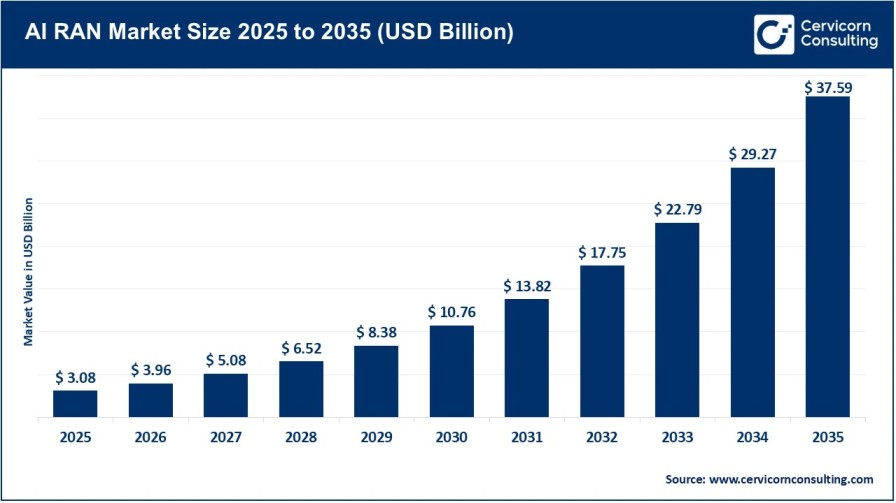
The global AI-RAN market is rapidly transforming the telecommunications industry, positioning itself as a major innovation area for next-generation network infrastructure. Market estimates indicate that the industry, valued at around USD 3.08 billion in 2025, is expected to reach nearly USD 37.59 billion by 2035, growing at a notable CAGR of 28.5% throughout the forecast period.
As telecom providers continue expanding 5G infrastructure while preparing for the transition to 6G technology, AI-powered Radio Access Networks (AI-RAN) are becoming increasingly vital for optimizing spectrum usage, automating network operations, lowering operational expenses, and enabling ultra-fast, low-latency connectivity.
Understanding AI-RAN Technology
AI-RAN, or Artificial Intelligence Radio Access Network, refers to the integration of artificial intelligence and machine learning capabilities into telecom radio access systems. These intelligent technologies help operators optimize network traffic, forecast congestion, enhance signal quality, and automate operational tasks in real time.
Unlike traditional RAN infrastructures that rely on static configurations and manual intervention, AI-RAN solutions continuously analyze network conditions and dynamically adjust resources according to traffic demands and user behavior.
The growing complexity of telecom ecosystems—driven by technologies such as Open RAN, massive MIMO, edge computing, IoT expansion, and dense 5G deployments—is accelerating the need for AI-driven automation across modern communication networks.
Major Drivers Supporting AI-RAN Market Growth
Growing Adoption of Intelligent Network Automation
Telecom operators are increasingly leveraging AI-powered automation platforms to improve network efficiency and reduce operational expenditures. AI-based technologies can automatically identify faults, optimize network handovers, and enable self-healing functionalities.
Industry analysis suggests that AI-native automation can reduce operating costs for Tier-1 telecom providers by nearly 25% through predictive maintenance and intelligent resource management.
Expansion of 5G and Future 6G Infrastructure
The global expansion of 5G networks is creating significant data traffic and operational complexity. AI-RAN systems help telecom companies maximize spectrum efficiency, minimize interference, and improve network throughput in high-density urban environments.
Artificial intelligence is also expected to become a core element of future 6G communication frameworks, allowing networks to autonomously adapt and optimize performance in real time.
Rising Deployment of Open RAN (O-RAN)
Open RAN technology is enabling telecom providers to create more flexible and interoperable network ecosystems. AI integration becomes more effective within O-RAN environments because virtualized network components can be managed through centralized intelligent orchestration systems.
Market research indicates that Open RAN contributes nearly 45% of the AI-RAN market due to its scalable and multi-vendor infrastructure advantages.
Increasing Importance of Edge AI Computing
Edge computing is becoming essential for supporting real-time AI processing within telecom infrastructure. AI-RAN systems process data closer to end users, significantly reducing latency while improving responsiveness for applications such as autonomous vehicles, industrial automation, and immersive AR/VR experiences.
Deploying AI capabilities at the network edge can lower latency by approximately 40–60%, making it highly valuable for emerging digital applications.
Get Free Sample Report: https://www.cervicornconsulting.com/sample/2937
Emerging Trends in the AI-RAN Market
Shift Toward AI-Native Network Architectures
Telecom companies are increasingly transitioning toward AI-native infrastructures where artificial intelligence is embedded directly into network architecture rather than functioning as an external optimization tool.
This shift is expected to redefine how future telecom networks are designed, managed, and optimized.
Green RAN and Sustainable Network Operations
Energy efficiency and sustainability are becoming critical priorities for telecom operators worldwide. AI-driven energy management technologies allow networks to dynamically reduce power usage during low-traffic periods.
Since radio access infrastructure accounts for a significant share of telecom energy consumption, AI-powered optimization can substantially improve efficiency while supporting environmental sustainability goals.
AI-Enabled Spectrum Optimization
AI-powered spectrum management solutions are increasingly being deployed to improve spectrum allocation efficiency and minimize interference in congested network environments.
Studies indicate that AI-driven spectrum optimization can improve spectral efficiency by more than 35% compared to conventional approaches.
Convergence of AI and Cloud-Native Telecom Infrastructure
The rise of cloud-native telecom ecosystems is accelerating AI-RAN adoption globally. Major cloud providers such as Amazon Web Services, Microsoft Azure, and Google Cloud are collaborating with telecom operators to support scalable AI workloads and advanced edge computing environments.
Regional Market Analysis
North America Leading the Global Market
North America currently dominates the AI-RAN market, accounting for nearly 38% of global revenue. The region benefits from significant investments in AI infrastructure, mature telecom ecosystems, and strong collaborations between telecom operators and technology companies.
The United States continues to serve as a major innovation hub for AI-powered telecom infrastructure, interoperability standards, and network cybersecurity technologies.
Asia-Pacific Emerging as a High-Growth Region
Asia-Pacific is projected to witness the fastest market growth due to aggressive 5G deployment programs across countries such as China, India, Japan, and South Korea.
Rapid growth in mobile data consumption and large-scale telecom investments are accelerating demand for AI-based network optimization technologies throughout the region.
Europe Focusing on Sustainable AI-RAN Deployment
European telecom operators are prioritizing sustainable network modernization and energy-efficient telecom infrastructure. AI-powered optimization solutions are helping operators lower energy usage while achieving environmental sustainability objectives.
Competitive Landscape
The AI-RAN market remains highly competitive, with leading telecom equipment manufacturers, semiconductor companies, and cloud service providers heavily investing in AI-enabled networking technologies.
Key companies operating in the market include:
- Nokia
- Ericsson
- Huawei
- Samsung Electronics
- Qualcomm
- NVIDIA
- Intel
- Cisco Systems
- NEC Corporation
- Mavenir
Strategic alliances are further accelerating innovation in the market. The creation of the AI-RAN Alliance by organizations including NVIDIA, Ericsson, Nokia, and SoftBank represents a major step toward embedding AI directly into telecom infrastructure.
Challenges Impacting AI-RAN Adoption
Despite strong growth potential, several challenges continue to influence market adoption:
- High infrastructure deployment and modernization costs
- Growing compute and processing requirements
- Complex orchestration across virtualized environments
- Power efficiency constraints at the network edge
- Security, interoperability, and integration challenges
Telecom companies must balance increasing AI processing demands with scalability, performance optimization, and energy efficiency goals.
Future Outlook
The future of the AI-RAN market remains highly optimistic as telecom providers continue moving toward autonomous and AI-native communication networks. The convergence of AI, edge computing, Open RAN, cloud-native telecom architecture, and future 6G development will continue driving substantial investments across the industry.
AI-RAN is expected to become a foundational technology supporting advanced digital applications including smart factories, industrial IoT, autonomous transportation, digital twins, metaverse ecosystems, and smart city infrastructure.
As telecom infrastructure becomes increasingly software-defined and intelligent, AI-RAN will play a central role in shaping the future of global digital connectivity.
Contact for Detailed Insights: https://www.cervicornconsulting.com/contact-us