Digital Twins in Healthcare Market: Innovation Trends, Market Expansion, and Future Opportunities
-
- Published Updated
- 6,375 views
Market Overview
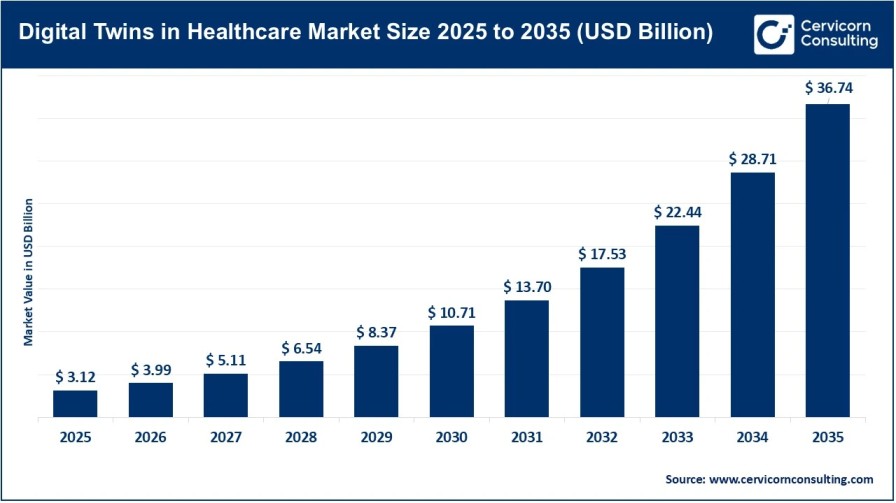
The global Digital Twins in Healthcare Market is gaining significant momentum as healthcare organizations increasingly adopt advanced digital technologies to improve patient care, optimize operational performance, and accelerate medical innovation. Valued at approximately USD 3.12 billion in 2025, the market is expected to reach nearly USD 36.74 billion by 2035, growing at an impressive CAGR of around 28% throughout the forecast period. The increasing integration of artificial intelligence (AI), Internet of Things (IoT) devices, cloud-based platforms, and predictive analytics is driving widespread adoption of digital twin solutions across the healthcare sector.
Read a Full Report: https://www.cervicornconsulting.com/digital-twins-in-healthcare-market
Understanding Digital Twins in Healthcare
A healthcare digital twin is a virtual replica of a physical healthcare entity, such as a patient, organ, medical device, healthcare facility, or clinical process. These digital models continuously collect and process real-time data from electronic health records (EHRs), diagnostic imaging systems, wearable technologies, connected sensors, and clinical databases to simulate scenarios, evaluate performance, and forecast future outcomes.
The market includes a broad range of products and services, such as:
Digital twin software platforms
AI-powered healthcare analytics
Cloud-based healthcare infrastructures
Simulation and modeling technologies
Data integration and management solutions
Hospitals, pharmaceutical companies, medical device manufacturers, and research institutions are increasingly utilizing these technologies to improve diagnosis accuracy, personalize treatment plans, optimize healthcare operations, and speed up drug discovery processes.
The Growing Importance of Digital Twin Technology
Digital twins are revolutionizing healthcare by enabling predictive, real-time, and data-driven decision-making. Rather than relying solely on historical information, healthcare professionals can simulate disease progression, assess treatment outcomes, and anticipate potential complications before they arise.
Key benefits include:
Advancing precision medicine initiatives
Improving surgical planning and clinical training
Lowering costs associated with clinical trials
Accelerating pharmaceutical research and innovation
Enhancing patient monitoring capabilities
Optimizing healthcare resource allocation
Reducing operational inefficiencies
Supporting preventive healthcare strategies
Improving the safety and effectiveness of medical devices
As healthcare systems increasingly focus on personalized medicine and value-based care, digital twin technology is becoming a vital component of modern healthcare transformation.
Request a Sample Report: https://www.cervicornconsulting.com/sample/2965
Key Market Growth Drivers
Several factors are contributing to the rapid growth of the Digital Twins in Healthcare Market:
Increasing use of AI and machine learning in clinical decision-making
Rising adoption of wearable health-monitoring devices
Growing demand for personalized healthcare solutions
Expanding investments in healthcare digitization projects
Continuous growth in cloud computing capabilities
Greater emphasis on predictive and preventive care models
Advancements in medical imaging technologies
Wider deployment of IoT-connected healthcare environments
Rising healthcare expenditures globally
Growing need for operational efficiency and cost optimization
Healthcare providers are deploying digital twin technologies to improve treatment outcomes, increase precision in care delivery, streamline workflows, and support continuous monitoring of chronic diseases.
Major Industry Participants
Several leading technology and healthcare companies are actively shaping the future of the market, including:
Microsoft Corporation
Siemens Healthineers AG
Koninklijke Philips N.V.
Amazon Web Services (AWS)
Dassault Systèmes
These organizations continue to invest in next-generation digital twin platforms, AI-enabled healthcare solutions, and scalable cloud infrastructures.
Emerging Market Trends
AI-Driven Personalized Medicine
Artificial intelligence is strengthening digital twin capabilities by enabling advanced predictive analysis and helping healthcare providers design highly personalized treatment plans based on individual patient characteristics.
Virtual Patient Modeling
Healthcare organizations are creating digital patient replicas that can simulate disease development and assess treatment effectiveness before real-world implementation.
Integration of Connected Health Devices
Wearable technologies, biosensors, and remote monitoring systems continuously supply real-time data to digital twin platforms, allowing healthcare providers to deliver proactive and preventive care.
Faster Drug Development Cycles
Pharmaceutical companies are utilizing digital twins to simulate drug responses and treatment outcomes, helping reduce development timelines and research expenses.
Smart Hospital Initiatives
Hospitals are building digital representations of infrastructure, equipment, and clinical workflows to enhance operational efficiency, resource utilization, and patient satisfaction.
Medical Device Virtual Testing
Manufacturers are increasingly leveraging digital twins to evaluate and optimize medical devices in virtual environments before deployment, improving reliability and reducing development risks.
Expansion of Cloud-Based Healthcare Platforms
Cloud infrastructure provides the scalability and computing power required to support complex digital twin applications and large healthcare datasets, enabling broader market adoption.
Practical Applications Across the Healthcare Industry
Siemens Healthineers AG
Siemens Healthineers employs digital twin technology to improve hospital performance, optimize imaging equipment, and streamline clinical workflows, helping healthcare organizations operate more efficiently.
Koninklijke Philips N.V.
Philips integrates connected healthcare solutions with digital twin concepts to support predictive healthcare, remote patient monitoring, and proactive disease management.
Microsoft Corporation
Through Azure Digital Twins, Microsoft allows healthcare providers to create virtual models of hospitals, medical equipment, and patient ecosystems, delivering actionable operational and clinical insights.
Dassault Systèmes
Dassault Systèmes utilizes virtual patient simulations to enhance clinical trial design, accelerate pharmaceutical research, and support precision medicine initiatives.
Regional Outlook
North America
North America remains the leading regional market, supported by sophisticated healthcare infrastructure, significant investments in AI technologies, widespread cloud adoption, and growing precision medicine programs. The region accounted for approximately 46.8% of global market revenue in 2024.
Major growth initiatives include:
National healthcare AI programs
Precision medicine funding efforts
Healthcare interoperability standards
Expansion of telehealth and digital care services
Europe
Europe continues to strengthen its market position through extensive healthcare digitization programs and favorable regulatory support.
Key initiatives include:
European Health Data Space (EHDS)
Horizon Europe healthcare projects
EU Digital Strategy programs
National AI healthcare frameworks
Asia-Pacific
Asia-Pacific is projected to achieve the fastest market growth over the forecast period. Countries such as China, Japan, India, Singapore, and South Korea are making substantial investments in AI-powered healthcare infrastructure and digital health ecosystems.
Major initiatives include:
Ayushman Bharat Digital Mission
National Digital Health Mission
Healthy China 2030
Society 5.0 (Japan)
Smart Nation Initiative (Singapore)
Latin America
Healthcare modernization programs, telehealth expansion, and growing cloud adoption are supporting gradual market growth throughout Latin America.
Middle East & Africa
Nations such as Saudi Arabia and the United Arab Emirates are investing heavily in smart healthcare infrastructure, AI adoption, and digital transformation programs to modernize healthcare delivery systems.
Competitive Landscape
The Digital Twins in Healthcare Market remains highly competitive, with technology providers, healthcare organizations, software developers, and cloud service companies continuously investing in innovation and product development. Strategic partnerships between healthcare providers, pharmaceutical companies, AI specialists, and cloud vendors are accelerating market adoption worldwide.
The convergence of artificial intelligence, IoT, cloud computing, and predictive analytics is expected to unlock substantial opportunities in personalized medicine, healthcare operations management, medical device innovation, and pharmaceutical research over the coming decade.
For customized market intelligence and detailed industry insights, visit: https://www.cervicornconsulting.com/contact-us