AI in Steel Market Report Covering Robotics, IoT and Predictive Analytics
-
- May 29th, 2026
- 4,458 views

FREE SEO Topical Map Generator: Find Your Next Content Ideas
AI in Steel Market Size
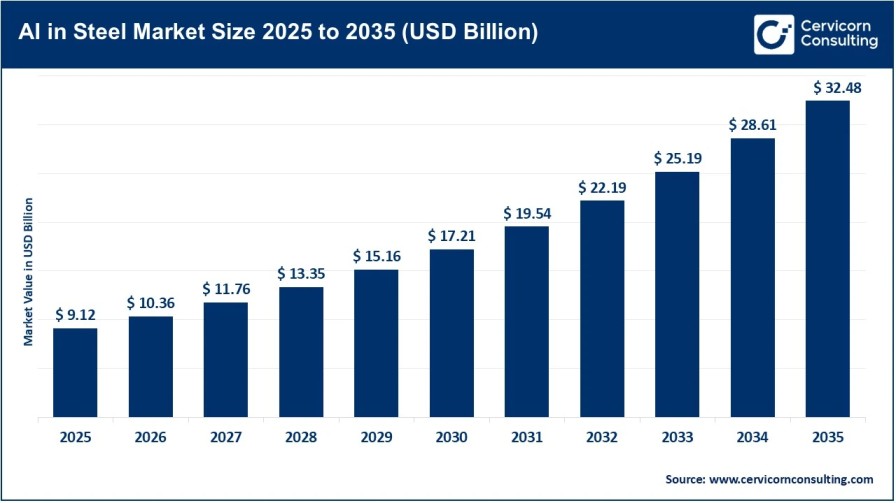
The global AI in steel market accounted for approximately USD 9.12 billion in 2025 and is forecasted to reach nearly USD 32.48 billion by 2035, growing at a CAGR of around 13.5% during the forecast period.
Read a Full Report: https://www.cervicornconsulting.com/ai-in-steel-market
Introduction to the AI in Steel Market
The AI in steel market represents the adoption of artificial intelligence technologies across steel manufacturing operations, supply chain management, industrial automation systems, and quality assurance processes. AI-driven technologies utilized in the steel sector include machine learning software, robotics, intelligent sensors, predictive analytics platforms, digital twin solutions, cloud-enabled monitoring systems, and computer vision technologies.
These advanced systems help steel manufacturers boost operational efficiency, reduce production costs, strengthen workplace safety, and maintain superior product quality. AI-powered platforms analyze extensive real-time manufacturing data to identify inefficiencies, predict equipment malfunctions, automate inspections, and optimize resource utilization.
Key applications of AI in steel manufacturing include:
Predictive maintenance for heavy industrial machinery and furnaces
Automated surface defect detection in steel products
Energy optimization and emission reduction
Smart production scheduling and planning
Automation of rolling mill operations
Supply chain and logistics optimization
Workplace safety monitoring systems
Environmental sustainability management
Demand forecasting and inventory planning
The market includes AI software providers, industrial automation companies, robotics manufacturers, cloud platform vendors, and digital transformation service providers supporting steel producers worldwide.
Get a Free Sample: https://www.cervicornconsulting.com/sample/2959
Importance of AI in the Steel Industry
Artificial intelligence is becoming increasingly essential in the steel industry as manufacturers seek to improve efficiency, lower operational costs, meet sustainability goals, and comply with stringent environmental regulations. Traditional steel production processes often involve excessive energy consumption, unexpected equipment downtime, inconsistent product quality, and labor-intensive operations. AI technologies address these challenges through intelligent automation, predictive analytics, and real-time operational monitoring.
One of the most important benefits of AI adoption in steel manufacturing is predictive maintenance. Steel plants rely heavily on large-scale industrial equipment operating under harsh conditions, and unplanned failures can result in major production disruptions. AI-driven maintenance systems use sensor-generated data and machine learning algorithms to detect potential equipment problems before breakdowns occur, helping companies reduce downtime and maintenance expenses.
AI also enhances quality management through advanced computer vision systems capable of identifying microscopic surface defects during production. This improves consistency, reduces waste, and enhances customer satisfaction.
Sustainability is another major factor accelerating AI adoption in the steel sector. Since steel production contributes significantly to global carbon emissions, AI-powered energy optimization systems help reduce fuel usage, improve energy efficiency, and minimize environmental impact. As governments enforce stricter emission standards, AI technologies are becoming increasingly important for sustainable steel manufacturing.
Additionally, AI improves worker safety by monitoring hazardous industrial environments, identifying operational risks, and automating dangerous processes. Smart manufacturing facilities supported by AI also enable improved transparency, remote monitoring, and faster operational decision-making.
Major Growth Drivers of the AI in Steel Market
Several important factors are contributing to the expansion of the AI in steel market, including:
Increasing adoption of Industry 4.0 technologies
Rising demand for automation and operational efficiency
Growing deployment of predictive maintenance systems
Expanding investments in industrial digital transformation
Greater focus on sustainability and carbon reduction
Advancements in industrial IoT, cloud computing, and edge analytics
Increased use of machine learning and real-time data analytics
Government initiatives supporting smart manufacturing
Intensifying competition within the global steel sector
Steel manufacturers are increasingly investing in AI-powered systems to optimize production workflows, improve product quality, reduce operational expenses, and increase profitability.
Leading Companies in the AI in Steel Market
Several global technology and automation companies are driving innovation in the AI in steel market:
| Company | Specialization | Key Focus Areas |
|---|---|---|
| Siemens | Industrial automation and digitalization | Smart manufacturing, AI analytics, digital twins |
| ABB | Robotics and industrial automation | Intelligent robotics and predictive maintenance |
| Honeywell | Industrial software and process automation | AI-driven plant optimization |
| Rockwell Automation | Manufacturing automation | Industrial IoT and smart factory technologies |
| Schneider Electric | Energy management and automation | AI-powered sustainability and energy optimization |
Emerging Trends in the AI in Steel Market
Predictive Maintenance and Asset Optimization
Predictive maintenance remains one of the most commonly implemented AI applications in steel manufacturing. AI systems evaluate operational data from industrial equipment and sensors to predict machinery failures before they occur. This helps lower maintenance costs, improve equipment reliability, and reduce production downtime.
Digital Twin Technology in Steel Manufacturing
Digital twin technology is gaining widespread adoption in steel production facilities. AI-enabled digital twins create virtual models of manufacturing systems, enabling companies to simulate operations, improve workflows, optimize energy consumption, and identify inefficiencies before implementation.
AI-Based Quality Inspection
Machine learning and computer vision technologies are revolutionizing steel inspection processes. AI-driven inspection systems use advanced imaging and recognition technologies to identify cracks, defects, and structural inconsistencies in real time, helping manufacturers improve product quality and reduce waste.
Energy Optimization and Green Steel Production
Sustainability has become a major priority for steel manufacturers worldwide. AI technologies help optimize furnace temperatures, monitor fuel usage, and reduce carbon emissions. AI-powered energy management systems are increasingly supporting green steel production initiatives and environmental compliance.
Industrial IoT and Edge Computing Integration
Industrial IoT devices generate massive volumes of operational data across steel plants. AI integrated with edge computing enables real-time data processing close to production systems, improving operational responsiveness and supporting faster decision-making.
Autonomous Robotics and Smart Automation
AI-powered robotics are increasingly utilized for repetitive and hazardous industrial tasks such as welding, inspection, maintenance, and material handling. These technologies improve workplace safety, enhance productivity, and reduce reliance on manual labor.
Successful AI Adoption Examples in the Steel Industry
ArcelorMittal
ArcelorMittal has implemented AI-driven predictive maintenance and smart manufacturing technologies across several facilities. The company uses AI solutions to optimize blast furnace performance, improve raw material utilization, and enhance energy efficiency.
Tata Steel
Tata Steel uses AI technologies for manufacturing optimization, quality management, and supply chain operations. AI-based defect detection systems help improve production consistency and reduce material waste.
POSCO
POSCO has introduced smart factory technologies powered by AI, industrial IoT, and robotics. These technologies help optimize manufacturing operations and reduce production costs.
Nippon Steel Corporation
Nippon Steel integrates AI-driven systems into blast furnace management and process optimization to improve fuel efficiency, operational precision, and steel quality.
China Baowu Steel Group
China Baowu Steel Group has invested significantly in AI-powered smart manufacturing systems and big data analytics to optimize logistics, energy management, and production scheduling.
Regional Analysis of the AI in Steel Market
North America
North America represents a key market for AI adoption in steel manufacturing due to advanced industrial infrastructure, strong automation capabilities, and increasing investments in digital transformation technologies. The United States leads the region with rising implementation of robotics, predictive maintenance, and industrial IoT systems.
Government initiatives supporting industrial modernization, smart manufacturing, and sustainable production are accelerating AI adoption across the region.
Europe
Europe remains one of the leading regions for AI-enabled steel manufacturing due to strict sustainability regulations and strong Industry 4.0 adoption. Countries such as Germany, France, Italy, and the United Kingdom are investing heavily in intelligent manufacturing technologies and digital production systems.
The European Union’s Green Deal and carbon neutrality goals are encouraging investments in AI-powered energy optimization and emission reduction technologies.
Asia Pacific
Asia Pacific dominates the global steel industry and is expected to remain the largest market for AI integration in steel manufacturing. Countries including China, India, Japan, and South Korea are rapidly adopting AI-powered manufacturing technologies to improve productivity, operational efficiency, and sustainability.
Government programs such as China’s “Made in China 2025” and India’s “Digital India” and “Make in India” initiatives continue supporting industrial automation and digital transformation across the region.
Latin America
Latin America is gradually increasing the adoption of AI technologies in steel manufacturing as companies seek improved operational performance and competitiveness. Brazil and Mexico are among the leading regional markets investing in predictive maintenance, automation, and energy optimization technologies.
Middle East and Africa
The Middle East and Africa region is witnessing growing adoption of AI technologies due to rising investments in industrial diversification and infrastructure development. Countries such as Saudi Arabia and the UAE are actively promoting smart manufacturing, robotics, and Industry 4.0 initiatives.
Future Outlook of the AI in Steel Market
The future of the AI in steel market appears highly promising as manufacturers continue prioritizing automation, sustainability, and digital transformation. AI technologies are expected to become deeply integrated across all stages of steel production, from raw material sourcing to final product delivery.
Advancements in machine learning, generative AI, industrial robotics, digital twins, and real-time analytics will further improve operational intelligence and manufacturing efficiency. The increasing global focus on carbon neutrality and sustainable steel production will continue driving investments in AI-powered energy optimization technologies.
Cloud computing, edge analytics, and connected industrial ecosystems are also expected to play a major role in enabling smarter and more efficient steel manufacturing facilities. In addition, collaborations between steel manufacturers and technology providers will accelerate innovation and support the development of intelligent, sustainable, and highly productive production systems.
To Get Detailed Overview, Contact Us: https://www.cervicornconsulting.com/contact-us