AI in Transportation Market: Key Projects, Technologies, and Growth Opportunities
-
- Published Updated
- 5,945 views
AI in Transportation Market Size
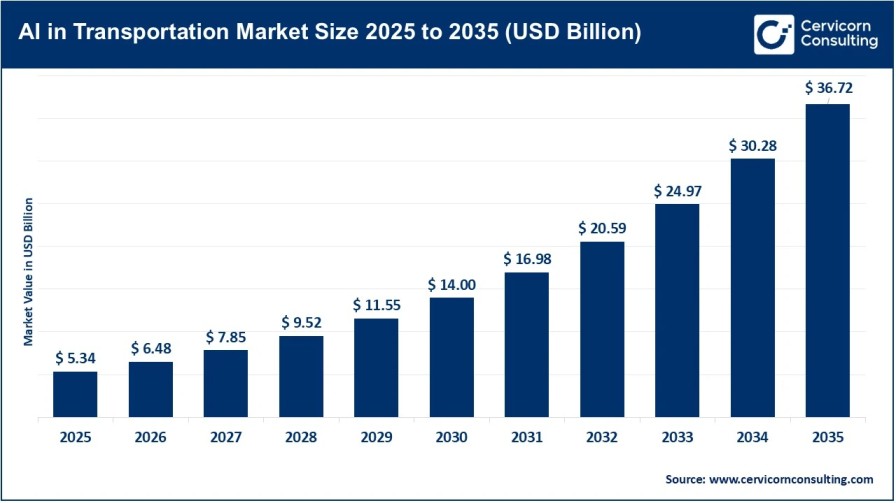
The worldwide AI in transportation market was valued at nearly USD 5.34 billion in 2025 and is projected to grow to approximately USD 36.72 billion by 2035, registering a notable compound annual growth rate (CAGR) of 21.3% throughout the forecast period.
Read a Free Sample: https://www.cervicornconsulting.com/ai-in-transportation-market
What is the AI in Transportation Market?
The AI in transportation market represents a rapidly evolving ecosystem of technologies, software platforms, hardware infrastructure, and services that use artificial intelligence to improve transportation systems, logistics operations, mobility services, and vehicle management. Key technologies supporting this transformation include machine learning, deep learning, computer vision, natural language processing (NLP), predictive analytics, and edge computing.
These AI-powered solutions are increasingly being integrated into autonomous vehicles, smart traffic control systems, fleet management platforms, predictive maintenance tools, intelligent public transportation services, and advanced logistics networks. As transportation infrastructure becomes increasingly connected and data-driven, AI is enabling smarter decision-making, automated vehicle operations, route optimization, and more efficient infrastructure utilization.
Public authorities, vehicle manufacturers, logistics providers, and technology companies are investing significantly in AI-driven transportation technologies to address congestion, safety concerns, environmental challenges, and operational inefficiencies.
Download a free sample report: https://www.cervicornconsulting.com/sample/2968
Key Drivers Accelerating Market Growth
Several important factors are fueling the expansion of the AI in transportation market:
Growing deployment of autonomous and connected vehicle technologies
Rising investments in smart city infrastructure projects
Increasing need for efficient logistics and supply chain management
Continuous breakthroughs in machine learning and computer vision
Strong emphasis on improving road safety standards
Expansion of intelligent transportation and traffic management systems
Increased implementation of predictive maintenance platforms
Rapid urban growth and worsening traffic congestion
Government support for smart mobility initiatives
Greater availability of real-time transportation and mobility data
Expansion of electric vehicle networks and charging infrastructure
Rising demand for operational efficiency and cost savings
Ongoing technological innovation by automotive and technology leaders
Why AI is Essential in Transportation
Improved Safety Standards
Artificial intelligence helps reduce traffic accidents through advanced driver assistance systems (ADAS), collision avoidance technologies, and autonomous driving capabilities that minimize human error.
Smarter Traffic Operations
AI enables transportation agencies to monitor road conditions in real time, optimize traffic signal patterns, and reduce congestion through intelligent traffic management systems.
Increased Efficiency
Transportation companies use AI to optimize routing, improve fleet utilization, reduce fuel consumption, and streamline logistics and delivery operations.
Environmental Sustainability
AI supports sustainable transportation by reducing emissions through optimized route planning, improved traffic flow management, and support for electric and autonomous vehicles.
Enhanced Passenger Experience
Travelers benefit from intelligent navigation tools, accurate arrival forecasts, personalized mobility solutions, and more reliable transportation services.
Cost Savings
Organizations leverage AI-powered analytics to lower maintenance costs, reduce downtime, improve workforce efficiency, and maximize asset performance.
Major Players in the AI in Transportation Market
Several global companies are leading innovation in transportation AI:
Tesla, Inc. develops advanced autonomous driving systems and Full Self-Driving (FSD) technology powered by neural networks.
NVIDIA Corporation provides AI computing infrastructure and its DRIVE platform for autonomous transportation solutions.
Intel Corporation strengthens transportation intelligence through Mobileye, advanced driver assistance systems, and computer vision technologies.
Alphabet Inc. drives autonomous mobility innovation through Waymo and AI-powered mapping capabilities.
Microsoft Corporation offers cloud-based transportation analytics, digital twin technologies, and Azure mobility solutions.
Emerging Trends Influencing Market Development
Autonomous Vehicle Evolution
Autonomous vehicles rely on AI algorithms to process information gathered from cameras, radar, LiDAR, GPS, and other sensors, enabling real-time driving decisions.
Advantages:
Improved road safety
Lower transportation expenses
Reduced traffic congestion
Enhanced mobility access
Intelligent Traffic Management
Urban centers worldwide are adopting AI-powered traffic systems to improve roadway efficiency and optimize transportation planning.
Advantages:
Reduced congestion levels
Lower fuel usage
Faster emergency service response
Improved urban mobility strategies
Predictive Maintenance Technologies
AI-driven predictive maintenance systems help transportation operators identify potential equipment issues before failures occur.
Advantages:
Reduced operational downtime
Lower maintenance spending
Extended equipment life cycles
Improved system reliability
Smart Logistics and Fleet Optimization
AI technologies enhance logistics operations through intelligent route planning, vehicle scheduling, cargo tracking, and warehouse management.
Advantages:
Faster delivery performance
Improved customer satisfaction
Reduced transportation costs
Greater supply chain transparency
Connected Transportation Networks
Vehicles are increasingly becoming connected elements within integrated transportation ecosystems.
Advantages:
Real-time vehicle communication
Better road safety
Enhanced navigation accuracy
Improved traffic coordination
Digital Twin Applications
Transportation organizations are using digital twins to model, monitor, and optimize infrastructure and operational performance.
Advantages:
More accurate planning
Better infrastructure management
Lower implementation risks
Enhanced operational resilience
AI-Powered Public Transit Systems
Transit authorities are implementing AI for scheduling, demand forecasting, passenger analytics, and service optimization.
Advantages:
Better passenger satisfaction
Increased operational productivity
Lower operating expenses
Improved resource utilization
Real-World Applications of AI in Transportation
Waymo Robotaxi Services – United States
Waymo operates one of the world's most sophisticated autonomous ride-hailing platforms, leveraging machine learning and advanced sensor technologies to navigate complex urban environments.
Tesla Full Self-Driving Program – Global
Tesla continuously enhances its autonomous driving capabilities through AI models trained on extensive real-world driving datasets and frequent software updates.
Singapore's Intelligent Mobility System
Singapore utilizes AI-enabled transportation infrastructure to optimize traffic management and improve urban mobility efficiency.
Deutsche Bahn Predictive Maintenance Initiative – Germany
Germany's railway operator uses AI to forecast equipment failures, improve network reliability, and minimize service interruptions.
China's Smart Transportation Infrastructure
China continues to invest heavily in AI-powered highways, autonomous vehicle testing programs, intelligent traffic monitoring systems, and advanced logistics networks.
Port of Rotterdam Smart Logistics Operations – Netherlands
The Port of Rotterdam leverages AI solutions to optimize cargo movement, shipping operations, and overall supply chain efficiency.
Regional Market Insights
North America
North America remains a major market for transportation AI due to strong technological capabilities, substantial autonomous vehicle investments, and advanced infrastructure.
Key Countries: United States and Canada
Europe
Europe's market growth is supported by environmental initiatives, intelligent mobility programs, and strict transportation safety regulations.
Key Countries: Germany, France, United Kingdom, Netherlands, and Sweden
Asia-Pacific
Asia-Pacific is anticipated to experience the fastest growth, fueled by rapid urbanization, smart city development, and significant government investments in AI technologies.
Key Countries: China, Japan, South Korea, India, and Singapore
Latin America
The region is witnessing increasing adoption of AI-driven transportation technologies, particularly in urban mobility and logistics sectors.
Key Countries: Brazil, Mexico, Chile, and Colombia
Middle East & Africa
The market is expanding due to growing investments in smart infrastructure, digital transformation programs, and intelligent mobility solutions.
Key Countries: United Arab Emirates, Saudi Arabia, South Africa, and Egypt
Competitive Landscape and Future Outlook
The AI in transportation market features intense competition among technology providers, vehicle manufacturers, transportation operators, cloud service vendors, and government stakeholders. Leading companies such as Tesla, NVIDIA, Intel, Alphabet, and Microsoft continue investing in autonomous systems, edge computing, cloud-based infrastructure, and advanced transportation analytics.
As governments and businesses increasingly prioritize sustainability, mobility innovation, and transportation safety, AI adoption is expected to accelerate across road transport, railways, aviation, maritime logistics, and public transit systems. This growth trajectory is likely to unlock significant opportunities for market participants over the coming decade.
Explore the complete market report: https://www.cervicornconsulting.com/contact-us