Apple vs Whoop Can A Screenless Apple Band Disrupt Health Wearables
-

- September 24th, 2026
- 78 views
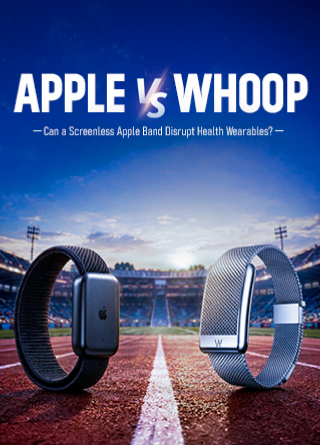
Apple may be exploring a wearable that challenges one of the most familiar ideas in the smartwatch market: that a wearable needs a screen.
According to reports from MacRumors and The Verge, Apple has been experimenting with a screenless health and fitness tracker that could use a fabric strap and a sensor-equipped computing module positioned against the wrist. While the device has not been officially announced, the reported concept has drawn comparisons with WHOOP, a company that has built its wearable business around continuous health tracking without a display.
The potential competition is interesting because Apple and WHOOP have taken very different approaches to wearable technology. Apple Watch has turned the wrist into a miniature extension of the iPhone, complete with notifications, apps, communication tools, fitness features, and health monitoring. WHOOP, on the other hand, has removed the screen almost entirely from the equation and focused on collecting physiological data in the background.
A screenless Apple wearable could represent a shift in Apple's strategy. Instead of adding another display to the wrist, Apple could be developing a device designed primarily around health monitoring, long-term wearability, and data collection.
But there is an important caveat: the product is reportedly still experimental, and Apple has not confirmed that it will ever reach consumers.
Is Apple Really Making a Screenless Fitness Tracker?
At this stage, it is more accurate to say Apple is reportedly testing the idea rather than preparing a confirmed product launch.
Reports indicate that Apple's prototype features a fabric band connected to a small computing module that sits against the wrist. The device is reportedly designed to collect health and fitness information through onboard sensors, including heart-rate data.
However, many important details remain unknown. Apple has not confirmed the product's name, specifications, pricing, battery capacity, software features, or even whether it plans to release the device.
Reports also suggest that the project could still be canceled or changed substantially during development. If Apple eventually decides to commercialize it, the product may not appear before 2028.
That makes comparisons with existing devices slightly unusual. WHOOP 5.0 is already available, while Apple's reported device exists only as a prototype.
Still, Apple's broader health strategy makes the idea less surprising.
The company has been steadily expanding the health capabilities of Apple Watch and the Health app. Apple Watch Series 12 introduced more frequent measurements for metrics such as heart rate and heart rate variability, along with a new Readiness feature. Apple is also expanding the Health app with Health Age, which considers information such as VO2 max, resting heart rate, sleep, and HRV.
These developments are moving Apple deeper into an area where WHOOP has already established its identity: turning continuous physiological data into insights about recovery, readiness, fitness, and overall health.
Why Would Apple Build a Wearable Without a Screen?
At first glance, removing the screen may seem like an unusual decision for Apple.
The Apple Watch has become one of the company's most recognizable products, and its display is central to everything from notifications and messages to workout information and apps.
But a screenless device can serve a different purpose.
WHOOP has spent years promoting the idea that a health wearable does not need to compete for the user's attention. Instead, the device can collect information continuously while the wearer goes about their day.
A similar approach could make sense for Apple if the goal is to create a dedicated health tracker rather than another smartwatch.
A screenless design could provide several potential benefits.
First, the device would not need to constantly display notifications, messages, alerts, or applications. That could make it less distracting than a smartwatch.
Second, eliminating the display could allow Apple to concentrate the hardware around sensors, processing, connectivity, and battery efficiency rather than screen technology.
Third, a simpler design could make the wearable more comfortable for continuous use, particularly during sleep.
There is also another possibility: the device could coexist with a traditional watch. Someone who likes wearing a mechanical or conventional smartwatch could potentially use a screenless health tracker on the other wrist or through another compatible form factor.
That is one of WHOOP's central ideas. Its founder, Will Ahmed, has previously explained that adding a display could turn WHOOP into another watch and undermine the product's purpose.
Apple could potentially adopt the same philosophy.
The market itself also suggests that screenless wearables may have room to grow. IDC expects wristband shipments to reach around 40.2 million units in 2026 and has suggested that screenless health-tracking wristbands could establish a lasting niche even as the broader wristband market faces pressure.
WHOOP 5.0 Vs. Apple's Reported Wearable
Comparing WHOOP 5.0 with Apple's reported prototype requires some caution because one is a shipping product and the other has not been officially announced.
WHOOP 5.0 is built specifically around continuous health and fitness monitoring. It offers more than 14 days of battery life and focuses on metrics related to recovery, sleep, strain, and overall health.
Apple's reported device appears to follow a similar hardware philosophy, but its capabilities remain unknown.
| Category | WHOOP 5.0 | Reported Apple Prototype |
|---|---|---|
| Display | None | None |
| Design | Screenless sensor with fabric band | Reportedly fabric band with computing module |
| Battery | 14+ days | Not disclosed |
| Primary focus | Recovery, sleep, strain, health, coaching | Health and fitness tracking reportedly |
| Heart-rate monitoring | Continuous tracking | Reportedly included |
| Readiness/Recovery | WHOOP recovery and performance system | Apple already offers Readiness through Apple Watch |
| Health Age | WHOOP Age | Apple Health Age available through Apple ecosystem |
| Business model | Membership-based | Unknown |
| Availability | Available now | Unconfirmed; reportedly no earlier than 2028 |
The comparison highlights an important point: Apple would not be entering a category without established competition.
WHOOP already has a product, a health-focused software platform, a subscription model, and years of experience building a wearable around the idea of screenless tracking.
Apple's Biggest Potential Advantage: Its Health Ecosystem
If Apple eventually launches a screenless fitness band, its strongest advantage may not be the hardware itself.
It could be the ecosystem surrounding it.
Apple already has a large network of devices and services that can contribute to health data. Apple Watch works with the iPhone and Health app, while health information can also interact with compatible third-party applications and clinical records.
Apple is also expanding the intelligence built into its Health experience. Its redesigned Health app uses Apple Intelligence to provide personalized insights across areas such as sleep, heart health, readiness, fitness, vitals, and longevity.
A screenless tracker could therefore become another data-collection point within an ecosystem that Apple has already spent years developing.
That could make the device useful without requiring it to duplicate everything an Apple Watch does.
Apple also has a substantial existing smartwatch customer base. IDC reported that Apple accounted for 21.5% of global smartwatch unit shipments in Q1 2026.
That installed base could give Apple an immediate audience for a new health-focused wearable.
However, the same ecosystem could also create a challenge.
Apple would need to clearly explain why consumers should purchase a screenless fitness band when the Apple Watch already offers health tracking, fitness monitoring, apps, and a display.
The product would need a distinct purpose rather than simply becoming an Apple Watch with its screen removed.
Why WHOOP Still Has Experience on Its Side
WHOOP's biggest advantage is that its screenless approach is not a new experiment for the company.
The entire product has been designed around continuous physiological monitoring.
WHOOP 5.0 offers more than 14 days of battery life and supports features designed to make continuous wear easier. Compatible plans can include the Wireless PowerPack, allowing users to charge the device while continuing to wear it.
WHOOP also supports alternative placement through compatible apparel, giving users more flexibility in how they wear the sensor.
The company's software is another major part of the product. WHOOP combines physiological data with analytics and coaching, focusing heavily on sleep, recovery, strain, performance, and broader health trends.
Its subscription structure also connects the hardware with its software experience. In the United States, annual plans currently range from $199 for WHOOP One to $239 for Peak and $359 for Life, with higher tiers offering additional features such as Healthspan and cardiovascular capabilities.
This means Apple would have to compete against more than a piece of hardware.
It would be competing with an established health-tracking platform and a product philosophy that WHOOP has been refining for years.
Is the Screenless Wearable Category Growing?
Screenless fitness trackers are no longer simply a niche experiment.
The category is attracting attention as consumers look for ways to monitor health without adding another device that constantly demands interaction.
Google entered the space in 2026 with the $100 Fitbit Air, which focuses on simplicity, comfort, and continuous health tracking.
WHOOP is also expanding its focus beyond traditional sports and recovery metrics into areas such as longevity and cardiovascular health.
At the same time, Apple is introducing more health-oriented features into its existing ecosystem, including Readiness and Health Age.
These developments point toward a broader shift in wearable technology.
The next stage of wearable competition may not be about adding more screens, notifications, and applications. Instead, some companies may focus on making devices that collect more information while demanding less attention from the user.
That creates an interesting opportunity for Apple.
The company does not necessarily need to invent the screenless wearable concept. WHOOP has already demonstrated that consumers can be interested in a device that effectively disappears into the background.
Apple's challenge would be to bring its own strengths to that concept without losing the simplicity that makes it attractive.
Could Apple's Screenless Band Challenge WHOOP?
A future Apple screenless fitness tracker could potentially compete with WHOOP, but several questions would need to be answered first.
How long would its battery last?
Would Apple require a subscription?
Would advanced health insights be available without an Apple Watch?
Could the device be worn independently from an iPhone?
Would Apple allow users to wear it through clothing or other accessories?
Most importantly, would the device provide meaningful advantages over an Apple Watch?
These questions matter because screenless wearables succeed partly by doing less.
That may sound contradictory, but it is central to the category. A screenless health tracker does not need to replace a smartwatch. It can instead focus on collecting health information continuously while staying out of the user's way.
Apple's reported prototype could therefore become interesting precisely because it would represent a departure from the company's usual approach to wearable technology.
Conclusion
Apple's reported exploration of a screenless fitness tracker suggests the company may be considering a different role for wearables.
Instead of putting another display on the wrist, Apple could focus on sensors, continuous health monitoring, battery life, comfort, and integration with its broader Health ecosystem.
WHOOP has already shown how this model can work. Its screenless design, long battery life, recovery tracking, sleep monitoring, and coaching platform have created a distinctive alternative to traditional smartwatches.
Apple would bring different strengths to the category, particularly its large ecosystem, existing health infrastructure, software capabilities, and established customer base.
But the product remains unconfirmed. Apple has not announced the reported device, its specifications are unknown, and reports indicate that a commercial launch would not happen before 2028.
For now, Apple vs. WHOOP is therefore more of a potential future competition than a direct product battle.
If Apple eventually brings the concept to market, the biggest question may not be whether it can build a screenless fitness tracker.
It may be whether Apple can resist the temptation to turn it into another smartwatch.
In a wearable market filled with screens, notifications, and constant interaction, Apple's most interesting innovation could ultimately be a device designed to stay out of the way.