Build Operate Transfer Model- What Is BOT in IT Outsourcing
-
- Published Updated
- 59 views
When software demands skills, tech leaders face a tough choice in deciding if they should spend months trying to hire local engineers in a tight market or hire temporary contractors who leave as soon as the project finishes.
With traditional outsourcing you get the code. but it leaves you relying on an external vendor for a long time or sometimes forever. This is why the companies that are forward-thinking are going to the (BOT) IT Outsourcing Service.
Understanding the Build Operate Transfer (BOT) model in IT outsourcing
This model is more of a strategy setup where an external partner hires, runs, and scales a dedicated tech team for your business where as soon as everything runs smoothly, the tech team hands you over the full operational and legal ownership.
In simple words, think of it as hiring a skilled local builder to set up your foreign office until it starts making good profit. You do not have to deal with distinct agencies who apply their own set of team cultures as the Build-operate-transfer (BOT) model truly works as an extension of your company.
What really sets this model unique comes down to three main parts:
Custom talent alignment as developers are hired mainly for your stack, product goals and workplace culture.
Zero infrastructure overhead where your partner takes care of local business registration, workspace, payroll and legal compliance.
Eventual full ownership as soon as the contract ends, and every developer, line of code and physical asset moves directly under your brand.
But as a disclaimer know that for a successful BOT model you need to partner with a right software development outsourcing team that can turn vendor fees into permanent operational equity.
The BOT Ownership Transfer Basic Checklist
Download Now
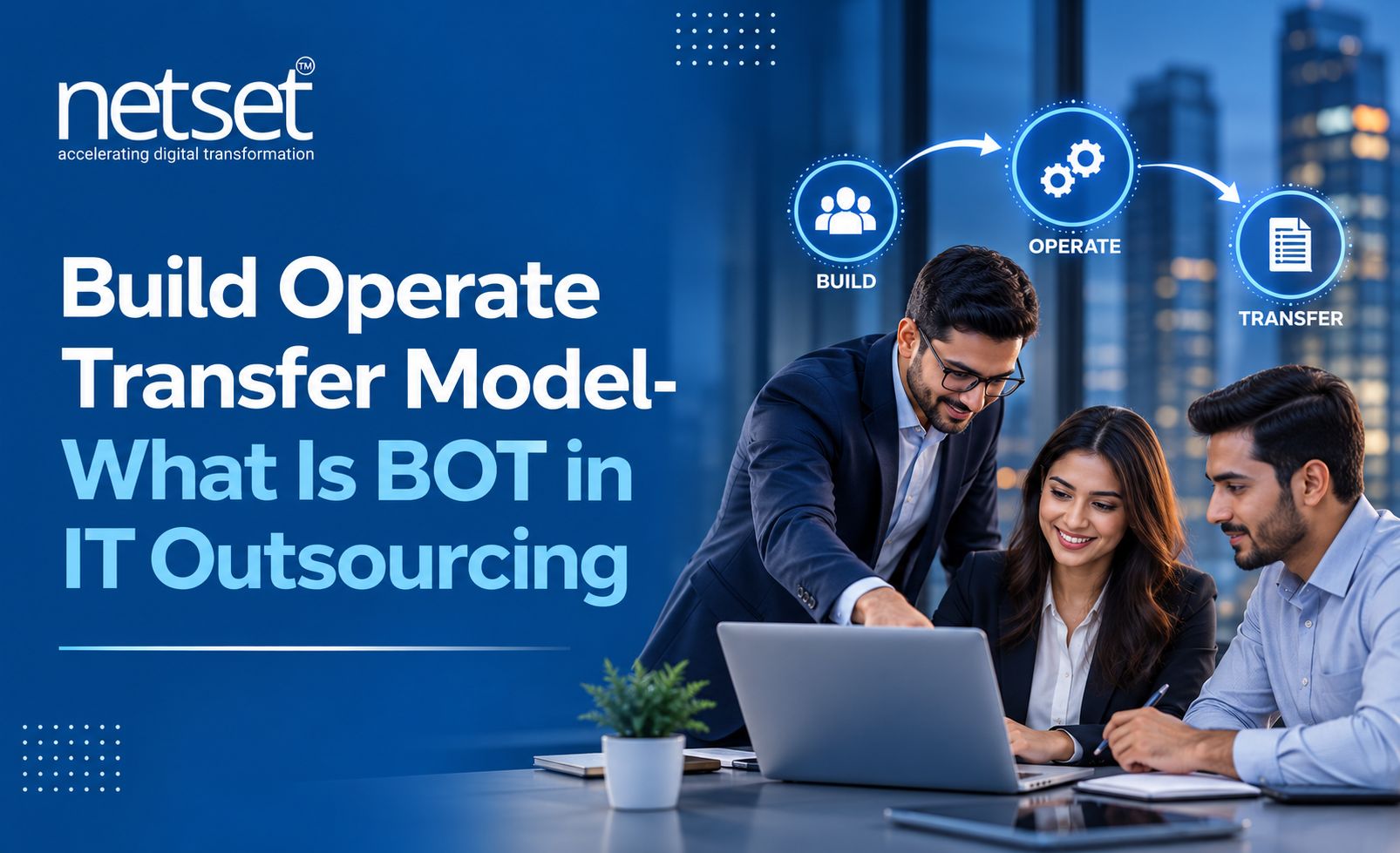
The three phases of how the BOT lifecycle works?
Such an engagement process has to follow some very structured phases because the tech team you hire will take responsibility for your offshore unit and help you reach from zero to total independence normally within an 18-to-36-month timeline.
Phase 1: Build (setting up the groundwork)
This is the first stage with BOT where your tech partner builds out your legal and operational infrastructure layer right from the ground up. They work to bring your local legal entity to life, arrange hardware and office space, and run proper hiring campaigns to add the best engineering talent in your team.
Running hiring campaigns: A proper corporate like sourcing of some of the best developers who meet the skill bar you set for your business.
Environment Setup: Doing a complete set up of your cloud workspaces, CI/CD pipelines and local compliance with the best scalability in mind.
Bringing workflow to life: With your defined agile workflows, the partner makes sure that all the workflow SOPs are prepared as per your product expectations, coding standards and culture expectations right from day one.
Phase 2: Operate (running and stabilising the engine)
As soon as the hiring of a team is done, the tech partner starts managing the daily HR, admin tasks and delivery governance as per the key performance indicators and service level agreements you mentioned. This is the phase where your dedicated offshore development team takes the form of a high-performance engine running your business.
Daily Management: The vendor runs and takes care of payroll, benefits employees get, all the facilities, and compliance with local labour laws.
Optimization of process: Your offshore team constantly puts efforts into bringing stability to the engineering workflows, preparing all the important documentation as standard and making sure the team captures required knowledge for best productivity.
Work under leadership: Your main office takes decisions about the priorities of the product while your tech partner manages the technical nuances and daily operations to achieve those priorities.
Phase 3: Transfer (Handling over the keys)
After a few months, when your tech partner brings your business to a stable level just as you want, then you can take it over with full operational maturity.
Contract Novation: Developer employment contracts move right to your local entity.
IP and Asset Handover: All of the resources that belong to you whether it is code repositories, equipment, licences or the system accesses, they are transferred to you in the handover process.
Post-Transfer Support: Your partner gives short-term support as an advisor to make sure you are able to achieve a seamless handover without delivery hiccups.
BOT vs Traditional Sourcing: Choose your growth strategy
To choose how to scale your engineering team comes down to two main questions:
How fast do you need to move?
Do you later want to own the capabilities?
The simple thing about staff augmentation is that it is fast, but it only fills temporary resource gaps, and the outsourcing vendor gives you completed product or service but the knowledge part stays with the vendor. You can build your own in-house team which will give you total control but of course comes with some big capital investment, may be some legal hurdles, and months of local setup. For a new founder, the process can be rewarding or completely destroy their savings and investments if not done right.
BOT brings the fast setup of traditional outsourcing but with the option for you to take over the control (just like a full-time office with all resources) in the future once the business is proved with stability and profitability.
Prefer Reading : In-House vs. Staff Augmentation- Cost, Speed, Scalability Compared
Scaling Option |
Ownership Transfer |
Upfront Setup Risk |
Time-to-Market |
Long-Term Cost Savings |
Build-Operate-Transfer (BOT) |
Transfer of Full ownership to you from the tech partner as soon as the business reaches the maturity point. |
Low because your tech partner absorbs legal and setup complexity due to the experience they have with scaling businesses. |
Fast as the time frame normally stays between 6 to 10 weeks. |
This stays much higher from 40% to even 60% in savings (as researched by Deloitte) as it removes the traditional margin system. |
Traditional IT Outsourcing |
Vendors keep the team as well as full ownership of the process. |
Low because you outsource all your projects to the third-party vendor. |
Can be instantaneous within a few days as some businesses go for white label solutions too. |
Low because ongoing maintenance of the product keeps on costing to your business. |
Staff Augmentation |
No entity created and suits best for short-term contractors. |
Minimal because you just have to mostly pay for the staff. |
Immediate |
Moderate |
In-House Captive Center |
You are the owner of everything right from day one. |
Very High because you need to set up local legal, real estate, HR setup and other elements from scratch. |
Slow and usually takes more than a year to run operations with stable balance |
High |
When you hire dedicated developers through BOT, you avoid vendor lock-in while building a permanent offshore asset.
Prefer Reading : Staff Augmentation vs Outsourcing vs In-House Development- Which Model Should You Choose
Strategy benefits: Why do tech companies scale with BOT?
Now you must be wondering what is there in Build-Operate-Model that tech leaders go with this framework. Well, there are a number of benefits and once being that it solves all the basic hiring challenges while giving strong financial returns later on.
Notable cost savings and value
Just think that you are going for a senior engineer from the western markets who can cost you around $150,000 every year. Now if you want to build the same level talent team with an offshore centre, the costs are going to go down as per the living expenses like from India, you can bring that cost down by 40 to 60%. As soon as you get the ownership transfers, you can remove vendor margins completely and steer the team on your own.
Faster time to market
If you go for opening a foreign subsidiary on your own then it can easily take up a year of hard effort where you have to take care of everything, learn all the regional regulations, and commute problems. A BOT partner who already has their local networks and HR infrastructure can easily help you build an operational business on profit within just a few months. Hence the time drops notably from a year or more to just a few months and in some cases, weeks depending on what you want them to do.
Scalability without Upfront CapEx
In place of spending a big chunk of investment only for the legal fees (some regions are too strict to open a business), office infrastructure, recruitment agencies, and similar elements, you might run out of budget very easily. There your partner absorbs all of your unnecessary costs so that you can focus on product development and only make the investments that are important.
Total Knowledge Retention
This one is very important as it was one of the main problems with traditional vendors who kept the institutional knowledge with them as soon as the contract ended. Under BOT, every line of code, process standard and architectural decision stays inside the team you eventually own.
Common BOT challenges and fixes to overcome roadblocks
While BOT gives a clear path to ownership, navigating cross-border operations requires active management. Here is how leading software development outsourcing company solve common challenges:
Developer Attrition at Handover
Challenge: Engineers may feel uneasy when employment switches from the vendor to your direct company payroll.
Fix: Start transfer preparations 6 months early, share clear career growth paths, and offer retention incentives.
Cultural and communication friction
Challenge: It can be tough to manage time zone gaps and the difference in the communication styles may slow down velocity of sprint.
Fix: Set up sync overlap hours daily, use common messaging tools, and place a local engineering lead on site.
Intellectual Property and Legal Transfer
Challenge: Vague contracts can create legal confusion over code ownership during handover.
Fix: Make sure that all IP rights are assigned to your company from day one in the initial agreement with regular security audits.
Build your engineering hub with NetSet's outsourcing services
For scaling your software, you are not locked between on-site offices or outsourcing the complete project as you have a third option that is BOT model.
However, for a successful implementation you need a partner who has the relevant experience in this regard. NetSet Software has been in the IT space for the past 2 decades, and is recognized as a trusted software development outsourcing company. We can handle the heavy lifting offshore recruitment, operational management and local compliance for you before finally transferring you the ownership.
You remain the leadership handle to guide your bot outsourcing development team and with our smooth, risk free operational management experience.
So, if you are ready to build your offshore technology hub then all you have to do is contact our team today and get started.
FAQs
What is BOT in IT outsourcing?
Build operate transfer is getting traction lately where a local partner builds, manages and scales your offshore tech team then finally hands over the full ownership and assets to your company at the maturity.
How long does a normal BOT engagement take before transfer?
Most BOT projects run between 18 and 36 months thus giving the team enough time to mature, stabilise delivery, and align with your company culture before handover.
Who owns the code and IP? During the operation phase?
In a well-structured BOT agreement, beneficial IP ownership belongs to your company from day one, with formal legal transfer finalised during the handover.
How does BOT differ from staff augmentation?
The goal of staff augmentation is to add temporary developers to cover short-term skill gaps, but BOT creates a sustaining engineering team that you ultimately own.
How do you prevent developer turnover during the transfer phase?
By beginning handover preparations 6 months in advance, giving clear career progression and offering retention bonuses to make sure there stays job security.