Gojek vs Grab: Business Model Comparison for Startup Founders
-

- Published Updated
- 4,731 views
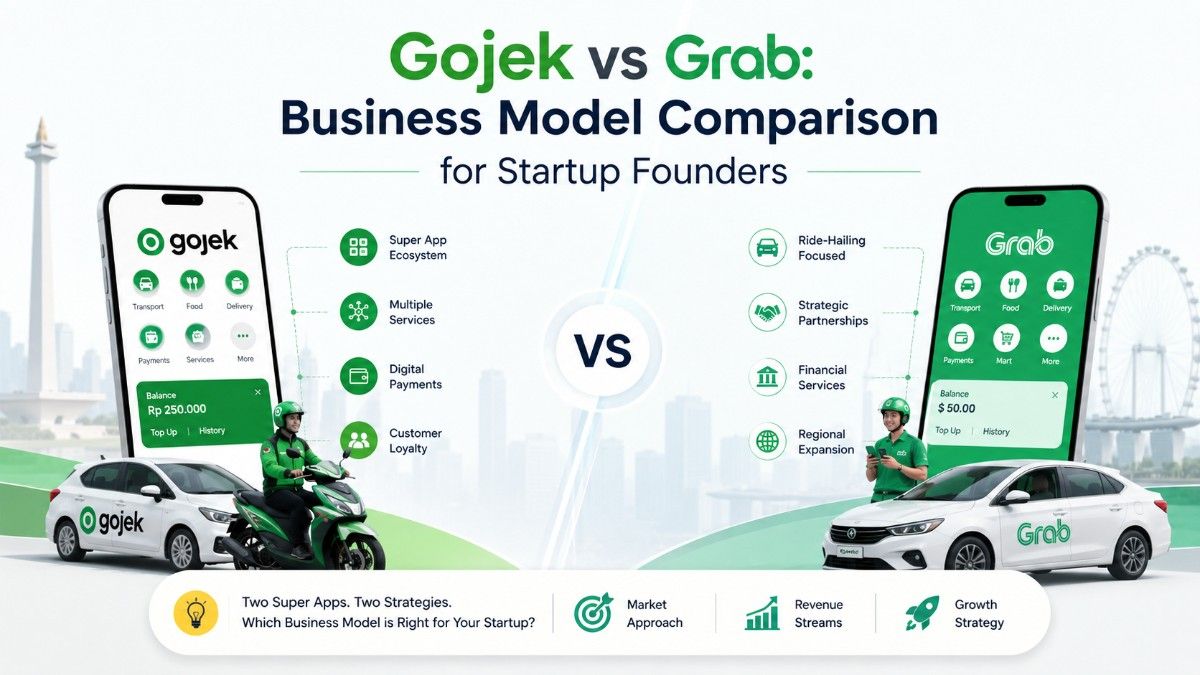
In Southeast Asia, two major super apps are leading — Gojek and Grab, both of which offer a variety of services, including transport, food delivery, and payments. While Gojek and Grab have many similarities in terms of their offerings, they adopt contrasting approaches to business strategy and revenue arrangements.
The difference between them would help aspiring founders and young entrepreneurs navigate how to launch their marketplace businesses. If you are thinking about a custom platform or a Gojek clone app, these strategies can help you make better product decisions.
Gojek vs Grab at a Glance
The table below highlights the major differences between Gojek and Grab.
Feature |
Gojek |
Grab |
Founded |
2010, Indonesia |
2012, Malaysia |
Headquarters |
Jakarta (GoTo Group) |
Singapore |
Primary Market |
Indonesia |
Southeast Asia |
Core Strength |
Deep local ecosystem |
Regional expansion |
Parent Company |
GoTo Group |
Grab Holdings |
Digital Wallet |
GoPay |
GrabPay |
Key Ride Services |
GoRide, GoCar |
GrabRide |
Food Delivery |
GoFood |
GrabFood |
Business Focus |
Local market leadership |
Cross-country scalability |
Both are super apps by definition, but Gojek works on cementing its place in Indonesia while Grab tries to create consistent platform levels across different Southeast Asian markets.
What Are Gojek and Grab?
Gojek and Grab are popular southeast asian tech companies. They provide a single mobile app that provides various services such as transportation, food delivery, courier or parcel delivery, online payment options, and other services. Users looking for those services can connect with available Service providers.
Gojek was founded in Indonesia in 2010. At that time, it built its business around courier and motorcycle ride-hailing services. As time evolved, it started providing multiple on-demand services such as food delivery, parcel service, ride-sharing, home services and other services to customers in Singapore and Indonesia. After merging with Tokopedia, it is now part of GoTo Group.
Grab was founded in 2012 in Malaysia. They were focused on a taxi-booking service. As time evolved, they started providing multiple services such as food delivery, digital payments, financial services, and other services. By the time it became one of Southeast Asia's leading super app companies.
Both companies are examples of the platform economy, where businesses create value by connecting different groups of users instead of owning all the underlying assets.
What is the super app business model?
A super app refers to an app that offers multiple services. People don’t need to install several apps for each service; e.g., they can use one app for taxi services, food delivery, online shopping, payments, and many other services. Hence, its value lies in the convenience, which increases customer retention and creates many opportunities for cross-selling.
The platform business model of Gojek and Grab works on the connections between consumers, drivers, shops, and financial partners. Monetisation of the platforms is possible through commissions from rides, deliveries, payments, and fintech services. The more users join the platform, the more effective it works.
Gojek vs Grab Business Model Comparison
Although Gojek and Grab both serve similar markets, their marketplace strategies differ,
Gojek has a localised marketplace approach in its strategy. The marketplaces of Gojek are designed to address specific challenges in Indonesia, keeping in mind the preferences, practices, and behaviour patterns of its customers.
Grab, on the other hand, uses a regional marketplace model that enables it to operate in Southeast Asia without having to make several changes in its system.
This difference in their strategies impacts almost every aspect of the functioning of the two companies, from product development to marketing techniques.
The clear lesson for entrepreneurs and businesses is that scaling the business requires uniformity and consistency across different countries, while successful completion of projects in one country requires deep localisation.
Services & Ecosystem Comparison
The range of services that the two companies provide leads to elevated customer engagement and various potential revenue streams.
Service |
Gojek |
Grab |
Ride-hailing |
GoRide, GoCar |
GrabRide |
Food Delivery |
GoFood |
GrabFood |
Parcel Delivery |
GoSend |
GrabExpress |
Digital Wallet |
GoPay |
GrabPay |
Financial Services |
Loans, insurance, payments |
Lending, insurance, payments |
The two companies benefit from their cross-service usage. A customer who uses ride-hailing services regularly will likely order food delivery or make a payment with the digital wallet from the company.
Revenue Model Comparison
Gojek and Grab have several revenue sources, such as ride-hailing commissions, delivery fees, merchant commissions, payment services, and fintech products. Grab also has an advertising aspect to its business, while Gojek remains focused on improving its main ecosystem. These strategies result in decreased dependency on only one service and greater sustainability of both companies’ businesses.
Unit Economics Comparison
A healthy unit economy is essential for a sustainable market, rather than a fast-paced economy alone.
Important metrics that are usually considered are:
- Customer Acquisition Costs (CAC) – this is the total cost incurred while attracting a single customer to a business.
- Customer Lifetime Value (CLV) – the total revenue generated from a customer in the long run.
- Market Liquidity– the efficiency of matching customers with drivers and merchants.
Both Gojek and Grab work towards the improvement of these metrics by motivating customers to use several services. When a customer books a ride, orders food, and makes digital payments within the same app, acquisition costs become divided among several revenue sources while lifetime value increases. This makes the overall platform more efficient.
Technology Strategy Behind Each Platform
Neither Gojek nor Grab can be imagined without technology. Technology becomes the basis of both companies’ platforms. Their platforms rely on AI and machine learning to improve efficiency, increase individual user experience, and improve the work of their marketplaces.
Technology is employed to:
- Connect riders with the drivers around.
- Define the fastest route of delivery.
- Implement dynamic pricing based on demand.
- Fraud detection and payment security.
- Provide personalised promotions and recommendations.
Much more important than simply defining which technology they should work with, both companies see how technology can make the operations of their marketplaces not only faster, but also more secure.
Market Expansion and Localisation Strategy
Gojek and Grab both operate in Southeast Asia. They have different strategies for business expansion. Gojek set out to conquer the Indonesian market before expanding carefully into the surrounding areas. Its services are highly adapted for the preferences of local consumers.
Grab, however, has taken a different approach, as it has focused on entering various Southeast Asian markets from the get-go, standardising as much of its operations as possible but still accounting for the local languages used in each country.
This is an important lesson for entrepreneurs to decide whether it is better to establish a business in one market first, or whether to follow the example of Grab to expand quickly in different markets.
Why Gojek and Grab took different strategies
The two companies went in different directions because the markets they operated in were different. Gojek had strong connections to Indonesia’s huge domestic market and was able to create a high level of customer loyalty through successful local services.
On the other hand, Grab wanted to grow much more generally, seeking to become the number one super app in Southeast Asia. This methodology eventually allowed Grab to serve more customers, yet also brought more complications in operations.
Neither approach is universally better. The best option depends on market size, competition level, available resources, and business goal.
How Gojek and Grab Compete Nowadays
Competition between Gojek and Grab has moved beyond ride-hailing.
Gojek and Grab compete with each other in the following areas:
- Transportation Service
- Food delivery Service
- Logistics
- Digital payments
- Financial services
- Merchant services
They have a competitive edge because of the strength of the ecosystem, not any single service. Network effects are more powerful the more services consumers use.
Challenges Facing Both Companies
Running a super app requires onerous expenditures. Both companies face the same types of challenges:
- Spending resources on development while ensuring profitability.
- Balancing Incentives for Users, Drivers, and Retailers.
- Adapting to the changing regulations from the authorities.
- Challenging new businesses and niche apps.
- Managing complex technology infrastructure.
As systems increase in size, the need for sustainable growth becomes more important than the need for rapid growth.
Strengths and Weaknesses of both
Gojek has the advantage of being focused on the Indonesian market. This helps in developing a loyal customer base and gives a good understanding of local customers. But Gojek’s growth potential is limited if it is entirely dependent on one market.
Grab is strong because of its expansion in many Southeast Asian countries. This provides it with opportunities to enter new markets. Having to operate in multiple regions adds complexity and cost to your operations.
In short, Gojek is better at local knowledge while Grab is impressive at being much bigger.
Which Business Model Is Best for Startups?
It depends on the objectives of your business.
Startup Context |
Best Way to Proceed |
Single-country startup |
Localized Gojek-like model |
Multi-country expansion |
Regional Grab-like model |
Limited capital |
Concentrate on the primary service |
Ecosystem vision in the long run |
Develop gradually into a super app |
Hybrid Approach
Many startup companies may benefit from the implementation of a hybrid strategy. Start with one core service that provides a high value proposition in one market, then validate product-market fit before moving into other related services and regions. This would help minimise execution risk while maximising opportunities for long-term growth.
Mistakes Made by Startups That Should Be Avoided
Rather than ensuring that one problem is addressed properly, entrepreneurs focus on building many features together.
The Following are some common mistakes:
- Launching multi-service at starting.
- Ignoring the importance of the liquidity of the marketplace.
- Expansion prior to achieving product-market fit.
- Single revenue stream dependence.
- Not considering the complexity that operations include.
Successful marketplaces often scale step by step rather than aiming to be a super app in one night.
Important Lessons for Entrepreneurs
The variations between Gojek and Grab provide important lessons that can be learned, such as:
- Solve your problems locally before you expand.
- Rather than adding features, make use of technology to improve your operations.
- Expand only after you have validated your marketplace economics.
- Create a network that strengthens the relationship between users, suppliers, and merchants.
- Diversify your revenue instead of holding on to one source of income.
The lessons learned from these services can be applied in various businesses, including ride-hailing, delivery, financial technology markets, and many more to follow.
Conclusion
AI, digital payments, and ecosystem integration will drive the future of super apps. Solve one problem first and then build sustainable unit economics and scale after PMF, not like Gojek or Grab. They care about deep localisation, whereas Grab is an example of the power of regional scale. Your marketplace defines your strategy, your ability to spend money and time growing the business, and where you see it growing in five years.
FAQs
1. How does Gojek differ from Grab?
Gojek is different from Grab because Gojek is mainly operating in Indonesia while Grab is expanding its services to several countries in the Southeast Asia Region.
2. Which company is bigger?
Grab is bigger. It operates in more geographical areas of Southeast Asia, across all markets, whereas Gojek is much stronger historically in Indonesia.
3. Which company makes more money?
That depends on the context. Revenues may be inconsistent on a moment-to-moment basis, as both companies are involved with transport, delivery, digital payment, and finance as well as other industries.
4. What business model do they use?
Both of the companies adopt a platform-based marketplace model in terms of connecting users, drivers, merchants, and banking services through a super app.
5. Why did Uber exit Southeast Asia?
Uber sold its business operations in the Southeast region to Grab in 2018 for Grab to reinforce its position in the region and take its shares in this business.
6. Can Startups Create a Gojek-like Super App?
Yes, but most successful start-ups take in one of a few key services, validate demand, and then expand over time instead of launching multiple services at once.
7. What are the biggest challenges of running a super app?
The key challenges are profit, balance between market players, compliance with laws and regulations, technology in terms of delivery and implementation, and network effects.