Business Analytics Careers Beyond Data Analyst: 7 Roles Management Students Should Know
-

- Published Updated
- 3,336 views
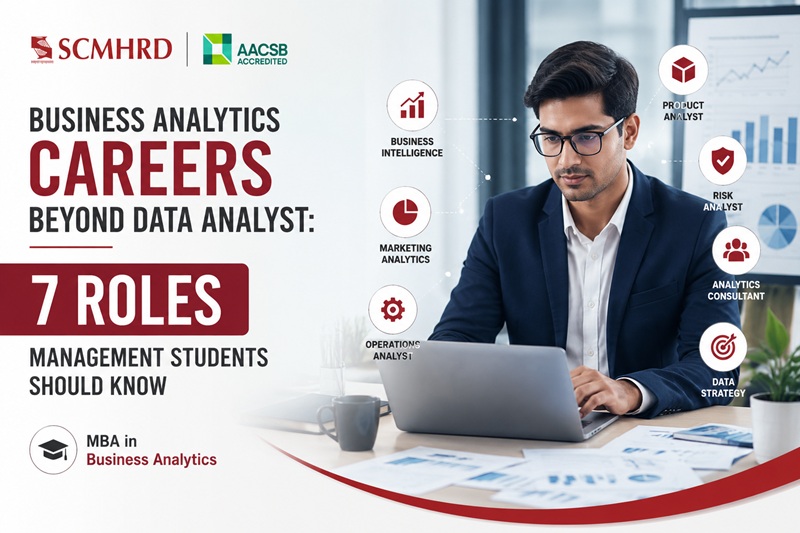
Business analytics careers are much broader than the familiar data analyst role. Companies need professionals who can connect data with marketing, products, finance, operations and strategy. This creates opportunities for management students who enjoy solving business problems but do not necessarily want a purely technical career. Understanding these options can also help students make more informed choices when considering an M.B.A. in Pune.
Why Business Analytics Careers Are Expanding
Businesses now collect data from customer interactions, transactions, digital platforms and internal operations. The challenge is turning this information into decisions.
Analytics professionals therefore need more than technical knowledge. They must understand business context, ask the right questions and explain findings clearly to decision-makers.
An M.B.A. focused on analytics combines these perspectives. SCMHRD, for example, describes its programme as combining conceptual and practical business analytics knowledge with management theory and corporate exposure. Students considering an M.B.A. in business analytics should therefore look beyond the data analyst title when planning their careers.
1. Business Intelligence Analyst
A business intelligence analyst turns organisational data into dashboards, reports and performance insights.
The role often involves tracking KPIs and identifying trends that managers need to understand. Data visualisation and business thinking are especially important because the goal is not simply to create a dashboard. The analyst must help people understand what the numbers mean.
2. Product Analyst
Product analysts study how customers interact with digital products or services.
They might analyse which features people use, where users leave a journey or whether a product change improves engagement. This career can suit students interested in technology, customer behaviour and data-driven product decisions.
3. Marketing Analytics Specialist
Marketing analytics professionals examine campaign, customer and sales data.
Their work can involve customer segmentation, campaign measurement and studying buying behaviour. A marketing analytics specialist may also help teams understand which channels or customer groups deserve greater attention.
This role blends marketing knowledge with quantitative thinking.
4. Risk Analyst
Risk analysts use data to identify and evaluate possible business or financial risks.
Banks, financial services firms and other organisations use risk analysis to support decisions around customers, investments and operations.
Students interested in this career benefit from statistics and analytical skills, but they also need to understand how business decisions create different types of risk.
5. Operations Analyst
Operations analysts study how processes perform.
They may examine inventory, productivity, supply chains, resource utilisation or service delivery. Their objective is usually to identify inefficiencies and recommend improvements.
This career may appeal to students who like structured problem-solving and want their analysis to influence how a business operates every day.
6. Analytics Consultant
Analytics consultants solve data-related business problems across clients, teams or industries.
One assignment might involve customer analytics, while another could focus on operational performance or business strategy. Consultants need analytical skills, but communication is equally important because recommendations must make sense to senior stakeholders.
SCMHRD also highlights data strategy consulting among the career pathways associated with business analytics.
7. Data Strategy Professional
Data strategy moves beyond individual reports or models. Professionals in this area think about how an organisation should use data across the business.
Questions may include which data should be collected, how teams should access it and where analytics could improve decision-making.
This path can become particularly relevant as professionals gain experience because it requires both analytical understanding and a wider view of business strategy.
Which Business Analytics Career Fits You?
Your choice should reflect the type of problem you enjoy solving.
Choose BI if dashboards and performance measurement interest you.
Consider product analytics if you enjoy technology and user behaviour.
Explore marketing analytics if customers and campaigns interest you.
Look at risk analytics if you prefer finance and structured assessment.
Consider operations analytics if process improvement appeals to you.
Explore consulting if you enjoy varied business problems.
Think about data strategy if you want to connect analytics with larger business decisions.
Conclusion
Business analytics is no longer limited to traditional reporting roles. It now supports decisions across products, marketing, finance, operations and strategy, which means management students need both analytical skills and a strong understanding of business context.
The M.B.A. in Business Analytics at Symbiosis Centre for Management and Human Resource Development (SCMHRD) is designed around this need. The programme offers exposure to tools such as Python, R, SQL, Tableau, Generative AI and other analytics platforms, along with live projects, case competitions and industry collaborations. As AI becomes a larger part of business decision-making, this mix of management learning and hands-on analytics experience can help students prepare for roles that go beyond the conventional data analyst profile.