Schools in Jaipur CBSE: How to Compare Academics, Routine and Student Support
-

- August 18th, 2026
- 2,305 views
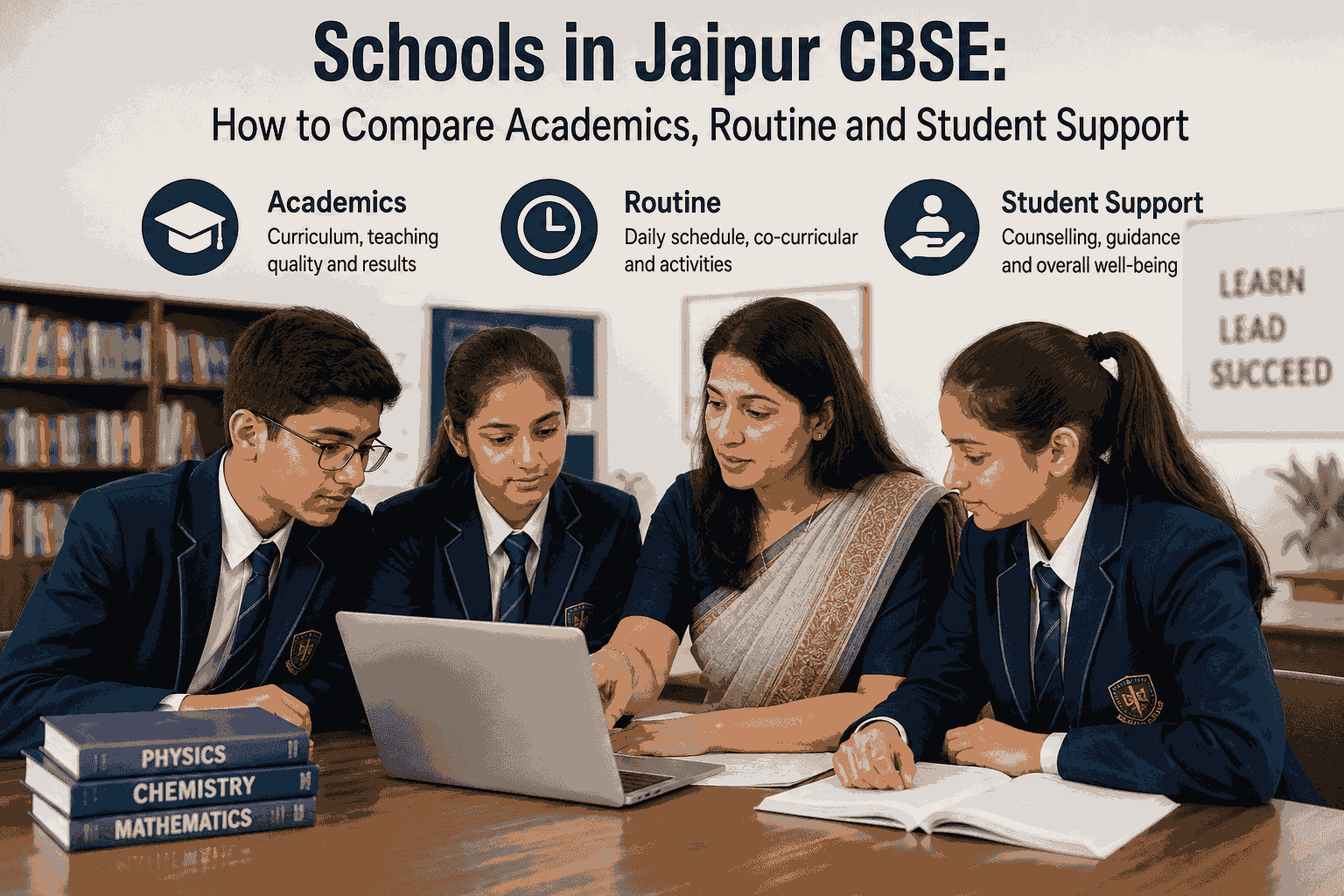
Parents searching for schools in Jaipur CBSE are often comparing schools that follow the same board but operate very differently from one another. The CBSE label tells you the academic framework. It does not tell you how a school structures the day, measures progress, supports a student who falls behind, communicates with parents or approaches Grades 11 and 12.
A useful comparison therefore starts with three areas: academics, daily routine and student support. Look at how teaching and assessments work, how manageable the complete school day is, and what happens when a child needs additional guidance.
SCOTLE HIGH SCHOOL is a CBSE-affiliated K-12 school on Sirsi Road, Jaipur. Its School Integrated Programme (SIP) for Grades 11 and 12 coordinates the CBSE board syllabus with specified competitive exam preparation within school hours.
This guide explains how Jaipur parents can compare CBSE schools using practical questions rather than relying on the board name alone.
How Should Parents Compare CBSE Schools in Jaipur?
Start by confirming CBSE affiliation, Grade coverage and subject options. Then examine what the student actually experiences each week.
For academics, ask how frequently students are assessed, how quickly feedback is returned and what happens after a weak area is identified. For routine, calculate school hours, travel, homework and any additional tuition or coaching. For student support, look at academic follow-up, career counselling and the channels available when either the student or parent needs help.
Senior-school families should also examine attendance and entrance-exam preparation together. CBSE mandates a minimum 75 per cent attendance for board examination eligibility under its Examination Bye-Laws (CBSE, 2024).
The same board can sit behind very different daily systems. Parents should compare those systems.
Key Takeaways
- CBSE affiliation establishes the board framework, but schools can differ considerably in timetable design, assessments, student support and parent communication.
- Assessment should be judged by what happens after the test, including the speed and usefulness of feedback, rather than by test frequency alone.
- CBSE requires at least 75 per cent attendance for board examination eligibility, so the practical weekly routine matters particularly in Grades 11 and 12.
- Jaipur parents should calculate the complete student day, including school, commuting and any separate tuition or competitive exam preparation.
1. Confirm the CBSE Basics First
The first stage is factual.
Before comparing teaching styles or programmes, confirm that the school is CBSE-affiliated and establish which Grades it currently serves.
Parents considering continuity through secondary or senior secondary school should also ask whether the school offers the Grades and subject choices they expect their child to need later.
A basic comparison might include:
| Area | What parents should verify |
|---|---|
| Board | Current CBSE affiliation |
| Grade coverage | Which Grades the school serves |
| Senior secondary | Whether Grades 11 and 12 are available |
| Streams | Relevant Science, Commerce or other subject options |
| Academic continuity | How the programme changes in higher Grades |
Do not let the CBSE label end the comparison.
Two schools following the same board can organise teaching, assessments and student support very differently.
At SCOTLE, the school is CBSE-affiliated, serves K-12 and has affiliation number 1731084.
2. Compare the Academic System, Not Just the Syllabus
Parents naturally ask what a school teaches.
It is equally useful to ask how the school knows whether the student has learnt it.
A clear academic system should make it possible to answer three questions.
How often is progress checked?
Assessment frequency gives parents one indication of how regularly the school reviews learning.
How useful is the feedback?
A score tells you how a student performed. It does not necessarily tell you where the difficulty lies.
Ask whether feedback is available by subject or topic and how quickly it reaches the student.
What happens next?
This is the important part.
If a student repeatedly struggles in one area, how is that pattern noticed? What does the teacher do with the information? When does the parent become involved?
The number of examinations is therefore not a useful comparison on its own.
At SCOTLE, the academic structure includes weekly assessments and bi-weekly comprehensive tests. Results are shared the same day with subject-wise analysis. A separate Foundation programme operates in Grades 9 and 10.
Parents can use the same questions elsewhere: what is assessed, when does the student receive feedback and what happens after a weakness is found?
3. Ask What an Ordinary School Day Actually Looks Like
A timetable can tell you things that a brochure cannot.
Ask each school to explain an ordinary weekday.
What time does the child arrive? When does formal instruction finish? How much work continues after school? Does the routine change significantly in Grades 9 and 10? What happens in Grades 11 and 12?
For younger students, a steady routine may be one of the larger considerations.
For senior-school students, the calculation becomes more complicated because school may be followed by tuition or competitive exam preparation.
Write the whole day down:
Travel to school + school hours + additional academic commitments + travel home + independent study
A schedule can look manageable when each part is considered separately and exhausting when the parts are combined.
This is particularly relevant in Jaipur. The local context in SCOTLE's guidelines notes temperatures around 40 to 45°C between April and June, when many families are also making admission and senior-school decisions.
Commute is not separate from learning. It affects the time and energy available for it.
4. Look Closely at Student Support
"Student support" can mean almost anything unless the school explains the process.
Parents should make the term specific.
Ask what happens when:
- a student performs poorly in one assessment;
- the same subject remains weak over several weeks;
- a student becomes uncertain about subject choices;
- a family needs clarification about academic progress;
- a senior-school student has difficulty balancing different academic demands.
A useful system should identify where the question goes and what happens next.
Student support is also not one single function.
Academic support helps address learning gaps.
Career counselling helps students think through subjects and future pathways.
Parent communication gives families a formal way to understand progress or raise concerns.
These should be compared separately.
At SCOTLE, career counselling begins from Grade 8 onwards with an IC3-certified counsellor. Foundation academic support begins separately in Grade 9.
That separation is worth asking about in every school you compare.
5. Examine Grades 11 and 12 as a Separate Decision
Senior secondary school changes the comparison.
For some students, CBSE board preparation is the main academic priority. Others may also be preparing for JEE Main, NEET, CUET, IPMAT, CA Foundation or another examination.
Parents should not evaluate these as unrelated decisions.
Instead, map the whole system.
Ask:
- Which streams and subjects are offered?
- How is CBSE board teaching scheduled?
- Which competitive examinations are actually supported?
- Does preparation happen during school hours or separately?
- Will the student study overlapping material in two places?
- How many separate assessment schedules will the student follow?
- Does the model require a second commute?
- How much independent study time remains?
The overlap between curricula makes this relevant. SCOTLE's verified guidelines cite NTA 2025 data stating that around 60 to 70 per cent of the JEE Main syllabus overlaps with the CBSE Grade 11 and 12 Physics, Chemistry and Mathematics curriculum.
At SCOTLE, SIP coordinates board topics and competitive-exam concepts within school hours from 7:30 AM to 3:30 PM. Science SIP covers Physics, Chemistry, Mathematics or Biology alongside JEE Main, NEET and CUET preparation. Commerce SIP covers Accountancy, Business Studies and Economics alongside CUET, IPMAT and CA Foundation preparation.
SCOTLE does not provide JEE Advanced preparation.
An integrated model is not automatically a better fit. A student who responds well to the external accountability of a dedicated coaching environment may prefer a separate system. SCOTLE's own guidelines recognise this trade-off.
The format should follow the student.
6. Compare Career Guidance Before Stream Selection
The Grade 10 result can turn career planning into a compressed family discussion.
Relatives recommend streams. Friends make choices. Coaching counsellors discuss programmes. The student may still be working out where their interests lie.
Parents can reduce some of that pressure by asking what guidance happens earlier.
Useful questions include:
- When does career counselling begin?
- Who conducts it?
- Is it available before Grade 11 stream selection?
- Are parents included in the process?
- Is counselling distinct from exam preparation?
- Can students discuss more than one possible pathway?
Career counselling should not be confused with deciding on behalf of the student.
Its value lies in creating more clarity before a significant academic choice has to be made.
Jaipur adds another local consideration. Families interested in competitive exams may also be weighing whether the student should remain in Jaipur, combine school with coaching or move towards the Kota route.
The earlier that conversation is structured, the less it depends on a last-minute recommendation.
At SCOTLE, the Career Counselling Cell begins from Grade 8 onwards.
7. Check How Parents Are Kept Informed
Parent communication is another area where quantity can be misleading.
Receiving frequent messages does not necessarily give a parent a clear picture of academic progress.
Ask instead:
- How are assessment results shared?
- Does the parent receive subject-wise information?
- How are PTMs structured?
- Where should an academic question be raised?
- What happens when a concern needs follow-up?
- Is there formal parent representation?
- Are mandatory school disclosures accessible?
A good communication system should make the route clear before a problem occurs.
At SCOTLE, the Parent Collaboration Programme provides structured channels for questions and feedback. Its PTA has 18 members with parent representation, and mandatory disclosures are published on the school website.
The comparison should not be "Which school sends more updates?"
It should be "Which school gives parents useful information through a clear process?"
A Practical Comparison Checklist for Jaipur Parents
Use the same checklist for every school on your shortlist.
| Factor | Question to ask |
|---|---|
| CBSE affiliation | Is the school's current CBSE status clear? |
| Grade coverage | Does it cover the Grades my child may need? |
| Daily routine | What does an ordinary school day look like? |
| Assessment | How frequently is learning checked? |
| Feedback | How quickly and specifically is feedback provided? |
| Academic support | What happens when a student falls behind? |
| Career guidance | When does counselling begin? |
| Grades 11 and 12 | How are senior-school academics structured? |
| Competitive exams | How do they fit with board study? |
| Attendance | Is the complete schedule compatible with regular school attendance? |
| Commute | What is the real daily door-to-door travel time? |
| Parent communication | How are progress and concerns handled? |
| Fees | Have we obtained current information directly from the school? |
| Student fit | Can my child realistically follow this routine? |
That last question connects everything else.
A school can have a clear academic structure and still be the wrong fit for a particular student. Another family may look at the same system and reach the opposite conclusion.
Both decisions can be reasonable.
Conclusion
Parents comparing schools in Jaipur under CBSE should look beyond the board label and examine the academic system around it. Teaching, assessment, student support, commuting, parent communication and senior-school planning all shape the child's actual experience.
The useful choice is the one whose routine and support structure make sense for the student and family using them every day.
For current information about SCOTLE programmes or admissions, visit www.scotle.org, email [email protected] or call +91-9116001115.
Frequently Asked Questions
1. What should parents check when comparing schools in Jaipur CBSE?
Start with CBSE affiliation, Grade coverage and subject options, then compare the daily timetable, assessment process, academic support, career counselling, commute and parent communication. For students approaching Grades 11 and 12, parents should also examine attendance requirements and how board study fits with any competitive exam preparation. The same board does not mean every school provides the same daily academic experience.
2. Are all CBSE schools in Jaipur academically similar?
No. Schools following CBSE may share the board framework, but the way they organise teaching, assessments, feedback, academic support and the school day can differ. Parents should therefore ask each school to explain what an ordinary week looks like and how it responds when a student struggles. The delivery system matters alongside the syllabus.
3. How should parents judge academic support in a school?
Ask what happens after a student performs poorly, not only how frequently tests are conducted. Find out how quickly teachers identify recurring weaknesses, what feedback reaches the student, when parents are informed and what follow-up process exists. A useful support system should make those mechanics clear rather than relying on general descriptions of academic care.
4. What should parents consider for Grades 11 and 12?
Parents should compare subject choices, board preparation, attendance, assessment frequency, career direction and competitive exam preparation as one combined routine. If preparation for JEE Main, NEET, CUET or another examination happens outside school, include that additional travel and timetable in the decision. At SCOTLE, SIP coordinates specified board and competitive-exam preparation within the school day.
5. How can parents contact SCOTLE for current admission or fee information?
Current information should be obtained directly through SCOTLE's official channels rather than relying on older third-party listings. Parents can visit www.scotle.org, email [email protected] or call +91-9116001115. SCOTLE does not publish fee figures or fee ranges in blog content.