CO2 Separation Membrane Market Growth, Trends, and Forecast 2026–2035
-
- Published Updated
- 7,044 views
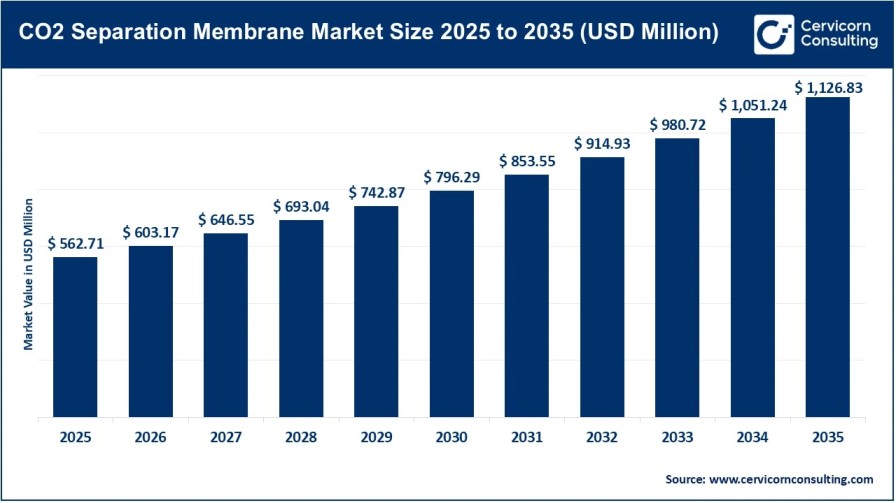
CO2 Separation Membrane Market Size and Future Growth Prospects
The worldwide CO2 separation membrane market was valued at nearly USD 562.71 million in 2025 and is expected to grow to approximately USD 1,126.83 million by 2035, advancing at a CAGR of 7.2% over the forecast period. The market's expansion is being driven by the growing need for efficient carbon management solutions and increasing adoption of advanced gas separation technologies across multiple industries.
Read a Full Report: https://www.cervicornconsulting.com/co2-separation-membrane-market
Importance of the CO2 Separation Membrane Market
As industries and governments intensify efforts to reduce carbon emissions and meet climate objectives, CO2 separation membranes have emerged as a key technology in the decarbonization landscape. These specialized membranes are designed to selectively extract carbon dioxide from industrial gas streams, helping organizations lower greenhouse gas emissions while enhancing process performance and operational efficiency.
CO2 separation membranes are widely deployed in applications such as natural gas treatment, renewable natural gas (RNG) production, hydrogen manufacturing, and carbon capture, utilization, and storage (CCUS) projects. In addition to their environmental benefits, these systems offer advantages such as lower energy consumption, compact installation requirements, and scalability, making them an attractive alternative to traditional gas separation methods.
Primary Factors Driving Market Growth
The CO2 separation membrane industry continues to gain momentum due to increasing investments in carbon capture infrastructure, stricter environmental regulations, rising adoption of biogas upgrading technologies, and growing demand for low-carbon hydrogen production. Market growth is also supported by innovations in polymeric, ceramic, mixed-matrix, and graphene-enhanced membrane materials that improve separation performance and reliability.
Additional growth contributors include expanding natural gas processing operations, supportive government policies aimed at industrial decarbonization, and increasing corporate commitments to achieving net-zero emissions. Ongoing technological developments are enhancing membrane selectivity, permeability, durability, and cost efficiency, leading to broader deployment across industrial sectors.
Request a Free Sample Report: https://www.cervicornconsulting.com/co2-separation-membrane-market
Competitive Landscape
The market is characterized by the presence of membrane technology innovators, engineering solution providers, specialty material manufacturers, and industrial gas companies. Industry participants are focusing on research and development, strategic alliances, pilot-scale demonstrations, and commercialization of next-generation membrane technologies to strengthen their competitive advantages.
Key Market Participants
BORSIG GmbH
BORSIG GmbH specializes in industrial gas separation membrane systems used in natural gas processing, petrochemical operations, and carbon capture applications. The company is recognized for its customized membrane solutions designed to address complex industrial requirements and maintains a strong presence throughout Europe, the Middle East, and Asia-Pacific.
Pall Corporation
Pall Corporation is a leading provider of filtration and membrane separation technologies serving industrial gas purification, carbon management, and sustainable manufacturing applications. As part of Danaher Corporation, the company operates extensively across North America, Europe, and Asia-Pacific.
Toray Industries, Inc.
Toray Industries is among the industry's leading innovators in polymeric and carbon-based membrane technologies. The company develops solutions for carbon capture, environmental protection, and biogas upgrading. Its investments in advanced all-carbon membrane technologies have strengthened its global market position. Toray reported total corporate revenues of approximately USD 18–20 billion in 2025 and operates in more than 30 countries.
UBE Corporation
UBE Corporation is a prominent supplier of gas separation membrane technologies, particularly for biomethane production and sustainable energy projects. Its expertise in polyimide membrane systems has enabled the company to establish a solid footprint across Asia, Europe, and the Americas. Estimated corporate revenue is approximately USD 4–5 billion.
NGK INSULATORS, LTD.
NGK INSULATORS focuses on advanced ceramic membrane technologies for industrial gas separation and carbon capture applications. Its innovations in ceramic materials have positioned the company as an important technology provider serving industrial customers worldwide. Estimated annual corporate revenue is around USD 4–5 billion.
Note: Revenue figures represent total company revenues, as specific revenue generated from CO2 separation membrane operations is generally not disclosed. Market share estimates are indicative due to the fragmented nature of the industry.
Emerging Trends Influencing Market Growth
Rising Investment in CCUS Infrastructure
Governments and industrial organizations are significantly increasing investments in carbon capture, utilization, and storage (CCUS) projects. Membrane technologies are gaining preference because they offer lower energy requirements, operational flexibility, and smaller footprints compared with conventional solvent-based systems.
Market Impact
- Greater deployment across power generation facilities
- Expansion of industrial carbon capture projects
- Increased investments in membrane production capabilities
Expansion of Biogas Upgrading Applications
Growing utilization of agricultural waste, landfill gas, and wastewater-derived biogas is driving demand for membrane systems capable of producing high-purity biomethane.
Market Impact
- Higher adoption in renewable energy projects
- Increased demand for modular membrane technologies
- Expanded opportunities across Europe and North America
Progress in Carbon-Based Membrane Technologies
Manufacturers are investing heavily in graphene-enhanced and all-carbon membrane solutions that deliver improved permeability and selectivity.
Market Impact
- Improved separation performance
- Reduced operating costs
- Enhanced commercial competitiveness
Growing Integration with Hydrogen Production
The rapid expansion of the hydrogen economy is creating new opportunities for membrane technologies, especially in blue hydrogen facilities where carbon capture is essential.
Market Impact
- New revenue streams for membrane suppliers
- Stronger partnerships between hydrogen and membrane technology providers
- Growth in industrial gas processing applications
Adoption of AI and Digital Monitoring Technologies
Industrial operators are increasingly implementing artificial intelligence and predictive analytics tools to improve membrane efficiency and extend equipment lifespan.
Market Impact
- Reduced maintenance expenses
- Improved reliability and uptime
- Enhanced operational productivity
Successful Global Applications
Natural Gas Processing in North America
The United States has become a leading adopter of membrane-based CO2 removal systems in natural gas processing operations. These technologies help producers meet pipeline specifications while lowering energy use and operating costs.
Biogas Upgrading in Germany
Germany extensively utilizes membrane technologies to convert biogas into biomethane, supporting renewable energy objectives and carbon neutrality commitments.
Industrial Carbon Capture Projects in Japan
Japanese companies including Toray, UBE, and NGK have developed advanced membrane solutions for carbon capture applications, improving capture efficiency and supporting commercialization efforts.
Renewable Natural Gas Projects Across Europe
Wastewater treatment facilities and landfill operators across Europe increasingly deploy membrane systems to upgrade biogas into renewable natural gas, supporting circular economy initiatives and improving waste-to-energy economics.
Regional Market Analysis
North America
North America remains a major market due to strong CCUS investments, extensive natural gas production infrastructure, and supportive government policies.
Key Policy Initiatives
- Carbon capture tax incentives
- Federal support for CCUS demonstration projects
- Hydrogen production funding programs
- Industrial decarbonization incentives
Europe
Europe continues to lead in sustainable technology adoption through ambitious climate policies and substantial renewable energy investments.
Key Policy Initiatives
- European Green Deal
- Net-Zero Industry Act
- Carbon Border Adjustment Mechanism (CBAM)
- Emissions Trading System (ETS)
Asia-Pacific
Asia-Pacific is expected to register the fastest market growth, driven by rapid industrialization, expanding hydrogen infrastructure, and increasing environmental commitments.
Key Policy Initiatives
- China's 2060 carbon neutrality target
- Japan's Green Growth Strategy
- South Korea's carbon-neutral industrial transformation plans
- India's National Green Hydrogen Mission
Middle East & Africa
The region is experiencing increased adoption of membrane technologies due to investments in hydrogen production and carbon capture projects.
Key Policy Initiatives
- National hydrogen development strategies
- Carbon capture investment programs
- Economic diversification initiatives
Latin America
Latin America is emerging as a promising market supported by renewable energy expansion and growing biogas production activities.
Key Policy Initiatives
- Renewable natural gas promotion programs
- Clean energy transition policies
- Waste-to-energy development incentives
Future Opportunities
Several developments are expected to generate substantial opportunities for market participants during the coming decade:
- Expansion of large-scale CCUS infrastructure
- Growth of renewable natural gas networks
- Development of blue and green hydrogen ecosystems
- Commercialization of graphene-enhanced and mixed-matrix membrane technologies
- Rising industrial decarbonization investments
- Greater adoption across cement, steel, and chemical industries
- Introduction of cost-effective, high-performance membrane materials
- Integration of digital monitoring and predictive maintenance solutions
As governments, industries, and investors continue prioritizing sustainability and emissions reduction goals, CO2 separation membrane technologies are expected to become a critical component of the global transition toward a low-carbon economy.
For Customized Research and Comprehensive Market Insights: https://www.cervicornconsulting.com/contact-us