Simple Guide to Using a Concrete Calculator Effectively
-
- May 03rd, 2026
- 5,744 views

FREE SEO Topical Map Generator: Find Your Next Content Ideas
When you are planning any construction work, whether it is building a house, making a driveway, or creating a small garden path, one thing you must calculate carefully is the amount of concrete needed. This is where a Concrete Calculator becomes very useful. It helps you estimate the exact quantity of concrete required for your project. Without proper calculation, you may end up wasting money by ordering too much material or delaying your project by ordering too little.
A Concrete Calculator is a simple tool that uses basic measurements like length, width, and depth to give you an accurate estimate. It removes confusion and helps both beginners and professionals work more efficiently. In this article, you will learn everything about using a concrete calculator in very simple language. We will explain how it works, why it is important, and how you can use it correctly.
Understanding Basics of Concrete Calculation
Before using a Concrete Calculator, it is important to understand the basics of concrete calculation. Concrete is usually measured in cubic units, such as cubic meters or cubic feet. This means you are calculating volume, not just area.
To calculate concrete manually, you need three measurements:
- Length
- Width
- Depth (or thickness)
The formula is simple:
Volume = Length × Width × Depth
For example, if you want to build a slab that is 10 feet long, 5 feet wide, and 0.5 feet thick, the volume will be:
10 × 5 × 0.5 = 25 cubic feet
This is exactly what a Concrete Calculator does for you automatically. It saves time and reduces mistakes. Many people find manual calculation confusing, especially when dealing with different units like inches, feet, or meters. A calculator handles all conversions for you.
Another important thing to understand is that concrete is not always used in perfect shapes. Sometimes, you may need to calculate for round columns, footings, or irregular areas. A good concrete calculator includes options for different shapes, making your job easier.
In short, understanding the basics helps you trust the results of a Concrete Calculator and use it more effectively.
Why Concrete Calculator Is Important Tool
A Concrete Calculator is not just a helpful tool—it is an essential part of any construction project. Whether your project is big or small, accurate calculation can save both time and money.
First, it helps avoid waste. Concrete is expensive, and once it is mixed, it cannot be stored for later use. If you order too much, you lose money. If you order too little, your work stops, and you have to reorder, which delays the project. A concrete calculator gives you the right estimate, reducing this risk.
Second, it improves planning. When you know exactly how much material you need, you can plan your budget better. This is especially important for homeowners who are working within a limited budget.
Third, it increases efficiency. Workers can complete their tasks smoothly when materials are available in the right quantity. There is no need for last-minute changes or interruptions.
Another benefit is accuracy. Manual calculations can lead to mistakes, especially when dealing with large projects. A Concrete Calculator removes human error and provides reliable results.
Finally, it is very easy to use. Most calculators are online and free. You just enter your measurements, and the result appears instantly.
In simple words, using a concrete calculator is a smart decision for anyone involved in construction.. https://onlineconcretecalculator.com/
How to Use Concrete Calculator Properly
Using a Concrete Calculator is very simple, but you need to follow the correct steps to get accurate results. Many people make small mistakes while entering data, which can lead to wrong calculations.
First, measure your area carefully. Use a measuring tape to get the exact length and width. For depth, make sure you measure how thick the concrete layer will be. Even a small mistake in measurement can change the final result.
Second, choose the correct shape in the calculator. Most concrete calculators offer options like slab, column, footing, or circular area. Select the one that matches your project.
Third, enter your measurements in the correct units. Some calculators use feet and inches, while others use meters. Make sure you are using the right unit system to avoid confusion.
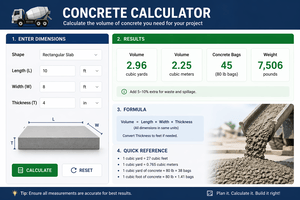
After entering all details, the calculator will show the volume of concrete required. Some advanced calculators also show the number of cement bags, sand, and gravel needed.
It is also a good idea to add a little extra, usually around 5% to 10%, to cover waste or uneven surfaces. This ensures you do not run out of material during the work.
By following these simple steps, you can use a Concrete Calculator properly and get accurate results every time.
Common Mistakes While Calculating Concrete
Even though a Concrete Calculator is easy to use, people still make mistakes that can affect their project. Knowing these common mistakes can help you avoid them.
One of the most common errors is incorrect measurement. If your length, width, or depth is wrong, the final calculation will also be wrong. Always double-check your measurements before entering them into the calculator.
Another mistake is ignoring unit conversion. For example, mixing inches with feet or meters can lead to incorrect results. Always use consistent units throughout your calculation.
Some people forget to include depth properly. They focus only on length and width, but depth is equally important in volume calculation. Without depth, you cannot calculate concrete correctly.
Not adding extra material is another common issue. In real-life construction, some concrete is always wasted due to spillage or uneven surfaces. If you do not add extra, you may run short.
Choosing the wrong shape in the calculator is also a mistake. If your project is circular but you select a rectangular option, the result will not be accurate.
Finally, relying completely on guesswork instead of using a Concrete Calculator can lead to serious problems. Always use proper tools for better results.
Avoiding these mistakes will help you use the calculator more effectively and complete your project smoothly.
Different Types of Concrete Calculations Explained
A Concrete Calculator can be used for different types of calculations depending on the shape and structure of your project. Understanding these types will help you choose the right method.
The most common type is slab calculation. This is used for floors, driveways, and patios. It involves simple length, width, and depth measurements.
Another type is column calculation. Columns are usually cylindrical, so the calculation involves radius and height instead of length and width. Many calculators have a special option for this.
Footing calculation is also important. Footings support structures and are usually deeper than slabs. Accurate calculation is necessary to ensure strong support.
There is also circular slab calculation, used for round areas like water tanks or garden features. This requires the radius of the circle.
Some projects involve stairs. Stair calculation is a bit more complex because each step must be calculated separately. Advanced concrete calculators can handle this easily.
Finally, irregular shapes can be divided into smaller regular shapes. You can calculate each part separately and then add the results.
By understanding these different types, you can use a Concrete Calculator for any kind of construction project.
Tips to Get Accurate Concrete Estimates
Getting accurate results from a Concrete Calculator is very important for successful construction. Here are some simple tips to help you.
Always measure twice before calculating. This reduces the chance of errors. Even a small mistake can lead to incorrect results.
Use the right tools for measurement. A good measuring tape or laser measure can improve accuracy.
Keep your units consistent. Do not mix feet, inches, and meters. Choose one system and stick to it.
Add extra concrete to your estimate. Usually, adding 5% to 10% is enough to cover waste and uneven surfaces.
Break complex shapes into smaller parts. This makes calculation easier and more accurate.
Use a reliable concrete calculator. There are many online tools available, but choose one that is simple and trusted.
Check your results again. If something looks unusual, re-enter your data and calculate again.
Finally, if your project is large, consider consulting a professional. They can verify your calculations and ensure everything is correct.
By following these tips, you can get the most accurate results from your Concrete Calculator and complete your project without problems.
Conclusion
A Concrete Calculator is a powerful and simple tool that makes construction work easier and more accurate. It helps you calculate the exact amount of concrete needed, saving both time and money. Whether you are a beginner or an experienced builder, using this tool can improve your work quality.
By understanding the basics, avoiding common mistakes, and following proper steps, you can use a concrete calculator effectively. It not only reduces stress but also ensures your project runs smoothly.
In today’s world, where accuracy and efficiency are important, a Concrete Calculator is something you should never ignore.
Frequently Asked Questions (FAQs)
1. What is a Concrete Calculator?
A Concrete Calculator is a tool that helps you estimate the amount of concrete needed for a construction project based on measurements like length, width, and depth.
2. Is a Concrete Calculator accurate?
Yes, it is very accurate if you enter the correct measurements. Always double-check your inputs for best results.