Cruise Data Scraping & API Market Report: Read-Only Feeds
-

- Published Updated
- 3,270 views
Executive Summary
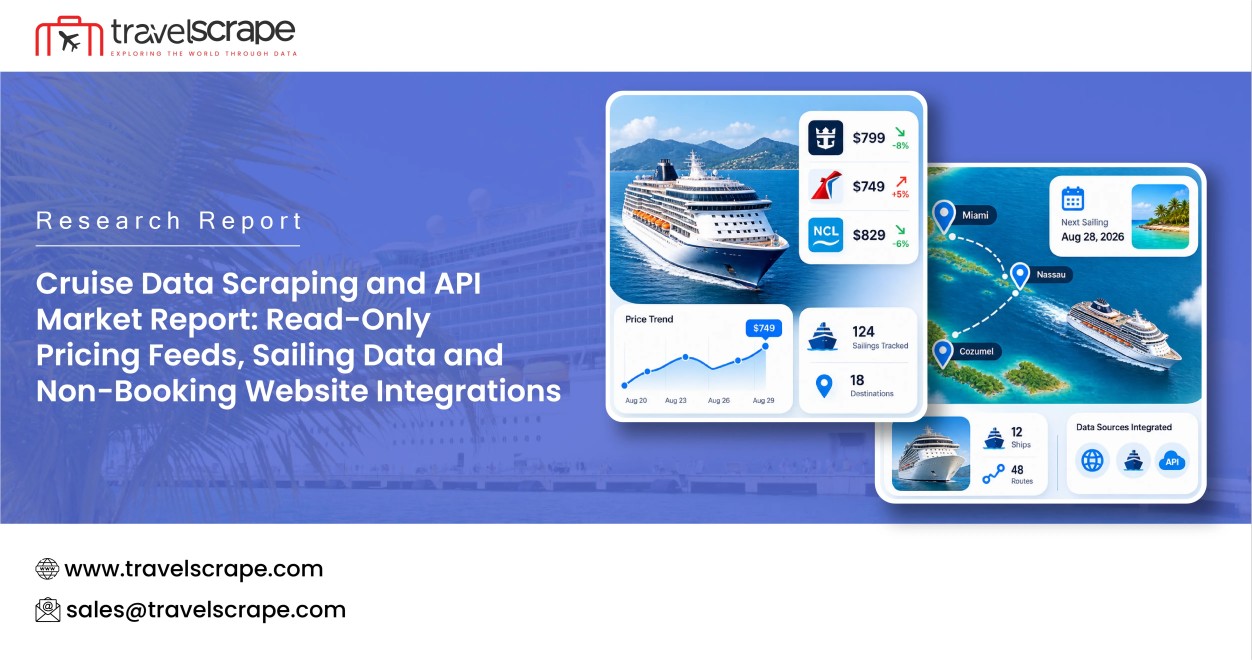
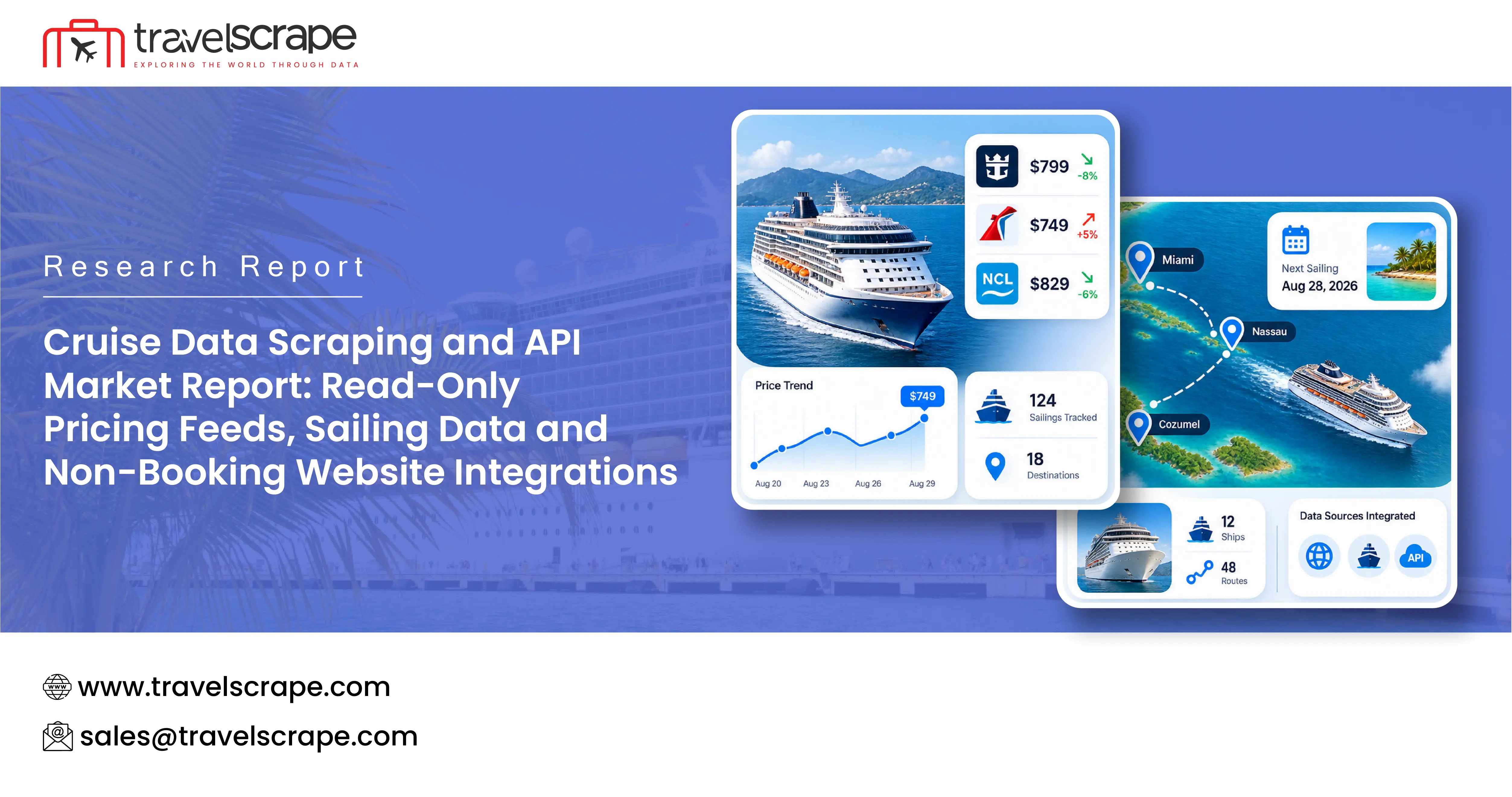
A growing share of cruise-related products never process a booking. Comparison sites, content and media platforms, affiliate portals, market-research tools, and AI answer engines all need current cruise pricing and sailing information—but they do not need, and often do not want, the complexity and liability of a transactional booking system. What they need is a read-only cruise data feed: structured sailing data and pricing they can display, compare, and analyze, delivered through a clean API. This report from Travel Data Scrape examines that market—the demand for read-only cruise data, the shape of non-booking website integrations, and what the underlying data looks like—built on cruise data scraping structured into consistent, application-ready feeds.
The market figures in this report are illustrative and directional rather than audited; they exist to frame the segment, and any figure intended for publication should be validated against current sources. What the analysis makes clear is structural and durable: demand for read-only cruise data is growing faster than demand for transactional cruise-booking rails, because far more products display and compare cruise information than sell it. Read-only feeds, sailing data, and non-booking integrations are where much of the practical value—and much of the growth—now sits.
Scope and Methodology
This report focuses on the read-only segment of the cruise data market: feeds that supply cruise pricing and sailing information for display, comparison, and analysis, as opposed to transactional systems that place bookings. The data behind such feeds is assembled through cruise data scraping across cruise lines and sailings, then normalized into a consistent schema and delivered via API.
For scope, "sailing data" covers the structural facts of a cruise—line, ship, itinerary, departure date, duration, ports, and cabin categories—while "pricing feeds" cover the fares and their conditions across cabins and over time. "Non-booking website integrations" refers to any product that consumes this data to inform users without processing the transaction itself. Market-size and growth figures here are directional illustrations meant to frame the opportunity, not precise measurements; the durable value of the report is the structure it describes, which holds regardless of the exact numbers. Travel Data Scrape's role is to supply the read-only data layer these integrations depend on.
Why Read-Only Cruise Data Demand Is Growing
The core insight of this market is a simple asymmetry: far more products need to show cruise data than to sell cruises. Every comparison site, review portal, content platform, and increasingly every AI assistant that answers cruise questions consumes cruise data, but only a small subset of them are licensed sellers processing transactions. This asymmetry is the engine of read-only demand.
Several drivers accelerate it. Content and comparison platforms compete on the freshness and breadth of the cruise information they display, which requires a live data feed rather than a static catalog. Affiliate and referral models let publishers earn from cruise interest without operating booking infrastructure—they display data, then hand off the transaction, so read-only data is exactly what they need. AI answer engines and chatbots increasingly field cruise questions and require structured, current data to answer accurately, and they too consume rather than transact. And market-research and analytics tools need the data purely for analysis, never for booking. In each case, the transactional layer is unnecessary overhead; the read-only feed is the whole requirement. Travel Data Scrape is built to serve exactly this segment.
What the Data Covers: Sailing Data and Pricing Feeds
A read-only cruise data feed has two complementary layers. The sailing-data layer captures the structural facts: the cruise line, the ship, the itinerary and its ports, the departure date, the duration, and the cabin categories offered. This is the relatively stable skeleton of the market—what sails, from where, to where, when. The pricing layer captures the fares and their conditions: per-cabin pricing, taxes and port fees, onboard credit and bundled perks, and availability, all changing over time as sailings fill.
Together these layers let a non-booking product do everything short of transacting: display sailings, compare fares across cabins and lines, filter to a budget, surface deals, and analyze trends. The separation matters for integration, too—a content site might consume mostly sailing data with light pricing, while a comparison tool leans heavily on the pricing feed. Delivering both as clean, well-structured data is what makes a read-only integration straightforward rather than a parsing project. Travel Data Scrape supplies both layers in a consistent schema, so integrators consume structured data rather than raw pages.
Sample What Read-Only Cruise Feeds Look Like
Concrete structures make the read-only model tangible. The examples below are representative of what a cruise data scraping feed from Travel Data Scrape delivers via API.
A sailing-data record captures the structural facts of a cruise:
{
 "sailing_id": "TDS-SL-20714",
 "cruise_line": "Sample Cruise Line",
 "ship": "Ocean Voyager",
 "itinerary": "7-Night Western Mediterranean",
 "departure_port": "Barcelona",
 "departure_date": "2026-09-19",
 "nights": 7,
 "ports_of_call": ["Barcelona", "Marseille", "Genoa", "Naples", "Palma"],
 "cabin_categories": ["Interior", "Ocean-View", "Balcony", "Suite"]
}
A read-only pricing-feed record attaches current fares to a sailing and cabin, with no booking capability:
{
 "sailing_id": "TDS-SL-20714",
 "captured_at": "2026-08-14T11:20:00Z",
 "currency": "EUR",
 "feed_type": "read_only",
 "cabin_pricing": [
 { "category": "Interior", "fare_pp": 899, "availability": "available" },
 { "category": "Balcony", "fare_pp": 1349, "availability": "limited" },
 { "category": "Suite", "fare_pp": 2599, "availability": "available" }
 ],
 "taxes_port_fees_pp": 180,
 "onboard_credit": 100
}
A compact API-response shape shows how an integration consumes filtered results:
{
 "query": { "region": "Mediterranean", "max_fare_pp": 1400, "cabin": "Balcony" },
 "results": [
 { "sailing_id": "TDS-SL-20714", "ship": "Ocean Voyager", "departure_date": "2026-09-19", "balcony_fare_pp": 1349 }
 ],
 "result_count": 1,
 "feed_type": "read_only"
}
Because the feed is read-only and cleanly structured, an integrator can display and compare sailings without building or maintaining any transactional layer.
Non-Booking Integration Patterns
Read-only cruise data supports a distinct set of integration patterns, each defined by displaying rather than transacting. Comparison and metasearch sites consume the pricing feed to rank sailings by budget and cabin across lines, then refer the user onward to book. Content and media platforms embed sailing data and indicative pricing into articles, guides, and deal roundups, keeping the information current without a booking engine. Affiliate portals surface cruise deals and hand off the transaction to a partner, earning on referral while consuming only read-only data. AI assistants and chatbots draw on structured sailing and pricing data to answer cruise questions accurately. And market-research and analytics dashboards ingest the data purely to study trends across lines, regions, and cabins.
What unites these is that the transactional layer is deliberately absent. This is not a limitation but a design choice: it removes the complexity, compliance burden, and liability of processing payments and reservations, leaving a lighter, faster integration. For most cruise-adjacent products, read-only is not a compromise—it is the correct architecture, and it is precisely the fit Travel Data Scrape's feeds are designed for.
Read-Only vs Transactional: Why the Distinction Matters
It is worth being explicit about why the read-only model is growing rather than the transactional one. A transactional integration must handle payment, reservation, inventory holds, cancellation, and the compliance and liability that come with moving money and holding bookings—a heavy build justified only for licensed sellers. A read-only integration carries none of that weight. It consumes current data, displays it, and refers the transaction elsewhere, which is exactly what the large majority of cruise-adjacent products actually need.
This distinction shapes the market. The population of products that display cruise data dwarfs the population that sells cruises, so the addressable demand for read-only feeds is structurally larger and growing faster. It also lowers the barrier to entry: a publisher, a comparison tool, or an AI product can add cruise capability with a data feed alone, no booking infrastructure required. For a data provider, this makes the read-only feed the higher-leverage product—and it is the one Travel Data Scrape is built to deliver at scale.
Emerging Demand: AI and Answer Engines
A distinct and fast-growing source of read-only demand deserves its own mention: AI assistants and answer engines. As travelers increasingly ask conversational tools to recommend, compare, or explain cruises, those tools need structured, current cruise data to answer accurately—and they consume it purely to inform, never to transact. This is read-only demand in its purest form, and it is expanding quickly as AI becomes a front door to travel research.
Serving it well requires clean, structured sailing and pricing data an AI system can reason over reliably, rather than raw pages it would have to interpret. A well-formed read-only feed is close to ideal for this: it gives an answer engine exactly the facts it needs, in a shape it can use, with no transactional layer to navigate. For a data provider, AI-driven consumption is likely to be one of the largest sources of read-only cruise-data growth in the coming years, and Travel Data Scrape's structured feeds are built to serve it.
What the Market Data Means
Taken together, the picture is clear: the practical growth in cruise data consumption is concentrated in read-only, non-booking use—comparison, content, affiliate, AI, and analytics—rather than in transactional booking rails. The value of a cruise data provider therefore lies in the quality, breadth, and freshness of its read-only feed: how completely it covers lines and sailings, how precisely it captures cabin-level pricing, how current it stays, and how cleanly it integrates. A feed that delivers structured sailing data and accurate pricing through a simple API meets the need of the entire non-booking segment at once.
For businesses evaluating the space, the implication is strategic. A product does not need to become a cruise seller to offer cruise capability; it needs a reliable read-only data layer. That lowers cost, speeds time to market, and sidesteps the liability of transactions—while still delivering the comparison, content, or intelligence users want. The market is rewarding data access over transactional depth, and read-only feeds are how that access is delivered.
Who Uses Read-Only Cruise Data
Several kinds of product build on read-only cruise feeds. Comparison and metasearch platforms rank and filter sailings for users without selling them. Content publishers and media sites keep cruise guides, deal pages, and editorial current. Affiliate and referral businesses monetize cruise interest without booking infrastructure. AI assistants and search products answer cruise questions from structured data. Travel-tech developers add cruise capability to broader travel apps via a feed. And analysts, investors, and cruise lines themselves use the data for market intelligence. In each case, the read-only feed is the whole requirement, and the report above describes a repeatable capability rather than a one-time artifact.
How Travel Data Scrape Delivers It
Travel Data Scrape supplies the read-only cruise data layer this report describes: cruise data scraping across lines and sailings, structured into sailing-data and pricing layers; cabin-level pricing captured as a full ladder rather than a single "from" price; a read-only, well-documented API and feed designed for non-booking integrations; and freshness that keeps displayed prices current as sailings fill. The same discipline extends across the wider travel data—flights, hotels, car rentals, and rides—so a product can add cruise capability alongside other verticals on one consistent foundation, all without building transactional infrastructure.
Whether you are running a comparison site, a content platform, an affiliate portal, an AI product, or a research tool, the completeness and freshness of your read-only cruise data set the ceiling on what you can offer. Travel Data Scrape supplies that foundation as clean, structured feeds, so cruise capability becomes an integration rather than a project.
Conclusion
The cruise data market's practical center of gravity has shifted toward read-only use: far more products display and compare cruise data than sell it, and demand for structured sailing data and pricing feeds is growing faster than demand for transactional booking rails. Non-booking integrations—comparison, content, affiliate, AI, and analytics—are where much of the value now sits, and they are best served by a clean, current, read-only feed rather than a heavy transactional stack.
With Travel Data Scrape delivering read-only cruise data through structured cruise data scraping and a well-designed API, comparison sites, publishers, affiliates, AI products, and analysts can add cruise capability without building booking infrastructure—turning current sailing and pricing data into features, insight, and revenue.
Ready to elevate your travel business with cutting-edge data insights? Scrape Aggregated Flight Fares to identify competitive rates and optimize your revenue strategies efficiently. Discover emerging opportunities with tools to Extract Travel Website Data, leveraging comprehensive data to forecast market shifts and enhance your service offerings. Real-Time Travel App Data Scraping Services helps stay ahead of competitors, gaining instant insights into bookings, promotions, and customer behavior across multiple platforms. Get in touch with Travel Scrape today to explore how our end-to-end data solutions can uncover new revenue streams, enhance your offerings, and strengthen your competitive edge in the travel market.