Crypto Payment Providers: What Their Support Teams Won't Tell You Upfront
-

- Published Updated
- 1,228 views
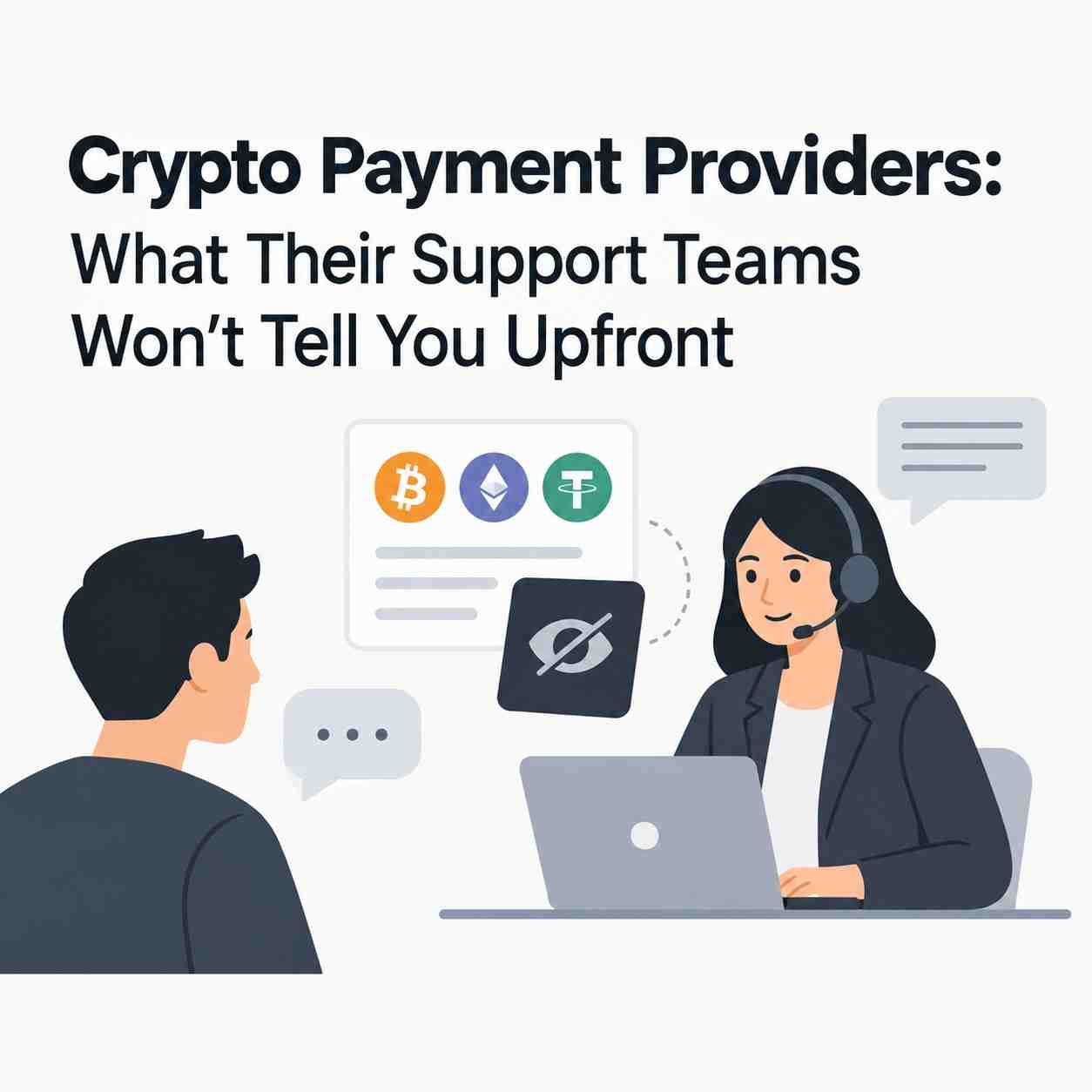
Ask a sales rep about response times and you'll hear "fast" and "priority support." Ask what actually happens when a transaction gets stuck at 2am on a weekend, and the answer gets vaguer fast. Crypto Payment Providers: What Their Support Teams Won't Tell You Upfront is about the gap between what a sales conversation promises and what a support ticket actually delivers once you're a paying customer with a real problem.
The short answer
Most Crypto Payment Providers don't volunteer their actual average resolution time, which tier of support you get at your specific volume, whether weekend and holiday coverage exists at all, or how a dispute between merchant and customer actually gets resolved when both sides disagree. None of this is necessarily dishonest, it's simply not offered unless asked directly. Crypto Payment Providers: What Their Support Teams Won't Tell You Upfront is really a list of questions worth asking before you sign up, not after your first real incident.
Response time commitments are vaguer than they sound
"24/7 support" and "fast response times" appear on nearly every provider's homepage, but these phrases rarely come with a specific number attached. A genuinely strong support commitment states an actual time, such as first response within one hour for critical issues, in writing, not just implied by the word "fast." Crypto Payment Providers: What Their Support Teams Won't Tell You Upfront often includes the fact that "24/7" sometimes means a chatbot or a ticket queue that's monitored around the clock, not necessarily a human who can resolve a payment issue at 3am on a Sunday.
Ask directly for a specific number: what's the actual average first-response time for a payment-blocking issue, not a general inquiry, and is that number published anywhere or only stated verbally during a sales call.
Support tiers depend on your volume more than you'd expect
Nearly every provider quietly runs a tiered support system, where a merchant processing meaningful monthly volume gets a dedicated account contact and priority queue placement, while a smaller merchant sits in a general ticket queue with everyone else. This isn't usually stated on a pricing page, and it's rarely brought up until a merchant asks directly or grows into a volume tier where a provider proactively reaches out. Crypto Payment Providers: What Their Support Teams Won't Tell You Upfront includes this tiering existing quietly in the background from day one, not appearing suddenly once you hit some threshold.
Ask what volume level unlocks priority support or a dedicated contact, and whether that threshold is fixed or negotiable for a fast-growing merchant.
Weekend and holiday coverage is inconsistent
A payment issue doesn't wait for business hours, but a provider's actual support staffing often does, even when their marketing implies otherwise. Some providers run a lean weekend team capable only of acknowledging tickets, not resolving them, pushing real fixes to the next business day. Others maintain genuine weekend coverage but only for their higher support tiers. This is one of the most commonly glossed-over parts of Crypto Payment Providers: What Their Support Teams Won't Tell You Upfront, since it only becomes visible the first time something breaks on a Saturday.
Ask specifically what weekend and holiday support actually looks like, not whether it exists, but what a ticket submitted at 11pm on a Saturday can realistically expect by Monday morning.
Disputes between merchant and customer aren't handled the way you'd assume
Card networks have a formal chargeback and dispute process. Crypto payment providers generally don't, since a confirmed blockchain transaction can't be reversed the way a card transaction can. What actually happens when a customer claims they paid but the merchant's system shows no record varies a lot by provider, and it's rarely explained clearly upfront. Some providers offer to help investigate a specific transaction hash against the blockchain on the merchant's behalf. Others simply point both parties to a block explorer and leave the reconciliation entirely to them.
Crypto Payment Providers: What Their Support Teams Won't Tell You Upfront should really include a direct answer to this scenario before it happens to you, since discovering a provider's actual dispute-resolution process during a live disagreement with a customer is a bad place to learn it.
Escalation paths aren't always clear from the outside
Most support systems have an informal escalation path for issues a first-tier agent can't resolve, but that path is rarely documented anywhere a prospective merchant can see it before signing up. Some providers escalate quickly and transparently. Others require a merchant to explicitly ask for escalation multiple times before a ticket reaches someone with the authority to actually fix a complex problem. Ask directly what the escalation process looks like for a ticket that a first-tier agent genuinely can't resolve, and how long that escalation typically takes in practice.
What happens during downtime isn't always automatic
A provider might advertise automatic reconciliation of payments received during an outage, but the actual mechanics of that reconciliation, whether it truly requires no merchant action or whether merchants still end up manually reporting missed payments after the fact, is something worth confirming directly rather than assuming from a marketing claim. Crypto Payment Providers: What Their Support Teams Won't Tell You Upfront includes the fact that "automatic reconciliation" sometimes still means a merchant has to open a ticket to trigger it.
Questions worth asking before you sign up
- What's your actual average first-response time for a payment-blocking issue, stated as a number, not a general phrase?
- What support tier do I get at my current volume, and what unlocks a higher tier?
- What does weekend and holiday coverage genuinely look like, not whether it exists but what it resolves?
- How do you help resolve a dispute between a merchant and a customer when a payment is contested?
- What's the actual escalation path when a first-tier agent can't solve my issue?
- Does your downtime reconciliation genuinely require no action from me, or do I still need to report a missed payment manually?
Asking these directly, before committing, is the practical way to approach Crypto Payment Providers: What Their Support Teams Won't Tell You Upfront rather than discovering the gaps during your first real incident.
Where FaradPay fits
FaradPay is a crypto payment provider, so ask it these same questions directly. Get a specific first-response time commitment in writing, confirm what tier of support applies at your volume, and ask exactly what weekend coverage and dispute resolution look like in practice. Those specific answers are the real test behind Crypto Payment Providers: What Their Support Teams Won't Tell You Upfront for any provider being evaluated, FaradPay included.
FAQ on Crypto Payment Providers: What Their Support Teams Won't Tell You Upfront
Why don't providers publish exact response times? Because a specific commitment is a promise they can be held to, so many prefer vague language like "fast" or "24/7" that sounds reassuring without setting a measurable standard.
Do all merchants get the same level of support? No. Most providers quietly tier support by volume, with dedicated contacts and priority queues reserved for merchants above a certain threshold.
Is weekend support usually as strong as weekday support? Often not. Some providers only acknowledge weekend tickets without resolving them until the next business day, so it's worth confirming directly.
How are disputes between a merchant and customer handled without chargebacks? It varies by provider. Some help investigate a transaction against the blockchain directly, while others leave reconciliation entirely to both parties.
Does automatic downtime reconciliation really require no action from the merchant? Not always. Some providers still require a merchant to open a ticket to trigger reconciliation, despite marketing language suggesting it's fully automatic.
What's the best way to learn a provider's real support quality before committing? Ask specific, scenario-based questions directly, since general marketing language rarely reveals how support actually performs under a real incident.
Final thoughts
Crypto Payment Providers: What Their Support Teams Won't Tell You Upfront comes down to one habit: ask specific, scenario-based questions before you sign up, not general ones a sales page already answers vaguely. A provider's real support quality shows up in the details, response time in hours not adjectives, weekend coverage that actually resolves issues, and a clear answer for what happens when a payment is disputed, and those details are worth getting in writing before you need them.