Top Features to Look for in a Dashcam for Cars
-
- June 01st, 2026
- 4,229 views

FREE SEO Topical Map Generator: Find Your Next Content Ideas
Buying a dashcam can feel like a small car upgrade until the road throws up a moment no one saw coming. A sudden brake, a tight lane change, a parking-lot scratch, or one confusing argument about who was at fault can turn that tiny camera into the calmest witness in the car.
The best dash cam for car use doesn’t just record pretty footage. It needs sharp video, wide coverage, reliable storage, emergency recording, parking mode, and quick access to clips when things go wrong. A dashcam should be useful before, during, and after every drive.
That’s where choosing the right boAt dash cam for car use really matters. Before you pick a model, it helps to understand which features actually make a difference when the drive doesn’t go as planned.
Why Should a Dash Cam for Car Use Offer More Than Just Recording?
A dash cam for car use should do more than record video; it should capture clear evidence, protect important clips, work in low light, support parking monitoring, and make footage easy to access when needed.
Resolution matters more than you notice, until you really need it. Blurry footage is almost useless when a number plate, traffic signal, or lane position needs to be seen clearly. But resolution alone doesn’t make a dashcam smart.
Buyers should also check:
Wide road coverage: More frames mean fewer missed details.
G-Sensor support: Sudden-impact clips should lock automatically.
Loop recording: Old clips should clear smoothly when storage fills.
Low-light recording: Night drives shouldn’t become dark guessing games.
App support: Videos should be easy to view, save, and share.
The boAt HIVE Dashcam M1 gets the basics of daily driving right. It records in 2K QHD, supports up to 512GB Micro SD storage, includes built-in GPS for route logging, and uses a G-Sensor to lock emergency footage during sudden impact.
It also offers low-light recording, loop recording, wide lane coverage, Wi-Fi app support, voice-command control, and parking mode support. That’s a strong fit for city drives, office commutes, and weekend highway runs.
What Makes a Dash Cam Front-and-Rear Setup Worth Considering?
A dash cam front-and-rear setup is useful because it records what happens both ahead of and behind the car simultaneously. That wider coverage helps during rear-end bumps, lane disputes, parking incidents, and unpredictable traffic situations.
Here’s the part many buyers miss. The front camera sees only half the story. If something happens behind the car, near the bumper, or while reversing out of a tight space, a single-front setup may not capture enough. That’s why a dual dash cam for car protection can feel more complete.
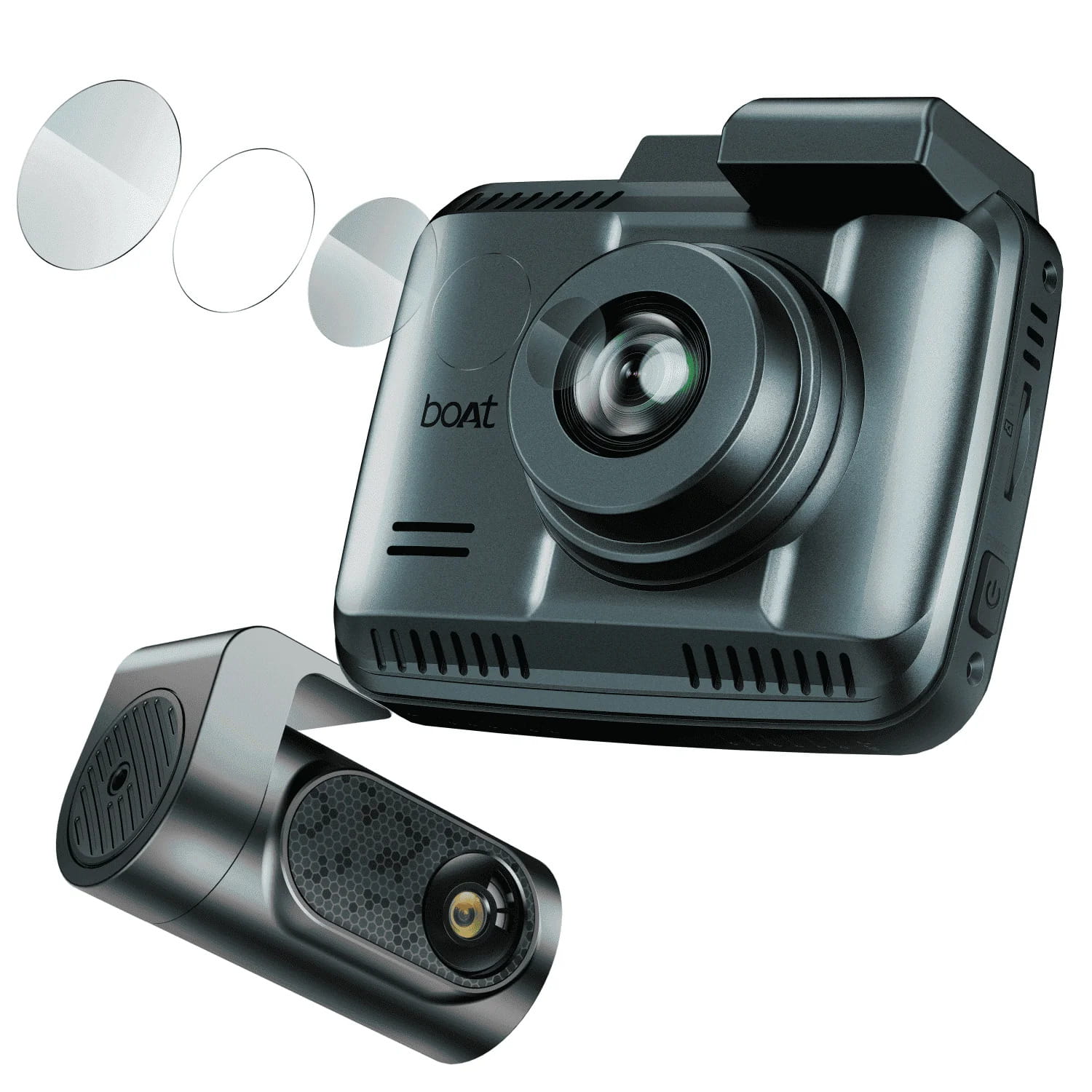
The boAt HIVE Dashcam F1 is built for that exact job. It supports 4K Ultra HD dual-channel recording with a 4K front camera and a 1080p rear camera working together. For buyers looking at a dual-dash-cam front-and-rear setup, this provides stronger coverage without adding separate camera systems.
The F1 also adds:
150° field of view
Sony STARVIS IMX335 sensor
ADAS safety alerts
Built-in GPS route logging
Wi-Fi 6 connectivity
Hivecam app support
Audio recording
2.4-inch IPS display
For someone searching for the best dual dash cam for a car, the real question is simple: Does the camera capture enough angles, enough clarity, and enough context when the drive gets messy? A good dual dash cam should answer yes before trouble arrives.
Which Dashcam Features Should Buyers Check Before Checkout?
Most dashcam mistakes happen when buyers focus on a single big feature and overlook the overall driving experience. A better choice starts by checking clarity, coverage, safety alerts, storage, parking protection, and phone connectivity.
1. Video clarity
boAt HIVE M1 records in 2K QHD, while boAt HIVE F1 offers 4K front recording with 1080p rear recording. Better clarity can make small details easier to spot.
2. Night performance
Low-light recording matters because not every incident happens in perfect daylight. boAt HIVE M1 supports low-light recording, while boAt HIVE F1 uses the Sony STARVIS IMX335 sensor for stronger night-time clarity.
3. Emergency recording
A G-Sensor is not just a fancy extra. It detects sudden impacts and locks critical footage to prevent it from being overwritten.
4. Parking support
Parking mode matters when the car is stationary. HIVE M1 supports parking mode, while boAt HIVE F1 offers 24H Smart Parking Monitor support with G-Sensor-triggered emergency recording.
5. Easy video access
Wi-Fi app support lets drivers view, download, and manage recordings on their smartphones. boAt HIVE F1 goes further with Wi-Fi 6 and Hivecam app support for faster access.
These are the details that decide whether a dashcam is genuinely useful after an incident or just decorative tech on the windshield.
Final Thoughts
Buying a dashcam isn’t about adding another gadget to the car. It’s about adding proof, context, and a little peace of mind to every drive. The right camera should make the road feel less uncertain, especially when traffic, parking, and sudden movement leave very little room for guesswork.
For everyday drivers, the boAt HIVE Dashcam M1 is a clean, practical upgrade that covers the essentials without complicating setup.
For drivers who want greater protection, the boAt HIVE Dashcam F1 offers a larger setup with 4K dual-channel recording, rear-camera coverage, ADAS alerts, Sony STARVIS night vision, Wi-Fi 6, GPS, and smart parking support.
FAQs
How does a dashcam help during daily driving?
A dashcam records road footage that can help during disputes, sudden incidents, parking bumps, and insurance conversations. A clear video can provide useful context when memory and opinions don’t match.
Why should I choose a dual dash cam?
A dual-dash cam records both front and rear views, providing wider coverage than a single front camera. It helps capture rear-end incidents, parking impact, and traffic situations behind the car.
What is the most important feature in a car dashcam?
Clear video quality matters, but it shouldn’t be the only feature. G-Sensor emergency recording, night clarity, storage support, parking mode, and app access matter just as much.
Are dashcams legal to use in cars?
In most places, they are legal if they don’t block your view and you follow local privacy rules.
Does a dashcam keep recording when the car is parked?
Many models offer parking mode, which records only when motion or impact is detected around your parked car.