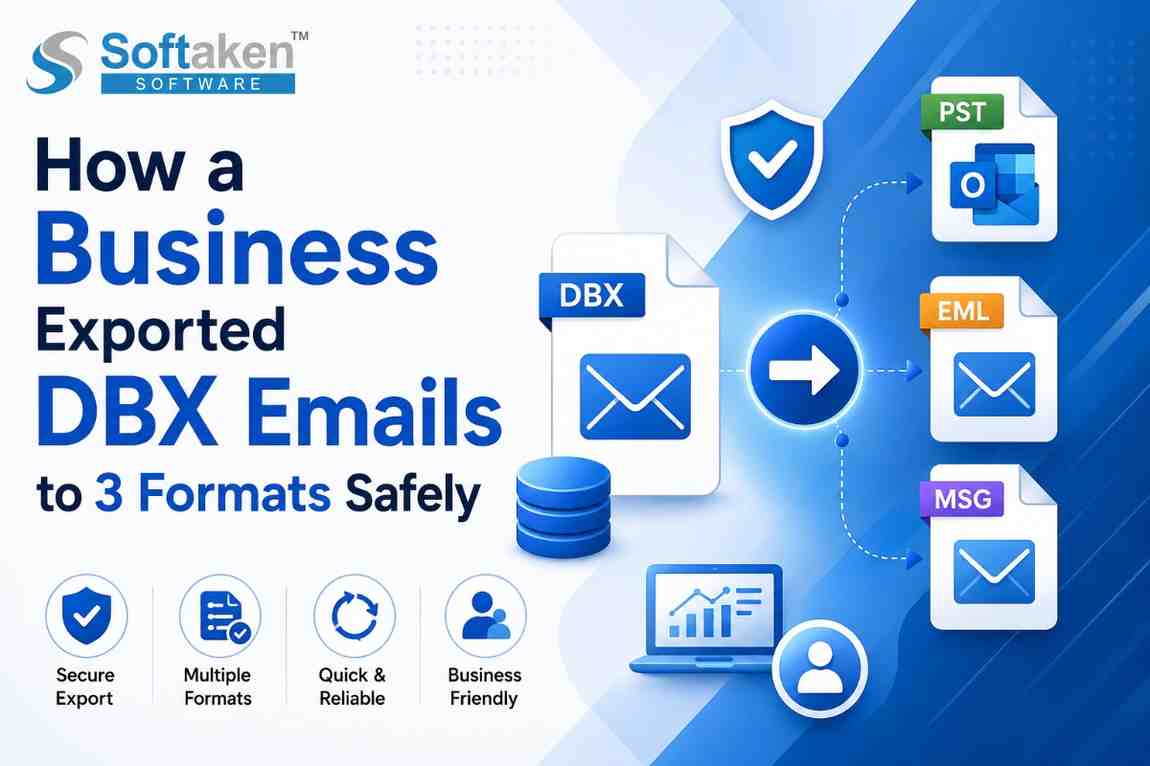
How a Business Exported DBX Emails to 3 Formats Safely
-

- September 18th, 2026
- 3,745 views
Introduction
This issue is a common problem for businesses that have been using Outlook Express for years and are now updating their IT infrastructure. Older DBX email files may still contain contracts, customer correspondence, project records, and financial correspondence but are incompatible with modern email applications. This case study covers the experience of a distribution company that needed to reuse its legacy email archive across different departments. Instead of moving all employees to a single email platform, the company preferred to keep its legacy Softaken Outlook Express DBX Converter email in multiple formats so each team could continue to use the email client of choice.
The task was simple—export one email archive in three different formats and preserve every important detail.
The Business Situation
The company had amassed more than seven years of customer emails using Outlook Express. When the company replaced the older computers with modern systems, employees quickly discovered that they could not access the archived DBX files directly.
· And it got more complicated because every department had different software.
· The Sales team worked in Microsoft Outlook.
· Thunderbird was preferred by Customer Support.
· The email records were stored as documentation in EML format with compliance.
· It was impractical to keep separate copies for each department manually.
· The organization needed a single, consistent process that could produce multiple output formats without having to recreate the archive over and over again.
Problems Before Migration
Before starting the project, the IT department identified a few practical concerns.
One Archive, Many Needs
All departments wanted the same historical e-mails but in different formats. Doing this manually, by creating separate archives, would increase the workload and the chance of inconsistencies.
Keeping Business Records
The archive contained quotes, contracts, invoices, purchase confirmations, and client correspondence. I could not afford to lose attachments or details of a message.
Restricted Access to Outlook Express
Employees were unable to check archived emails whenever they needed to because Outlook Express was not supported on modern versions of Windows.
Organization of the Original
Folders had been carefully sorted over many years. Rebuilding that structure separately for multiple email clients would be an unnecessary waste of time.
Migration planning
The IT team didn’t immediately kick off the conversion but instead put together a migration checklist.
Their priorities were to:
· Preserve the original DBX files.
· Output formats selected according to departmental requirements.
· Test converted files before distribution.
· Checking attachments and folder structure.
· Making sure historical emails were searchable post-migration.
· This preparation helped to avoid unforeseen problems during the project.
Practical Selection of Solutions
After evaluating the different options, the company selected the Softaken DBX Converter because the software allows exporting DBX emails to multiple email formats from the same source archive.
The software meant the IT team could produce the required output formats from a single workflow instead of having to do separate conversion projects for each department.
The emphasis was on retaining the data from the business, not just doing the conversion as fast as possible.
Migration process
The migration was conducted in a few organized steps.
Stage 1 – Confirming Archiving
Before conversion, the existing DBX files were verified to ensure that they contain complete email folders.
Stage 2 – Create Backup
A backup of the original Outlook Express archive was created to eliminate any remote chance of accidental data loss.
Stage 3 - Format Choice
The IT department selected three export formats according to the business needs:
Microsoft Outlook users: PST for
EML for storing documents
MBOX for Thunderbird users
Stage 4 – Conversion
The software scanned the archive and created separate output files with the original mailbox structure.
Stage 5 – Quality Assessment
Random samples of emails from each department were checked to ensure that:
· Attachments opened okay.
· No changes to the folder structure.
· The dates of the emails matched the original ones.
· Sender and recipient information was correct.
· The message formatting was preserved.
Project Impact
The migration included several operational improvements.
Improved Departmental Collaboration
Emails arrived in the format that worked with their existing workflows, so there was no need for file conversions later.
Historical Data Was Published
Employees no longer had to work on old computers just to read archived Outlook Express emails.
Less administrative burden
Instead of doing the same thing multiple times, the IT team did one structured migration.
Consistent Email History
All of the formats were from the same DBX archive, so information was consistent across departments.
Long-Term Lower Maintenance
The organization could retire its legacy Outlook Express environment but still maintain all historical communication as needed.
Lessons Learned
The migration project showed that planning is equally important as choosing the right conversion method.
The organization reported that:
· Always make sure you back up your legacy email archives before you migrate.
· Different business teams often use different email formats.
· Check the files converted to avoid problems in accessing them in the future.
· If you keep your folders organized, you will save yourself a lot of administrative time.
· Structured migration minimizes manual handling and reduces the possibility of errors.
Conclusion
Managing legacy Outlook becomes more difficult when companies move to modern operating systems and newer email platforms. The challenge here was more than just converting DBX files. The business had several departments that used different email applications but wanted to share a common email archive. The company easily transferred its old DBX emails into three different formats with the help of DBX Converter and a planned migration approach, all while maintaining message integrity, attachments, and folder hierarchy. This resulted in a centralized archive that multiple teams could access without duplicating the migration or risking inconsistent records.
For organizations facing similar compatibility issues, taking the time to plan the migration thoroughly before decommissioning legacy systems can lead to better long-term email accessibility.
Frequently Asked Questions (FAQs)
1. Does DBX Converter export DBX emails into multiple formats?
Yes. The software provides exported DBX files in various output formats that help users access archived emails in different email applications according to their needs.
2. Will I be able to view email attachments after I export the DBX files?
Yes. When converting, the software keeps email attachments with the messages in the exported files, so they are available.
3. Would it be possible to export DBX emails with the original folder hierarchy?
Yes. The software maintains the existing mailbox hierarchy; users can view the emails in the same folder hierarchy after conversion.
4. Who are the most benefited users of the DBX emails exported in different formats?
Businesses using departments with Microsoft Outlook, Thunderbird, Apple Mail, and other compatible email clients can also benefit from having different output formats for the same archive.
5. Why do companies need to check the converted files after migration?
Before you retire the original archive, it’s worth checking the exported files to ensure that emails, attachments, dates, sender information, and folder structures have transferred correctly.