Ecommerce Email Marketing Strategy: A Practical Playbook to Increase Repeat Sales
-

- Published Updated
- 474 views

An ecommerce email marketing strategy turns anonymous visitors into first-time buyers and first-time buyers into repeat customers. This guide lays out the practical components, simple frameworks, and exact steps needed to design email programs that increase conversions and lifetime value while keeping deliverability and compliance intact.
ecommerce email marketing strategy: core components
Start with clear objectives (revenue per recipient, repeat-purchase rate, retention) and map messages to the customer lifecycle. Key components of a robust ecommerce email program include list growth, segmentation, automated flows, campaign design, deliverability, and analytics.
1. Audience and segmentation
Segment subscribers by intent and behavior: new subscribers, first-time buyers, repeat buyers, high-value customers, lapsed customers, browsers with abandoned carts. Use purchase history, browsing events, and engagement signals (opens, clicks) to create dynamic segments. This reduces noise and improves relevance.
2. Automation and lifecycle flows
Automation is the workhorse of email marketing. Typical flows include: welcome series, abandoned cart sequence, browse abandonment, post-purchase (order confirmation + delivery + cross-sell), and re-engagement. Each flow should have a clear objective and measurable conversion goal.
3. Deliverability, compliance, and sender reputation
Deliverability affects whether emails reach the inbox. Implement authentication (SPF, DKIM, and DMARC), warm sending domains gradually, and monitor bounce and spam complaint rates. Follow legal requirements for commercial email: the CAN-SPAM Act and similar rules in other regions. For official guidance see the FTC’s CAN-SPAM compliance information: FTC CAN-SPAM guidance.
4. Creative and copy
Subject lines should be specific and value-driven. Preheader text must complement the subject line. Keep CTAs clear and match the landing experience. Use product images, urgency sparingly, and social proof for higher conversions.
5. Measurement and optimization
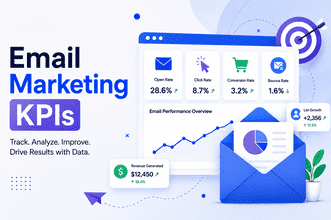
Track opens, clicks, conversions, revenue per recipient (RPR), unsubscribe rate, and deliverability signals. Use A/B tests for subject lines, send times, and content. Review tests as cohort analyses to avoid misleading short-term results.
R.E.A.C.H. Email Framework (named framework)
Apply this five-part model to every campaign and automation:
- Relevant — match content to segment intent.
- Engaging — subject + preheader + first 100px must hook.
- Actionable — single clear CTA per message.
- Consistent — cadence expectations and template consistency.
- Helpful — solve a problem or provide value, not only promotions.
5-Point Email Audit Checklist
- Authentication: SPF, DKIM, DMARC configured and monitored.
- Segmentation: at least 3 dynamic segments (new, active buyers, inactive).
- Automations: live welcome, cart-abandonment, and post-purchase flows.
- Metrics baseline: record open, click, conversion, and unsubscribe rates.
- Compliance: visible unsubscribe link and privacy policy linked.
Real-world example
A direct-to-consumer apparel brand implemented a welcome series (three emails over 10 days), an abandoned cart sequence (three emails with increasing urgency), and a post-purchase cross-sell email. After segmentation and a deliverability fix (added DKIM and reduced sending spikes), the store saw a 22% increase in revenue from email and a 9% lift in repeat purchases within 90 days.
Practical tips to implement immediately
- Start with a welcome series: introduce the brand, set cadence expectations, and include a first-purchase incentive in the second message.
- Automate abandoned cart emails within 1 hour, 24 hours, and 72 hours with progressive incentives.
- Segment by RFM (recency, frequency, monetary) to prioritize retention campaigns for high-LTV customers.
- Monitor deliverability weekly and suppress hard bounces and persistent non-openers into a re-engagement stream before deleting.
- Run simple subject-line A/B tests with at least 5–10% of the list to ensure statistical usefulness.
Trade-offs and common mistakes
Over-emailing vs under-emailing
Sending too frequently can increase unsubscribes and complaints; too rarely wastes the opportunity to build relationships. Use engagement-based cadence: more frequent messages for active buyers, less for low-engagement segments.
Personalization complexity
Hyper-personalization (deep one-to-one recommendations) improves results but requires clean data and engineering. Start with simple rules (category preferences, recent purchases) before investing in complex recommendation engines.
Ignoring deliverability
High creative quality means nothing if messages land in spam. Authenticate domains, clean lists, and watch complaint rates. Small stores often neglect DNS authentication, which is a fast win.
Analytics: what to track
Prioritize revenue per recipient, conversion rate per email, open and click rates, unsubscribe rate, and list growth rate. Tie email performance to site analytics or an attribution model to understand long-term LTV impact.
FAQ: Common questions
What is an ecommerce email marketing strategy and where should it begin?
An ecommerce email marketing strategy defines objectives, audience segments, key automated flows, measurement, and compliance steps. Begin with list growth and a welcome series, then layer cart recovery, post-purchase, and re-engagement flows while tracking revenue per recipient.
How many automated flows should a small store start with?
Begin with three: welcome series, abandoned cart, and post-purchase. Add browse abandonment and re-engagement after these are stable and producing measurable revenue.
How to reduce abandoned cart rates with email?
Send the first recovery email within an hour, include product image and price, add social proof, and follow up at 24 and 72 hours with urgency or a small incentive if needed. Ensure abandonment triggers are accurate to avoid spurious messages.
What deliverability safeguards are essential for ecommerce?
Configure SPF, DKIM, and DMARC, warm new sending domains slowly, remove hard bounces immediately, and monitor spam complaints. Maintain a clear unsubscribe process and segment by engagement to reduce complaints.
How should success be measured for an ecommerce email marketing strategy?
Measure revenue per recipient, conversion rate of emails, repeat purchase rate driven by email, list growth, and deliverability metrics. Tie email-attributed revenue to customer lifetime value to assess long-term impact.