How to Open EML Files Without Outlook
-

- Published Updated
- 2,650 views

Need to open an EML file but don’t have Microsoft Outlook installed? You have several options. EML email files can be opened using compatible email clients, desktop applications, or text editors, depending on whether you simply want to read the message or need to manage a large collection.
In this guide, you’ll learn how to open EML files without Outlook, how to access EML files using different methods, and when an EML converter such as SysTools can be a better choice for bulk processing or migration.
What Is an EML File?
EML is a file format used to store an individual email message. It can contain the email body along with information such as:
Sender and recipient details
Subject and date
Email headers
Message formatting
HTML content
Attachments
EML files are supported by several email applications, so Outlook is not required simply to view them.
How to Open EML Files Without Outlook?
If you have only a few EML files, you can open them using an email client that supports the format. You can also inspect an EML file with a text editor, although this will not provide the same readable email layout.
Here are the most practical methods.
Method 1: Open EML Files Using Mozilla Thunderbird
Mozilla Thunderbird is a desktop email client that can work with EML messages, making it one option for users who don't have Outlook.
Steps to Open EML Files in Thunderbird
Install Thunderbird on your computer.
Launch the application after installation.
Locate the EML file you want to view.
Use Thunderbird's available message import/open functionality to load the EML file.
View the email and check its content and attachments.
This method is useful when you want to read individual messages in an email-client interface rather than viewing the raw file contents.
Limitation
If you have a large number of EML files, manually handling them can become time-consuming. You may also need a different approach if your ultimate goal is to migrate the messages into Outlook.
Method 2: Open EML Files With a Text Editor
Another way to access EML files is through a basic text editor such as Notepad.
Steps
Right-click the EML file.
Select Open with.
Choose a text editor such as Notepad.
Review the contents of the file.
The file may display email headers, MIME information, HTML code, and encoded sections. As a result, this method is better for inspecting the underlying email data than for comfortably reading the message.
Best suited for: Checking email headers or examining the raw contents of an EML file.
Method 3: Use an EML-Compatible Email Application
Some email applications support EML files directly.
To try this method:
Right-click the EML file.
Select Open with.
Look for an installed email application that supports EML.
Select the application.
Open the message and verify its content.
The exact steps can differ depending on the application and operating system.
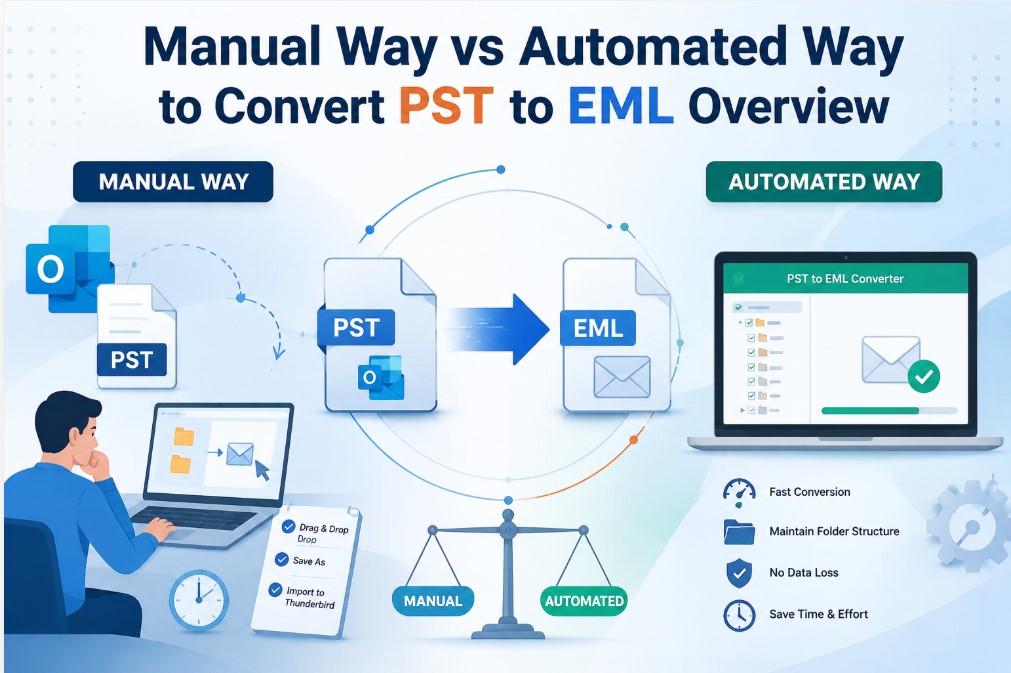
If you only need to read an email, there is generally no reason to convert it. Conversion becomes more useful when you have a large collection or need to move the messages to another platform.
How to Access EML Files in Bulk?
Opening EML files individually works reasonably well for a small number of messages. However, imagine having hundreds or thousands of files stored across different folders. Opening each message separately can take considerable time and make email management difficult.
Bulk processing may be useful when EML files are part of:
An old email backup
A mailbox export
An email migration project
A collection of saved messages
A transition from one email application to another
In these situations, a dedicated EML conversion tool can be considered instead of manually opening every message.
Automated Method to Convert EML Files
If you need to process a large number of EML files, SysTools EML Converter is one option to consider. It is designed for users who need to convert EML data into other formats or prepare EML messages for migration.
A typical workflow involves:
Add the EML files or the folder containing them.
Select the required output format.
Choose the destination location.
Start the conversion.
Open the converted data in the appropriate application and verify the emails.
For example, if your goal is to move EML messages into Outlook, an EML-to-PST conversion approach may be more appropriate than opening each EML file individually.
However, if you only have one or two messages to read, using an EML-compatible email client is likely to be simpler than using conversion software.
Why Choose Conversion Over Manual Opening?
Manual opening is convenient for a small number of emails, but it becomes less practical as the number of files increases.
A conversion-based approach can be worth considering when:
You have a large collection of EML files.
You need to migrate emails to another application.
You want to process multiple files together.
You need a format supported by your destination email client.
Manually opening individual messages is taking too much time.
The right choice depends on the destination and the type of email data you need to preserve.
dates, and other email information.
Conclusion
You don't need Microsoft Outlook just to read an EML file. For a few messages, an EML-compatible email client such as Thunderbird is a practical option, while a text editor can be useful for inspecting the raw contents.If you need to access EML files in bulk or migrate them to Outlook, manually opening every message may not be the most efficient approach. In that situation, a this dedicated tool can be considered for bulk EML conversion.