Why Fasteners Matter More Than You Think: The Unsung Heroes of Every Big Machine:
-
- May 04th, 2026
- 7,333 views
You know what is funny?
We spend crores of rupees on machines, buildings, bridges, and factories. We talk about steel quality, design engineering, and load capacity. But nobody, almost nobody, talks about the small things that actually hold all of it together.
Fasteners.
Yes. Those bolts, nuts, and screws sit quietly inside every machine, every structure, every pipeline. They do not speak. They do not shine. But the moment one of them fails? Everything stops. Sometimes, everything falls.
Let me tell you a short story first.
A Small Thing That Stopped a Big Factory
A factory manager in Pune once shared something that stayed with me for a long time.
His production line went down for almost 11 hours. Not because of a machine failure. Not because of a power cut. Not because of a software error.
It was because of one loose bolt.
One bolt was not the right grade. One bolt was not tightened to the right torque. One bolt that looked fine from the outside but was simply wrong.
Eleven hours of production loss. Lakhs of rupees gone.
After that day, he said something very simple: "I never want to hear the word 'cheap fasteners' in my factory again."
And that is exactly why we are writing this today.
What Are Fasteners? Let Us Start From the Beginning
If you are in manufacturing, construction, oil and gas, automobiles, railways, or infrastructure, you already know what fasteners are. But let us say it clearly for everyone.
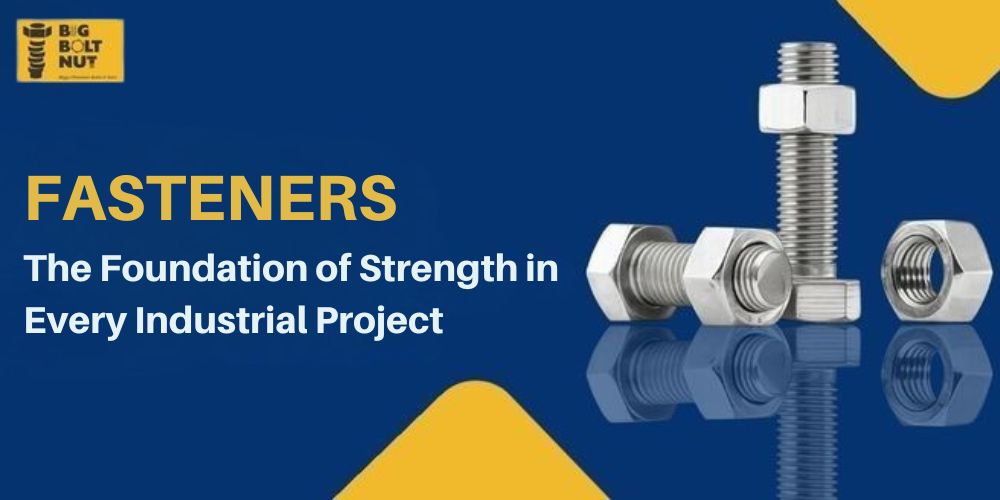
Fasteners are mechanical components that are used to join two or more objects together. They can be permanent or non-permanent. They come in hundreds of types, shapes, sizes, and grades.
The most common types of fasteners include:
Bolts — threaded fasteners that work with a nut to clamp parts together
Nuts — paired with bolts to create a tight joint
Screws — self-threading fasteners used in many assembly applications
Washers — flat discs that distribute load and protect surfaces
Studs — rods threaded on both ends, used in heavy-duty applications
Anchor bolts — used to fix structures to concrete or masonry
Now, these might sound simple. But the engineering behind a high-quality fastener is anything but simple.
Why Grade and Quality of Fasteners Is Not Something You Should Ignore
Here is what most people in procurement get wrong.
They look at the price first. Then they look at the size. And then — maybe — they check the grade.
That is the wrong order.
When you are buying fasteners for industrial or heavy engineering applications, the grade of the fastener tells you everything. It tells you how much tensile strength the bolt has. It tells you how much load it can handle before it starts to deform. It tells you whether it will survive heat, pressure, vibration, and corrosion.
In Indian markets, you will often see fasteners graded as 4.6, 6.8, 8.8, 10.9, and 12.9. These numbers are not random. They are a global standard. And choosing the wrong grade for the wrong application is one of the most expensive mistakes a company can make.
For example:
A Grade 4.6 bolt is fine for light structural work. But if someone uses it where a Grade 8.8 or 10.9 is required — like in heavy machinery or high-pressure pipelines — the results can be dangerous.
This is where working with a trusted and experienced fastener manufacturer or supplier makes all the difference.
The Indian Fastener Industry — Bigger Than Most People Think
India is actually one of the top
But here is the challenge.
Not every supplier in India maintains the same quality standards. The market has a wide range — from very low quality, ungraded fasteners that are sold just by weight, to precision-engineered, internationally certified fasteners /that meet IS, DIN, ASTM, and ISO standards.
As a buyer — especially if you are in B2B procurement — you need to know who you are buying from.
Look for suppliers who:
Have proper quality certifications (ISO 9001, for example)
Offer material test certificates (MTCs) for every batch
Can supply fasteners in custom sizes and specifications
Have experience working with industries like power, oil and gas, railways, or heavy engineering
Have a consistent track record and client references
Heavy Hex Bolts, Structural Bolts, Foundation Bolts — Do You Know the Difference?
One thing that confuses many procurement teams is the wide variety of fasteners available in the market.
Let us make it simple.
Foundation Bolts (Anchor Bolts): These are used to fix heavy machinery, steel columns, and equipment to concrete foundations. They go into the ground and hold everything above them steady. If these fail, the whole structure becomes unstable.
Heavy Hex Bolts and Nuts: These are larger and stronger versions of regular hex bolts. Used in structural steel connections, flanges, and heavy equipment. The word "heavy" here means thicker walls and higher load capacity.
Structural Bolts: Designed specifically for steel-to-steel connections in buildings, bridges, and industrial structures. These must meet very specific tightening and proof load requirements.
Eye Bolts and U-Bolts: Used for lifting, rigging, and clamping applications.
Flange Bolts: Used in piping systems and flanged connections. Very common in oil, gas, and chemical industries.
Each of these has a specific job. And using the right fastener for the right job is what separates a safe, long-lasting structure from one that gives you problems every few months.
What Should You Actually Look for When Sourcing Fasteners?
Whether you are a purchase manager, a project engineer, or a business owner — here are some practical things to check before you place your next fastener order:
1. Material Specification Is it mild steel? Alloy steel? Stainless steel? High tensile? The material must match your application environment — especially if there is heat, moisture, or chemicals involved.
2. Thread Standard BSW, BSF, Metric, UNC, UNF — the thread type must match the mating component perfectly. A mismatched thread is a disaster waiting to happen.
3. Surface Finish Plain, hot-dip galvanised, zinc plated, black oxide — each coating serves a different purpose. Galvanising, for instance, provides excellent corrosion protection for outdoor or coastal applications.
4. Dimensional Accuracy A fastener that is even slightly off in dimension can cause assembly problems, affect torque values, and compromise joint integrity.
5. Traceability For critical applications, always ask for heat number traceability and material test certificates. This is standard practice in power plants, refineries, and railways.
A Word on Consistency — Because That Is What B2B Really Needs
In B2B relationships, what matters more than a great first order is consistent quality across every order.
Any supplier can send you one good sample. But can they deliver the same quality in batch after batch? Can they handle urgent requirements? Can they support you when you have a non-standard requirement?
These are the real questions.
Companies like Big Bolt Nut have been building their reputation in the Indian fastener market by focusing exactly on this — consistency, quality documentation, and the ability to handle large, complex, and custom orders across industries.
When you are choosing a fastener partner for your business, think long-term. Think about reliability. Think about who will still be there to support you 2 years from now, not just who gave you the best price today.
Final Thoughts — The Bolt That Holds Your Business Together
We started with a story about one loose bolt shutting down a factory for 11 hours.
Here is how the story ends.
That factory manager switched to a certified, grade-verified fastener supplier. He started asking for MTCs. He trained his team to check fastener grades before installation. And in the two years after that change — not a single production stoppage because of a fastener failure.
Small things done right create big results.
Fasteners are not a glamorous product. But they are one of the most critical decisions you make in any industrial project. Choosing the right grade, the right material, the right supplier — that is engineering. That is risk management. That is smart business.
So the next time someone in your team says "it's just a bolt, let's go with the cheapest option" — remember the 11-hour shutdown. Remember the lakhs lost. And remember that the right fastener from the right source is always — always — cheaper than the problems a wrong one creates.
If you are looking for a reliable, quality-certified fastener manufacturer and supplier in India that understands the real demands of industrial and infrastructure projects, Big Bolt Nut is a name worth knowing. With a wide range of high tensile bolts, heavy hex nuts, foundation bolts, and custom fasteners for demanding applications, they bring both product quality and supply consistency to the table.
Explore their range and get in touch with the team at Big Bolt Nut to discuss your specific requirements.
Related Posts