What are the key features to look for in food manufacturing ERP software?
-

- September 23rd, 2026
- 106 views
Choosing the right ERP platform can make daily production calmer, cleaner, and easier to control. The best food manufacturing ERP software connects recipes, inventory, production, quality, traceability, purchasing, sales, and finance so teams are not constantly reconciling spreadsheets or chasing missing information. For food and beverage manufacturers, the goal is not just “more software”; it is better visibility from raw ingredients to finished goods.
Why does ERP matter so much in food manufacturing?
ERP matters in food manufacturing because small data gaps can quickly become costly operational problems. If inventory is inaccurate, production may run short on a critical ingredient. If lot records are incomplete, a recall investigation can take longer than it should. If recipes and yields are managed outside the system, margins become harder to understand.
A strong food industry ERP helps bring these moving parts into one shared environment. Production, warehouse, quality, procurement, and finance teams can work from the same information instead of relying on disconnected files. That is especially important in food production, where shelf life, allergens, batch records, compliance requirements, and changing demand all need to be managed at the same time.
Good erp software for food manufacturing should support the way food companies actually operate. It should understand batches, formulas, co-products, substitutions, catch weights, expiration dates, and regulatory documentation. Generic manufacturing erp solutions may cover basic production planning, but food manufacturers usually need deeper process manufacturing controls.
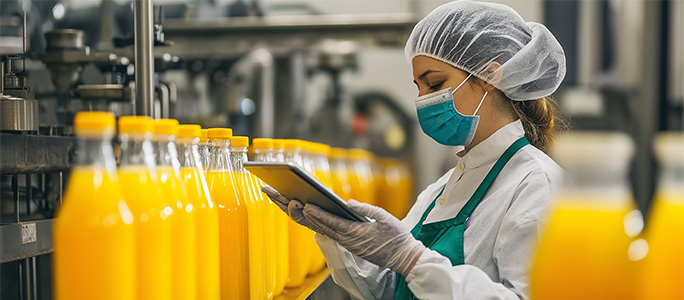
food manufacturing team reviewing ERP production dashboard
Core features every food manufacturer should evaluate
The right food manufacturing erp should reduce manual work while giving leaders a clearer view of what is happening across the business. When comparing platforms, start with the features that affect your most important daily processes.
Recipe, formula, and bill of materials management
Food manufacturers need reliable control over formulas, recipes, ingredients, packaging, and finished product specifications. The system should allow teams to manage versions, approved substitutions, batch scaling, ingredient percentages, and expected yields. This keeps production consistent and helps prevent informal recipe changes from creating quality or costing issues.
Look for software that makes it easy to update formulas without losing historical records. If a recipe changes because of a supplier switch, reformulation, or packaging update, you still need to know what was made, when it was made, and which version was used. Strong food production software should make that history easy to access.
Lot traceability from supplier to customer
Traceability is one of the most important features in food processing erp. Your system should track ingredients from receiving through production, storage, shipment, and customer delivery. In a recall, mock recall, or customer complaint investigation, teams should be able to identify affected lots quickly.
Traceability should work in both directions. You need to trace finished goods back to their ingredient lots, and you need to trace an ingredient lot forward to every batch and customer shipment it touched. This capability protects customers, supports compliance, and reduces the risk of over-broad product holds.
Inventory control with shelf-life visibility
Food inventory is rarely simple. Ingredients may expire, require temperature-sensitive handling, come in variable weights, or need allergen segregation. A capable erp food software platform should support expiration dates, lot status, inventory holds, quality release, warehouse locations, and first-expired-first-out logic where relevant.
Inventory visibility also helps with purchasing and production scheduling. If planners can see what is available, what is reserved, what is expiring soon, and what is already committed to orders, they can make better decisions. That can reduce waste, prevent stockouts, and improve confidence in production plans.
Which features separate basic ERP from food-ready ERP?
Food-ready ERP stands apart because it is built around process manufacturing realities rather than only discrete assembly. It should handle variable inputs, batch production, quality checks, regulatory documentation, and product traceability without requiring constant workarounds. If the system cannot manage these requirements naturally, your team may end up recreating critical controls outside the ERP.
When evaluating food and beverage manufacturing erp software, pay close attention to whether the platform supports these needs directly:
Batch and process manufacturing: Production should be organized around batches, formulas, yields, and production runs rather than only standard parts and assemblies.
Catch weight and variable weight handling: If your products are bought, produced, or sold by variable weight, the system should manage that complexity accurately.
Allergen and ingredient controls: The software should help identify allergen risks, manage segregation processes, and support clear ingredient documentation.
Quality checks and holds: Quality teams should be able to record test results, place inventory on hold, release approved lots, and document nonconformance issues.
Compliance documentation: Certificates, product specifications, batch records, supplier documents, and audit support should be easy to store and retrieve.
Recall readiness: The system should help teams perform rapid lot searches and support mock recall exercises.
These features are not just technical conveniences. They shape how confidently your team can respond to audits, customer requirements, quality events, and demand changes.
Production planning and scheduling capabilities
Food manufacturers often balance demand forecasts, customer orders, ingredient availability, labor capacity, equipment constraints, sanitation windows, and shelf-life limitations. The ERP should help planners see these constraints before they become production problems.
Good scheduling tools allow teams to group similar products, reduce changeovers, plan around capacity, and understand the ingredient impact of each production run. The system should also make it clear when a production plan depends on materials that have not yet arrived or have not been released by quality.
Useful planning features include:
Demand planning based on orders, forecasts, or a mix of both.
Material requirements planning that accounts for ingredients, packaging, and lead times.
Capacity planning for lines, equipment, labor, or production areas.
Production sequencing to reduce downtime and changeover complexity.
Visibility into shortages, late purchase orders, and expiring materials.
The practical benefit is simple: teams can spend less time reacting and more time planning. A well-configured food manufacturing erp software platform helps turn production scheduling into a coordinated process instead of a daily scramble.
Quality management built into the workflow
Quality should not live in a separate notebook or spreadsheet if the rest of the business runs in ERP. A strong system allows quality checks to happen at receiving, during production, after production, and before shipment. This creates a more complete record and helps prevent unapproved materials or finished goods from moving forward.
For food manufacturers, quality management may include inspections, test results, certificates of analysis, nonconformance reports, corrective actions, supplier approvals, and sanitation records. The exact needs vary by business, but the ERP should be flexible enough to support your quality process without forcing duplicate data entry.
Integrated quality management also improves communication. When a lot is on hold, production and warehouse teams should see that status immediately. When a supplier issue appears repeatedly, purchasing should have the information needed to respond.
Costing, margins, and financial visibility
Food production costs can shift quickly because ingredient prices, yields, waste, packaging costs, labor, and freight all affect margin. ERP should help connect operational activity with financial results. If production data and accounting data live in different systems, it becomes harder to know which products, customers, or production runs are truly profitable.
A useful food manufacturing erp should support standard costing, actual costing, or another costing approach that fits the business. It should help track ingredient usage, production variances, yield loss, scrap, rework, and inventory value. Leaders can then investigate problems with better context instead of relying on averages that hide operational details.
This is where food-specific ERP can become a decision-making tool rather than just a transaction system. When costing and production data are connected, teams can make better choices about pricing, purchasing, process improvement, and product mix.
Integration with the tools your team already uses
ERP rarely operates in isolation. Many food manufacturers also use warehouse technology, e-commerce platforms, EDI, labeling systems, scales, accounting tools, business intelligence software, or customer portals. The ERP should connect with the systems that matter to your workflow.
Before choosing a platform, map your current technology environment. Identify which systems must stay, which can be replaced, and which integrations are essential. An ERP that looks good during a demo can become frustrating if it cannot exchange data cleanly with the tools your team relies on.
Ask vendors about integration methods, implementation effort, data ownership, reporting options, and ongoing support. The goal is not to connect everything for its own sake. The goal is to reduce duplicate entry, improve accuracy, and create a more reliable flow of information.
A practical evaluation checklist
Use this checklist when comparing erp software for food manufacturing options. It can help separate polished demonstrations from platforms that fit real operating needs.
Does the system support batch production, formulas, yields, and version control?
Can it trace ingredients forward and finished goods backward by lot?
Does it manage expiration dates, inventory status, and quality holds?
Can it support allergens, certifications, customer specifications, and compliance documentation?
Does it help plan production around materials, capacity, and shelf life?
Can quality checks be embedded into receiving, production, and shipping workflows?
Does it provide useful costing and margin visibility?
Will it integrate with labeling, EDI, warehouse, finance, or reporting tools?
Is the interface practical for production, warehouse, and office teams?
Can the vendor explain how implementation will handle data, training, testing, and change management?
A checklist will not make the decision for you, but it gives your team a common framework. It also helps keep the conversation focused on daily operations instead of only software features.
Implementation readiness matters as much as features
Even the best food processing erp can underperform if the implementation is rushed or poorly planned. Before going live, companies need clean item data, accurate formulas, defined workflows, trained users, tested reports, and clear ownership. ERP success depends on people and processes as much as technology.
Start by documenting how work happens today. Then decide what should stay the same, what should change, and what the new system must control. This preparation helps avoid simply recreating old spreadsheet habits inside new software.
It is also wise to involve people from production, quality, purchasing, warehouse, finance, and sales early in the project. Each team sees different risks and requirements. Their input can reveal practical details that may not appear in executive-level planning.
Final takeaway
The best food manufacturing ERP software is not just a back-office system. It is an operational backbone that helps food companies manage recipes, lots, inventory, quality, production, compliance, and costs with greater confidence. When comparing food manufacturing erp, food production software, or broader manufacturing erp solutions, focus on how well each option supports the realities of food and beverage production.
Choose the platform that fits your processes, protects traceability, improves visibility, and can grow with the business. A thoughtful selection process now can save your team from years of manual workarounds later.