Food Retail Market Size, Share & Growth Forecast 2025–2035
-
- Published Updated
- 6,005 views
Food Retail Market Size
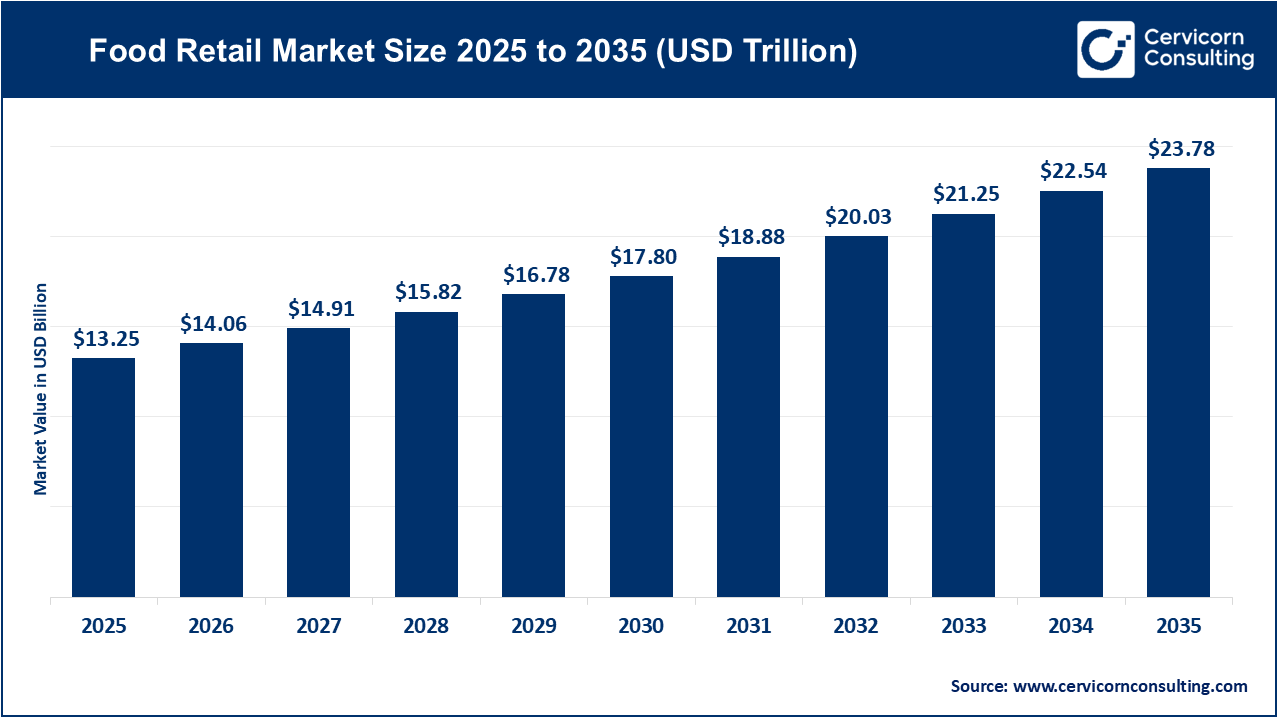
The global food retail market was valued at nearly USD 13.25 trillion in 2025 and is forecast to grow to approximately USD 23.78 trillion by 2035, registering a CAGR of 6.02% between 2026 and 2035.
According to market assessments, this expansion is being fueled by the growing adoption of organized retail networks, rising food demand worldwide, and changing consumer shopping habits, particularly the increasing preference for modern retail outlets and digital grocery platforms.
For more information, visit: https://www.cervicornconsulting.com/food-retail-market
What is the Food Retail Market?
The food retail market encompasses all organized and unorganized channels through which food products are sold directly to consumers for household consumption. This includes supermarkets, hypermarkets, convenience stores, neighborhood grocery shops, online grocery retailers, and omnichannel platforms that seamlessly integrate online and offline shopping experiences.
The market serves a broad spectrum of food categories, including fresh fruits and vegetables, dairy products, meat and seafood, packaged and processed foods, beverages, frozen foods, organic products, and ready-to-eat meals. As the final link in the food supply chain, food retail plays a critical role in connecting food producers and manufacturers with consumers while ensuring reliable access to safe, affordable, and high-quality food products.
Learn more at: https://www.cervicornconsulting.com/food-retail-market
Why is the Food Retail Market Important?
The food retail sector is essential for maintaining food availability and accessibility across global markets. It ensures that consumers have continuous access to everyday food necessities while adapting to evolving dietary preferences, lifestyle trends, and increasing demand for healthier and more sustainable food choices.
In addition to serving consumers, the industry significantly contributes to economic development by creating millions of jobs across retail operations, logistics, warehousing, supply chain management, and digital commerce. It also supports related industries such as agriculture, food manufacturing, and packaging, making it a key contributor to economic growth in both developed and emerging nations.
Food Retail Market Growth Factors
The market is experiencing steady growth due to several factors, including rapid urbanization, rising disposable incomes, and changing lifestyles that emphasize convenience-oriented and ready-to-eat food products. The expansion of organized retail infrastructure, particularly in developing economies, has improved product accessibility and consumer reach.
Furthermore, the growing popularity of online grocery shopping, advancements in cold-chain logistics, and widespread adoption of smartphones and digital payment technologies are transforming purchasing patterns. Increasing consumer demand for organic, nutritious, and premium food products, along with expansion initiatives by major retailers and favorable government policies supporting foreign investment in retail, continue to drive market growth.
Get a Sample Report:
https://www.cervicornconsulting.com/sample/food-retail-market
Major Companies Operating in the Food Retail Market
Walmart remains one of the world's largest retail organizations, operating hypermarkets, supermarkets, and wholesale clubs. The company focuses on cost leadership, supply chain efficiency, omnichannel grocery services, and private-label products. With revenue exceeding USD 650 billion in 2025, Walmart maintains a strong presence across North and South America.
The Kroger Co. is among the leading supermarket operators in the United States. The company emphasizes fresh food offerings, customer loyalty programs, private-label brands, and digital grocery solutions. Its revenue surpassed USD 150 billion in 2025, reinforcing its position in the U.S. grocery sector.
Amazon.com, Inc., through Amazon Fresh and Whole Foods Market, has established a strong presence in online grocery retail and premium food retailing. The company leverages AI-driven logistics, automation technologies, and subscription-based shopping models, generating approximately USD 100 billion from food retail operations in 2025.
Tesco PLC is a major grocery retailer headquartered in the United Kingdom. The company focuses on sustainability initiatives, digital transformation, and private-label offerings. Tesco generated approximately USD 80–90 billion in revenue during 2025 and remains a dominant player in the UK grocery market.
Carrefour S.A. operates an extensive network of hypermarkets, supermarkets, and convenience stores worldwide. Its strategic priorities include sustainability, omnichannel expansion, and private-label development. The company reported revenue of approximately USD 90–100 billion in 2025 and maintains a strong presence across Europe, Asia, and Latin America.
Key Trends Shaping the Food Retail Market
- Growing adoption of online grocery shopping and home delivery services.
- Expansion of private-label products to strengthen profitability and customer loyalty.
- Rising demand for organic, natural, and health-focused food products.
- Increasing implementation of artificial intelligence, automation, and advanced supply chain technologies.
- Strong emphasis on sustainability initiatives, including environmentally friendly packaging and waste reduction programs.
- Rapid expansion of quick-commerce platforms that offer grocery deliveries within minutes.
Successful Global Examples
- Walmart (United States): Developed a highly effective omnichannel grocery model supported by advanced logistics and competitive pricing.
- Tesco (United Kingdom): Strengthened customer engagement through Clubcard analytics and personalized shopping experiences.
- Carrefour (France): Successfully expanded into numerous emerging markets while adapting to local consumer preferences.
- Amazon Fresh & Whole Foods: Revolutionized grocery retail through AI-powered operations, automation, and integrated online-offline shopping experiences.
- DMart (India): Built a highly efficient, low-cost retail model focused on operational excellence and value pricing.
Global Regional Analysis
North America remains a dominant market, supported by major retailers such as Walmart and Kroger, robust logistics networks, and strong online grocery adoption.
Europe represents a mature market characterized by stringent food safety regulations, sustainability initiatives, and significant private-label penetration under European Union policies.
Asia-Pacific is expected to witness the fastest growth, driven by rapid urbanization, increasing disposable incomes, and expanding digital grocery ecosystems.
Latin America continues to grow steadily due to retail modernization efforts, infrastructure improvements, and favorable trade policies.
Middle East & Africa is emerging as a promising market, supported by urban development projects, rising food imports, and government initiatives focused on food security.
Additional Insights
For customized market intelligence, in-depth analysis, and comprehensive datasets, visit:
https://www.cervicornconsulting.com/contact-us