Generative AI vs Conversational AI: Key Differences, Use Cases, and Risks
-

- Published Updated
- 2,159 views
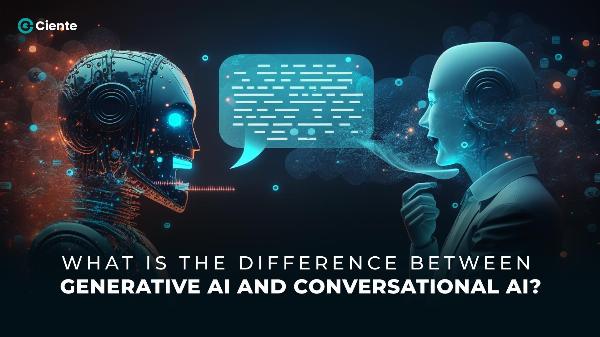
The difference between generative AI and conversational AI is a common question as organizations adopt advanced machine learning models. This article explains both concepts, highlights how they overlap, and outlines typical applications, technical distinctions, and governance considerations.
- Generative AI refers to models that create new content (text, images, audio, code) from learned patterns.
- Conversational AI focuses on systems that manage dialogue and interact with users in natural language.
- Conversational systems often use generative models, but also require dialog management, context handling, and safety controls.
- Key considerations include evaluation metrics, dataset quality, bias mitigation, and regulatory guidance such as standards from NIST.
Understanding the difference between generative AI and conversational AI
Generative AI and conversational AI are related areas within artificial intelligence and natural language processing, but each has a distinct purpose. Generative AI emphasizes content creation using learned distributions; conversational AI emphasizes maintaining coherent, goal-directed interactions with people. Both rely on machine learning architectures such as transformers, but they use different training objectives, interface designs, and operational safeguards.
What is generative AI?
Generative AI refers to models and techniques that produce new artifacts resembling the examples in their training data. Typical outputs include natural language text, images, audio, video, and code. Common technical concepts include large language models (LLMs), generative adversarial networks (GANs), diffusion models, and autoregressive transformers.
How generative models work
Generative models learn probability distributions over data during training and sample from those distributions during inference. Training uses large corpora and unsupervised or self-supervised objectives; fine-tuning can adapt models to specific domains or styles. Evaluation uses metrics such as perplexity for language, FID for images, and human assessments for subjective quality.
What is conversational AI?
Conversational AI describes systems designed to conduct dialogues with humans. These systems may provide information, complete tasks, answer questions, or simulate conversational agents. A complete conversational system includes components for intent recognition, dialogue state management, response generation, and often integration with external services or databases.
Components of conversational systems
- Natural language understanding (intent and entity extraction)
- Dialogue management (policy and context tracking)
- Response generation or selection (retrieval, template, or generation)
- Integration layers (APIs, databases, transaction systems)
Technical differences and overlaps
Generative AI and conversational AI overlap when generative models are used to produce dialogue responses. Key distinctions include:
- Objective: Generative models optimize for realistic content generation; conversational systems optimize for coherent, context-aware interaction and task completion.
- Context handling: Conversational AI tracks dialogue state over turns; pure generative models may treat each prompt independently without explicit state management.
- Control and constraints: Conversational systems require safety filters, business rules, and fallback strategies to avoid unsafe or incorrect responses.
- Evaluation: Conversational AI uses task success rates, user satisfaction, and retention in addition to content quality metrics.
Common use cases
Generative AI use cases
- Creative content: articles, marketing copy, art, music
- Code generation and data augmentation
- Drafting summaries and translations
Conversational AI use cases
- Customer support chatbots and voice assistants
- Virtual agents for scheduling, billing, and transaction workflows
- Interactive tutoring and mental health companions (with careful oversight)
Risks, evaluation, and governance
Both generative and conversational systems raise issues around hallucinations (incorrect outputs stated confidently), bias, privacy, and security. Evaluating these systems requires automated metrics combined with human review and adversarial testing. Public policy and standards bodies are developing guidance; for example, the National Institute of Standards and Technology (NIST) publishes resources on AI risk management and best practices for trustworthy AI (NIST).
Regulators such as the European Commission have proposed frameworks (the AI Act) that address high-risk AI systems and require transparency, documentation, and human oversight. Academic venues (ACL, NeurIPS) and professional societies also publish evaluation benchmarks and reproducibility guidelines.
Practical considerations for implementation
- Define clear objectives: content generation vs. interactive task completion.
- Select appropriate models: lightweight retrieval and templates for deterministic tasks; generative models for open-ended responses.
- Implement monitoring: logging, user feedback loops, and human-in-the-loop review for edge cases.
- Mitigate bias and protect data privacy by curating training data and applying differential privacy or access controls where needed.
Conclusion
Generative AI and conversational AI serve different but complementary roles. Generative AI focuses on producing novel content, while conversational AI focuses on managing interactions and achieving user goals. Many modern conversational systems incorporate generative components, but a production-ready conversational agent needs additional layers for state tracking, control, and safety.
What is the difference between generative AI and conversational AI?
Generative AI creates new content based on learned patterns; conversational AI organizes and manages dialogue to interact with users and accomplish tasks. Conversational systems may use generative models for responses but require extra mechanisms for context, policy, and integration.
Is conversational AI the same as generative AI?
No. Conversational AI is a broader category focused on dialogue and interaction. Generative AI is focused on creating content; it can be a component within conversational systems but is not equivalent to the full conversational stack.
Can generative models be controlled to improve conversational behavior?
Yes. Techniques such as fine-tuning, reinforcement learning from human feedback (RLHF), prompt engineering, and rule-based post-processing are used to guide generative models toward safer, more relevant conversational outputs. Continuous evaluation and human oversight remain important.
How should organizations evaluate these systems?
Evaluation should combine automated metrics (perplexity, BLEU, task success), human judgments, and operational monitoring. Compliance with applicable standards and regulatory frameworks is essential, and risk management practices recommended by organizations like NIST help align development with safety and accountability goals.