Geometric Design Trends Entering Indian Bathrooms in 2026
-
- September 27th, 2026
- 2,028 views
Geometry has always anchored great architecture. Lines, proportions, symmetry, and repetition give a space order without making it predictable. Today, these exact principles are finding fresh expression in Indian bathrooms. Homeowners, architects, and interior designers alike want spaces that feel contemporary yet enduring. They want restraint over noise. And it is the reason why geometry is leading modern bathroom ideas.
The latest modern bathroom design trends move strictly away from decoration for its own sake. Instead, shape itself acts as the primary design element. A rectangular basin, a precisely framed mirror, a linear shower, or a geometric tile pattern introduces character. More importantly, it does so without adding visual clutter. As we move through 2026, geometric design is less about rigid shapes and more about how different forms interact.
The Shift Towards Softer Geometry
Look closely at the emerging bathroom design trends 2026 is bringing forward, and you’ll see the most striking shift is the departure from rigid geometry toward organic forms.
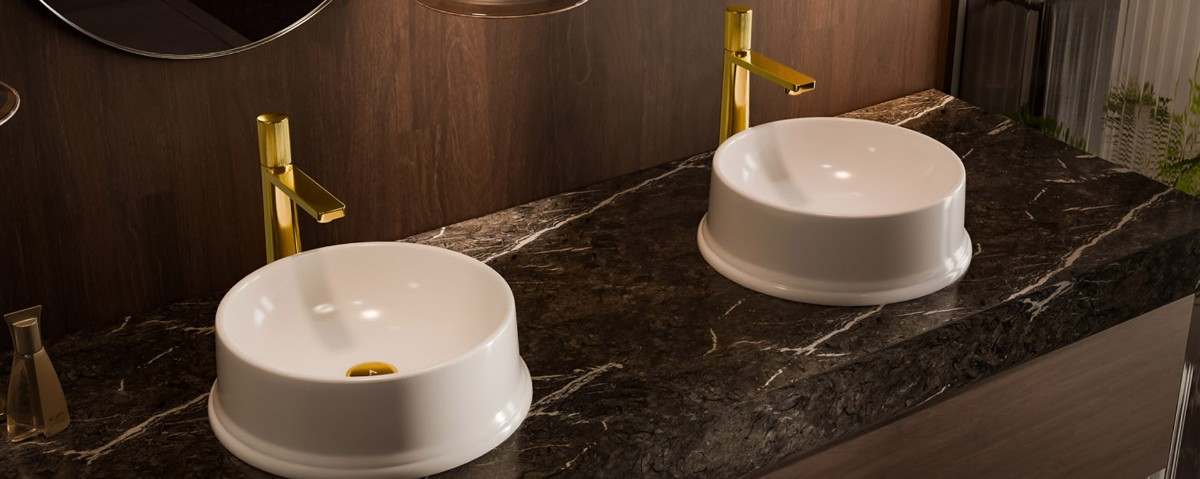
Make no mistake; straight lines still anchor the contemporary bathroom. They dominate cabinetry, tiling, and structural layouts. But today, designers actively soften those lines. They are balancing sharp angles with rounded mirrors, fluid basins, eased vanity edges, and elegant, sweeping arches. This contrast changes the entire atmosphere. It creates a bathroom that feels deeply structured without feeling severe.
The goal isn't to make every single element curved. Rather, combining contrasting forms creates a distinct visual rhythm. A rectangular vanity paired with a softly rounded basin feels far more considered than a room where every piece follows the exact same geometry.
Large-Format Geometry for a Cleaner Look
Tiles remain one of the fastest ways to introduce geometric bathroom design trends to your home. Large-format tiles create fewer grout lines, allowing surfaces to feel completely continuous, almost architectural.
For contemporary Indian homes, this technique works beautifully in bathrooms where creating a sense of spaciousness is critical. Stone-inspired surfaces, subtle linear patterns, and restrained tonal variations introduce depth without overwhelming the room. Rather than relying on intricate patterns everywhere, modern interiors use larger geometric planes to establish the room's visual foundation.
Curves as a Counterpoint to Straight Lines
The modern bathroom is becoming highly sculptural. Curved forms soften the cold precision of architectural lines while adding a sense of organic movement.
Picture a modern geometric bathroom. A circular mirror hangs directly above a sharp, linear vanity. Or think of a sculptural basin cutting through a flat, rectangular wall. These pairings generate intense visual interest through scale alone, completely bypassing the need for heavy ornamentation. Curves also make daily fixtures feel inviting and highly tactile. That detail matters immensely for basins, faucets, tubs, and mirrors; spaces where physical form dictates your daily routine.
Geometric Bathroom Design Through Faucets and Fittings
Geometry does not have to live on tiles or walls alone. Bathroom fittings offer some of the most refined expressions of shape within a space. Elements like showers, flush plates, handles, and valves can effortlessly mirror the same geometric flow established across the room. Collections like the Aris from Artize are made with clean lines, offering a minimalist aesthetic that’s perfect for geometric bathroom design.
Statement Mirrors with Architectural Forms
Mirrors are no longer an afterthought; they are central to geometric bathroom design. Clean geometric lines offer a unique symmetry that makes them highly expressive.
Circular, oval, arched, and irregularly framed mirrors act as natural focal points above the vanity. A distinctive silhouette also breaks the monotonous repetition of horizontal and vertical lines elsewhere in the room. For smaller bathrooms, this approach is incredibly effective. A statement mirror introduces personality without sacrificing an inch of floor space.
Minimalism Meets Geometric Design
The strongest modern bathroom ideas all share one core characteristic: absolute restraint.
Geometric design does not require loud patterns or an overload of shapes. A minimalist bathroom can be deeply geometric through its proportions, alignment, and negative space alone. A floating vanity, a precisely positioned mirror, concealed shower fittings, and large-format surfaces create a powerful architectural composition without a single decorative element. This is geometry at its best; defined by what is left out, not what is added.
The Art of Making Geometry Feel Timeless
Trends come and go. Good proportions, however, stay. That is precisely why architects and designers avoid chasing every passing pattern or shape. Instead, they rely on geometry as a foundational framework; a quiet tool used to strike a perfect visual balance.
Artize is one such bespoke bath brand that roots its entire collection in this exact design perspective. It stems from their core “Born From Art” philosophy, where artistic expression, excellent craftsmanship, superior materials, and precise engineering work together. This deliberate creation process ensures that every form feels deeply considered, not just temporarily fashionable. A space can easily embrace modern geometry while holding onto the natural materials, warmer tones, and comforting textures that prevent luxury from feeling clinical.
Final Thoughts
The emerging bathroom design trends in 2026 point toward a much more thoughtful interpretation of geometry. Sharp lines are yielding to curves, bold patterns are giving way to massive architectural forms, and bathroom fittings are becoming distinctly sculptural.
The most successful spaces will not be the ones with the most obvious geometric features. They will be the ones where proportions, shapes, materials, and negative space converse together. When every element, from the basin to the lighting, speaks the exact same design language, the result feels less like a temporary trend and more like a permanent architectural statement.