Buying GLP-1 Medication Online: What to Verify First
-
- Published Updated
- 41 views
Searching for GLP-1 medication online can feel remarkably simple: choose a website, answer a few questions, select a medication, and wait for delivery. But that convenience creates an important question that is easy to overlook:
How do you know the medication, prescriber, and pharmacy are legitimate before you order?
This matters because “GLP-1” is used online to describe several different prescription medicines, including oral and injectable products. Some are FDA-approved for specific conditions, while others may be compounded, investigational, or marketed without FDA approval. A website can also look professional without being a legitimate pharmacy.
If you are considering buying GLP-1 medication online, the safest approach is to verify the treatment pathway—not simply the price or convenience.
This guide explains what to check before ordering, how oral GLP-1 medication differs from injections, what potential side effects to discuss, and which questions are worth asking a healthcare professional.
First, What Exactly Are GLP-1 Medications?
GLP-1 medications work on pathways involving glucagon-like peptide-1, a hormone involved in blood glucose regulation, appetite, and digestion.
The category includes different medications with different FDA-approved indications, doses, formulations, and routes of administration. For example, semaglutide is available in oral tablet formulations as Rybelsus and Ozempic tablets for specific adults with type 2 diabetes, while semaglutide injections such as Ozempic and Wegovy have different approved uses.
Wegovy is approved for chronic weight management in certain adults and pediatric patients, and the FDA approved a higher-dose Wegovy HD injection in March 2026 for certain adults with obesity or overweight with a weight-related condition.
That distinction is important when searching for GLP-1 pills for weight loss. A medication being part of the GLP-1 class does not automatically mean that every formulation or brand is approved for weight management.
What does this mean for online shoppers?
Before ordering, identify:
- The exact active ingredient
- The brand or product name
- Whether it is a tablet or injection
- Its FDA-approved indication
- The prescribed strength and dosing schedule
- Whether it is an FDA-approved product or a compounded preparation
- The healthcare professional responsible for prescribing it
- The pharmacy that will dispense it
Practical takeaway: Never rely on the phrase “GLP-1” alone. Ask what exact medication you are being offered and what it is approved to treat.
Why Buying GLP-1 Medication Online Requires Extra Verification
Online access can be convenient, but convenience should not replace medical oversight.
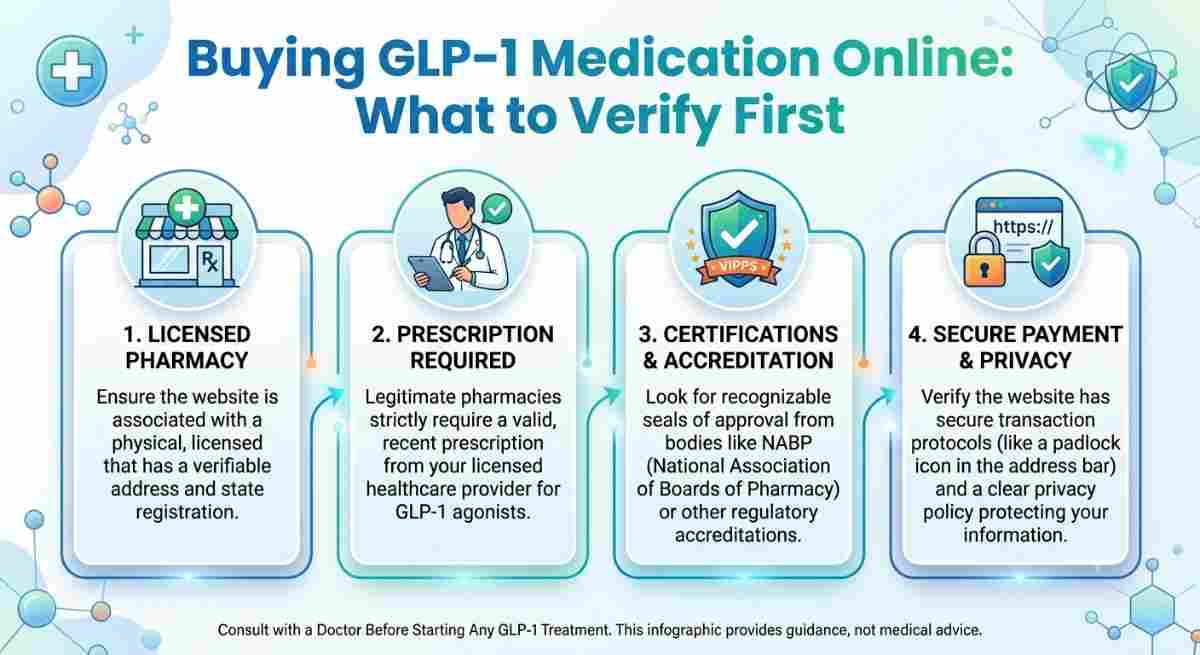
The FDA advises consumers to be cautious with online pharmacies. A legitimate online pharmacy should require a prescription for prescription medication, provide a physical U.S. address and telephone number, have a licensed pharmacist available, and be licensed by the appropriate state pharmacy board.
Websites that promise prescription medication without a prescription, advertise unusually low prices, or provide vague information about the pharmacy deserve additional scrutiny.
The risk isn't limited to getting the wrong product. FDA warns that medicines obtained from unsafe sources can contain incorrect amounts of active ingredients, the wrong ingredients, or potentially harmful substances. Improper storage can also affect medication quality.
Five things to verify before clicking “Order”
1. Verify the prescriber
A legitimate process should involve a licensed healthcare professional who evaluates whether the medication is appropriate for you.
Be cautious if a website appears to approve treatment automatically without obtaining meaningful medical information.
2. Verify the pharmacy
Check whether the dispensing pharmacy is properly licensed. In the United States, pharmacy licensing information can be checked through state pharmacy boards.
3. Verify the medication
Find out exactly what you are receiving. “GLP-1 weight loss medication” is not a specific drug name.
4. Verify the prescription
Prescription medication should be prescribed for an appropriate patient and indication. Avoid websites that encourage purchasing prescription products without appropriate medical evaluation.
5. Verify the packaging and labeling
When medication arrives, check the name, strength, expiration date, labeling, and packaging. If something looks substantially different from what you were expecting, contact the pharmacy or healthcare professional before taking it.
Practical takeaway: A legitimate-looking website is not enough. Verify the prescriber, pharmacy, product, prescription, and medication packaging separately.
Approved vs. Compounded vs. Unapproved: Why the Difference Matters
One of the most important details to understand when researching online GLP-1 treatment is that not every product containing a GLP-1-related ingredient has gone through the same FDA approval process.
FDA-approved medications
FDA-approved medications have been evaluated through the drug approval process for quality, safety, effectiveness, and specific labeled uses.
The prescribing information tells healthcare professionals how the product should be used, including approved indications, dosing, contraindications, warnings, and adverse reactions.
Compounded medications
Compounded drugs are prepared under specific legal and regulatory circumstances for individual patients or other permitted purposes. They are not FDA-approved products.
The FDA has emphasized that compounded drugs should not be represented as if they are FDA-approved versions of commercially available medications. In 2026, the agency also took action involving marketing claims for non-FDA-approved compounded GLP-1 products.
This does not mean every compounded medication is automatically unsafe. It means consumers should understand that compounded products have a different regulatory status and should ask who compounded the medication, under what circumstances, and what quality controls apply.
Unapproved or questionable products
Products sold online as “research,” “alternative,” “generic,” or “equivalent” GLP-1 medications can create additional uncertainty.
If a seller cannot clearly identify the medication, manufacturer or compounder, prescribing process, and regulatory status, that uncertainty is itself a reason to stop and investigate.
Practical takeaway: Ask whether the product is FDA-approved, compounded, or investigational before comparing prices or expected results.
Oral GLP-1 Medication vs. Injectable GLP-1 Medication
The phrase GLP-1 pills vs injections can make the choice sound simpler than it really is.
Route of administration is only one factor. The specific medication, approved indication, dose, medical history, tolerability, interactions, cost, and treatment goals all matter.
| Characteristic | Oral GLP-1 medications | Injectable GLP-1 medications |
|---|---|---|
| Administration | Taken by mouth | Administered by injection |
| Dosing frequency | Depends on the specific product; some oral semaglutide products are taken daily | Depends on the specific medication; some are daily and others weekly |
| FDA-approved uses | Depend on the exact product and formulation | Depend on the exact product and formulation |
| Weight-management indications | Must be checked against the specific product's current labeling | Several injectable GLP-1-related products have FDA-approved weight-management indications |
| Administration requirements | Some oral semaglutide products have specific instructions concerning fasting, water, and timing of other medicines | Injection technique and storage requirements vary by product |
| Common concerns | Gastrointestinal adverse effects and medication-administration instructions | Gastrointestinal adverse effects, injection technique, and product-specific precautions |
| Best choice | Depends on individual circumstances | Depends on individual circumstances |
There is no universally appropriate route for everyone.
For example, oral semaglutide tablets have specific administration instructions. Current prescribing information states that Rybelsus and Ozempic tablets should be taken once daily on an empty stomach with a limited amount of water, followed by a waiting period before food, beverages, or other oral medicines.
That means a pill is not necessarily “easier” simply because it does not involve an injection.
Practical takeaway: Compare complete treatment plans, not just pills versus injections.
What About GLP-1 Pills Side Effects?
Potential side effects depend on the medication and individual circumstances.
Gastrointestinal effects are among the most commonly reported concerns with GLP-1 therapies. Depending on the product, these may include:
- Nausea
- Vomiting
- Diarrhea
- Constipation
- Abdominal pain
- Decreased appetite
Some patients may experience more serious or clinically important adverse reactions. Product labeling includes warnings and precautions involving conditions such as pancreatitis, gallbladder disease, severe gastrointestinal reactions, kidney injury associated with volume depletion, and serious hypersensitivity reactions.
Semaglutide products also carry a boxed warning concerning thyroid C-cell tumors based on findings in rodents. They are contraindicated in people with a personal or family history of medullary thyroid carcinoma or in people with MEN 2.
This is one reason an online consultation should be more than a purchasing form.
A healthcare professional needs enough information to determine whether a particular medication is appropriate and whether other medications, medical conditions, pregnancy plans, or previous treatment experiences need to be considered.
Practical takeaway: Don't choose a GLP-1 medication solely because someone online describes it as effective or convenient. Review its specific risks and contraindications with a qualified professional.
Quick GLP-1 Pills Checklist
Before starting an oral GLP-1 medication, consider taking these questions to your healthcare professional:
- Which exact GLP-1 medication is being considered, and what is it approved to treat?
- Is the product FDA-approved or compounded?
- Why might this medication be appropriate for my health history and treatment goals?
- What side effects or warning signs should I watch for?
- Could this medication interact with anything else I currently take?
- How should I take it correctly, including food, water, and timing instructions?
- What should I do if I miss a dose, develop significant side effects, or need to stop treatment?
If you cannot get clear answers to these questions, pause before ordering.
Common Questions About Buying GLP-1 Medication Online
What are GLP-1 pills?
GLP-1 pills are oral medications that act on GLP-1-related pathways. In the United States, oral semaglutide products include Rybelsus and Ozempic tablets, with FDA-approved indications primarily related to type 2 diabetes and cardiovascular risk reduction in specified patients. The exact indication depends on the product and current prescribing information.
How do GLP-1 pills work?
GLP-1 receptor agonists affect physiological pathways involved in blood glucose regulation and digestion and can influence appetite. The exact effects and approved uses depend on the specific medication.
Are GLP-1 pills available by prescription?
Yes. FDA-approved oral semaglutide products are prescription medications. A legitimate online pharmacy should not bypass the prescription process.
What are potential side effects?
Common adverse reactions can include nausea, abdominal pain, diarrhea, decreased appetite, vomiting, and constipation. More serious warnings and precautions vary by medication, so patients should review the prescribing information and discuss their individual risk factors with a healthcare professional.
How are pills different from injections?
The main obvious difference is how they are administered, but there are additional differences involving dosing schedules, administration instructions, approved indications, storage, and product-specific risks. Some injectable GLP-1-related medications are approved for chronic weight management, while not every oral product has that indication.
Who should discuss GLP-1 treatment with a healthcare professional?
Anyone considering prescription GLP-1 treatment should discuss it with a qualified healthcare professional, particularly people who have other medical conditions, take multiple medications, are pregnant or planning pregnancy, or have previously experienced problems with similar medicines.
Can I buy GLP-1 medication without a prescription?
Be cautious of any website offering prescription GLP-1 medication without an appropriate prescription process. FDA specifically identifies the lack of a prescription as a warning sign when evaluating online pharmacies.
Myth vs. Fact: What Online Shoppers Should Know
Myth: “All GLP-1 medications are basically the same.”
Fact: GLP-1-related medications can have different active ingredients, formulations, strengths, administration routes, approved indications, and prescribing instructions.
Myth: “If a website says a product is equivalent to an FDA-approved drug, it must be FDA-approved.”
Fact: Marketing language does not establish FDA approval. Compounded products, in particular, have a different regulatory status from FDA-approved drugs.
Myth: “A pill is automatically safer or easier than an injection.”
Fact: Route of administration does not determine whether a medication is appropriate for an individual. Oral medications can have important administration instructions and potential adverse effects.
Myth: “A very low online price proves you've found a good deal.”
Fact: Price alone does not establish medication quality or pharmacy legitimacy. FDA lists unusually deep discounts as one warning sign consumers should consider when evaluating online pharmacies.
What Should You Check When the Package Arrives?
Your safety check should continue after you place the order.
When the medication arrives, examine the packaging before taking the first dose.
Check:
- Medication name
- Active ingredient
- Strength
- Dosage form
- Expiration date
- Prescription label
- Pharmacy information
- Packaging condition
- Storage instructions
If the package is damaged, the labeling is inconsistent with your prescription, the product looks unfamiliar, or important information is missing, contact the dispensing pharmacy before using it.
Do not assume that a professional-looking package proves authenticity.
FDA has warned about counterfeit medicines and has specifically reported counterfeit Ozempic incidents in the U.S. drug supply chain.
Practical takeaway: Treat delivery as another verification point—not the end of the safety process.
A Safer Way to Approach Online GLP-1 Treatment
Buying GLP-1 medication online does not have to mean choosing between convenience and responsible care.
A safer process looks more like this:
Healthcare evaluation → appropriate prescription → verified pharmacy → verified medication → correct use → ongoing follow-up
If you are researching treatment options, you can also explore reliable educational information about [GLP-1 pills] and use that information to prepare questions for your healthcare professional.
The goal should not simply be to find a website that sells a medication. The goal is to understand exactly what you are being prescribed, why it is being prescribed, who is dispensing it, and what you should know before taking it.
Final Takeaway
When Buying GLP-1 Medication Online, the most important question isn't “How quickly can I order it?”
It is:
“Can I verify what this medication is, who prescribed it, who dispensed it, and whether the product is appropriate for me?”
Check the medication's exact name and indication. Verify the prescriber. Confirm the pharmacy's licensing. Understand whether the product is FDA-approved or compounded. Review potential side effects and administration instructions. And don't let an attractive price or a polished website substitute for medical oversight.
GLP-1 medications can be useful prescription treatments for appropriate patients, but the right choice depends on the individual medication and the person's health circumstances.
Medical Disclaimer
This article is for general educational purposes only and is not a substitute for medical advice, diagnosis, or treatment. Medication approvals, labeling, availability, and regulations can change. Always consult a qualified healthcare professional and review the current prescribing information before starting, changing, or stopping a prescription medication.