Green Ammonia Market Future Outlook and Investment Opportunities
-
- June 02nd, 2026
- 4,133 views

FREE SEO Topical Map Generator: Find Your Next Content Ideas
Green Ammonia Market Size
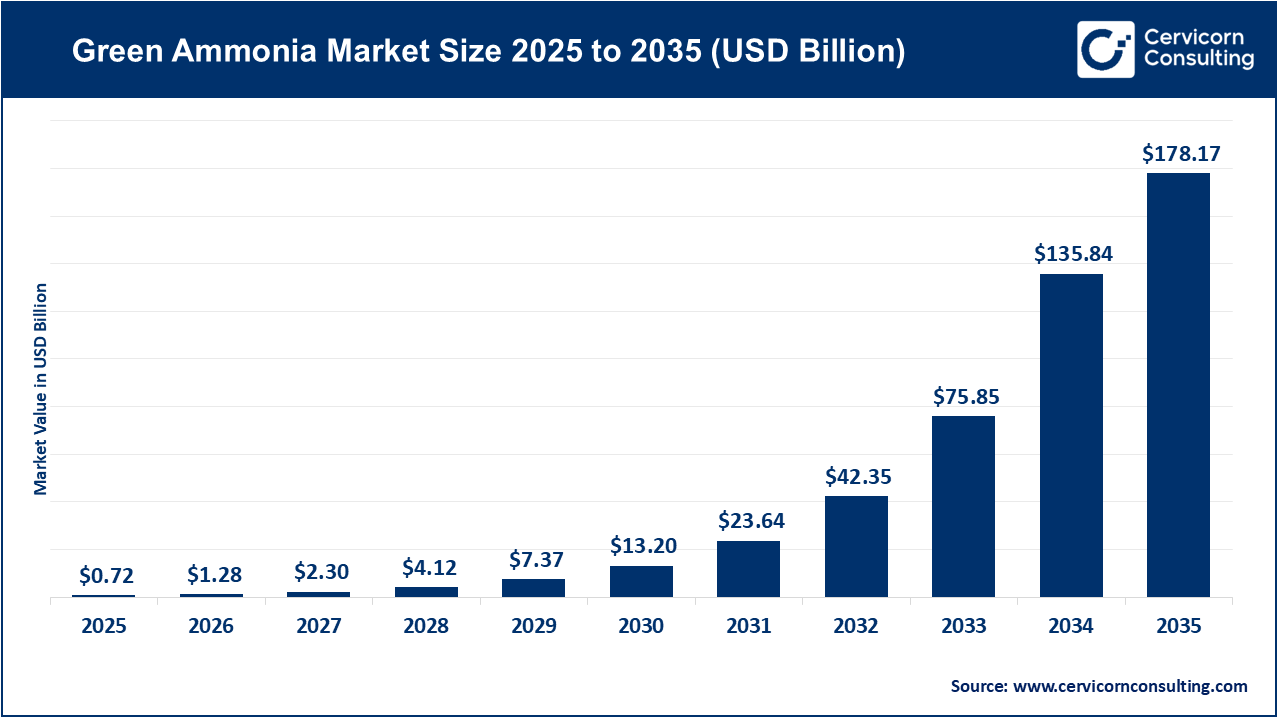
The global green ammonia market was valued at approximately USD 0.72 billion in 2025 and is expected to expand dramatically, reaching nearly USD 178.17 billion by 2035. The market is forecast to grow at an impressive CAGR of 73.52% between 2026 and 2035, supported by rising investments in renewable energy infrastructure, expanding green hydrogen production capacities, and increasing international commitments to carbon neutrality and industrial decarbonization.
Read Full Report: https://www.cervicornconsulting.com/green-ammonia-market
What is the Green Ammonia Market?
The green ammonia market represents the global value chain associated with the production, storage, transportation, and utilization of ammonia produced using renewable energy-based processes. Unlike conventional ammonia manufacturing, which relies heavily on fossil fuels and emits considerable carbon dioxide through the Haber-Bosch process, green ammonia is synthesized using green hydrogen generated via water electrolysis powered by renewable sources such as solar, wind, and hydropower.
In addition to its traditional role in fertilizer production, green ammonia is gaining traction as a sustainable hydrogen carrier, a low-carbon marine fuel, a long-duration energy storage solution, and a key enabler of industrial decarbonization. The market ecosystem includes renewable energy developers, electrolyzer manufacturers, hydrogen technology providers, ammonia producers, logistics and infrastructure companies, and end-use industries such as agriculture, chemicals, transportation, and power generation.
Key Growth Drivers of the Green Ammonia Market
The rapid expansion of the green ammonia market is being driven by a combination of environmental, technological, and economic factors. Increasing global efforts to reduce greenhouse gas emissions, growing investments in renewable energy projects, and rising demand for sustainable fertilizers are creating strong market momentum. Additional growth catalysts include the accelerating development of the hydrogen economy, stringent environmental regulations, government subsidies and incentive programs, growing adoption of alternative fuels in maritime transportation, advancements in electrolyzer efficiency, declining renewable electricity costs, increasing energy security concerns, implementation of carbon pricing mechanisms, large-scale industrial decarbonization initiatives, enhanced public-private partnerships, ongoing research and innovation activities, and the establishment of green hydrogen hubs that support green ammonia production and distribution networks.
Why is the Green Ammonia Market Important?
Supporting Global Decarbonization Goals
Green ammonia significantly lowers greenhouse gas emissions compared with conventional ammonia production. Since traditional ammonia manufacturing contributes substantially to industrial carbon emissions, transitioning to green ammonia can help governments and industries achieve climate and sustainability targets.
Enabling Renewable Energy Storage
One of the major challenges associated with renewable energy is intermittency. Green ammonia offers a practical solution by converting renewable electricity into a transportable and storable chemical form, enabling long-duration energy storage and global energy transport.
Accelerating the Hydrogen Economy
Hydrogen storage and transportation remain expensive and technically complex. Green ammonia serves as an efficient hydrogen carrier, allowing safer and more economical long-distance transport while supporting hydrogen infrastructure development worldwide.
Decarbonizing Maritime Transportation
The shipping sector is under increasing pressure to reduce carbon emissions. Green ammonia is emerging as one of the most promising zero-carbon marine fuels capable of supporting sustainable long-distance maritime operations.
Supporting Sustainable Agriculture
Ammonia remains a crucial component of fertilizer production. Green ammonia helps reduce the environmental impact of fertilizer manufacturing while maintaining agricultural productivity and enhancing food security.
Get a Free Sample Report: https://www.cervicornconsulting.com/sample/2676
Leading Companies in the Green Ammonia Market
Siemens Energy
Specialization: Energy technologies, renewable integration, hydrogen systems
Core Focus Areas:
- Green hydrogen production
- Electrolysis solutions
- Electrification of ammonia plants
Key Differentiators:
- End-to-end energy solutions
- Industrial-scale hydrogen infrastructure expertise
2025 Revenue: Approximately USD 39 Billion
Market Position: Major participant in hydrogen and green ammonia infrastructure development
Global Reach: Operations across more than 90 countries
Siemens Energy continues to play a critical role in the green ammonia ecosystem through advanced electrolysis technologies, renewable energy integration capabilities, and grid modernization solutions supporting large-scale hydrogen and ammonia projects.
Yara International ASA
Specialization: Fertilizers and sustainable ammonia production
Core Focus Areas:
- Green fertilizer production
- Renewable ammonia manufacturing
Key Differentiators:
- Extensive ammonia production expertise
- Global fertilizer distribution network
2025 Revenue: Approximately USD 15 Billion
Market Position: Leading fertilizer and ammonia producer
Global Reach: Presence in over 60 countries
Yara International remains one of the pioneers of commercial-scale green ammonia production, investing heavily in renewable ammonia facilities and sustainable agriculture initiatives.
ENGIE
Specialization: Renewable energy and low-carbon infrastructure
Core Focus Areas:
- Green hydrogen development
- Renewable power generation
- Green ammonia export projects
Key Differentiators:
- Large renewable energy portfolio
- Strong public-private partnership capabilities
2025 Revenue: Approximately USD 80 Billion
Market Position: Major renewable energy developer supporting green ammonia growth
Global Reach: Operations in more than 70 countries
ENGIE is actively collaborating with governments and industrial partners to develop integrated renewable energy and green ammonia projects supporting global energy transition objectives.
Air Products
Specialization: Industrial gases and hydrogen technologies
Core Focus Areas:
- Hydrogen infrastructure
- Ammonia production facilities
- Clean energy megaprojects
Key Differentiators:
- Leadership in hydrogen technologies
- Proven project execution capabilities
2025 Revenue: Approximately USD 13 Billion
Market Position: Leading supplier of hydrogen-related technologies
Global Reach: Operations in more than 50 countries
Air Products is developing several large-scale green hydrogen and ammonia projects globally and remains a key contributor to the commercialization of clean fuel technologies.
ITM Power PLC
Specialization: PEM electrolyzer technology
Core Focus Areas:
- Green hydrogen production systems
- Electrolyzer innovation
Key Differentiators:
- Advanced electrolyzer manufacturing expertise
- Strong R&D capabilities
2025 Revenue: Estimated between USD 50–100 Million
Market Position: Emerging leader in electrolyzer technology
Global Reach: Strong European presence with expanding international operations
ITM Power supplies critical electrolyzer systems required for green hydrogen production, making it an important technology provider for green ammonia projects worldwide.
Major Green Ammonia Market Trends and Their Impact
Expansion of Green Hydrogen Production Capacity
Rapid growth in global green hydrogen projects is directly supporting green ammonia production. Governments and private investors continue to allocate substantial funding toward electrolyzer deployment and renewable energy infrastructure.
Impact:
- Lower production costs
- Improved project economics
- Greater scalability
- Stronger investor confidence
Increasing Use of Green Ammonia as Marine Fuel
Shipping companies are increasingly evaluating green ammonia as a low-carbon alternative to conventional marine fuels to comply with tightening emissions regulations.
Impact:
- Creation of new demand streams
- Expansion of fueling infrastructure
- Growth in ammonia exports
- Accelerated commercialization
Emergence of Green Ammonia Export Hubs
Countries with abundant renewable resources are positioning themselves as major future exporters of green ammonia.
Impact:
- Enhanced international trade
- Improved energy security
- Development of global supply chains
- Increased foreign investment
Advancements in Electrolysis Technology
Continuous improvements in electrolyzer performance and efficiency are helping reduce the cost of green hydrogen and ammonia production.
Impact:
- Better cost competitiveness
- Improved operational efficiency
- Increased project feasibility
- Faster market growth
Corporate Net-Zero Commitments
Industrial sectors worldwide are incorporating green ammonia into sustainability strategies and decarbonization roadmaps.
Impact:
- Rising industrial demand
- Long-term supply agreements
- Stable revenue opportunities
- Expanded market potential
Notable Green Ammonia Projects Worldwide
NEOM Green Hydrogen Project – Saudi Arabia
One of the world's largest green hydrogen and ammonia developments, the NEOM project aims to become a major exporter of green ammonia.
Key Highlights:
- Gigawatt-scale renewable energy deployment
- Large export capacity
- Global benchmark for hydrogen economy projects
Yara Green Ammonia Facility – Norway
Yara is converting existing ammonia facilities to operate using renewable hydrogen.
Key Highlights:
- Reduced carbon footprint
- Commercial-scale green fertilizer production
- Proven industrial decarbonization model
Asian Renewable Energy Hub – Australia
Australia is investing heavily in renewable energy projects designed for green hydrogen and ammonia exports.
Key Highlights:
- Massive renewable generation capacity
- Export-oriented infrastructure
- Strong international partnerships
Fukushima Hydrogen Energy Research Field – Japan
Japan continues to invest in hydrogen and ammonia technologies to support its clean energy transition.
Key Highlights:
- Renewable hydrogen production
- Clean fuel demonstration initiatives
- Enhanced energy security
Port of Rotterdam Green Ammonia Program – Netherlands
The Port of Rotterdam is developing critical import and distribution infrastructure for green ammonia.
Key Highlights:
- Strategic import hub development
- Support for industrial decarbonization
- Strengthened European energy supply chains
Regional Outlook
North America
Growth is supported by hydrogen hub investments, renewable energy expansion, clean fuel initiatives, and industrial sustainability programs.
Key Policies:
- Inflation Reduction Act (IRA)
- Clean Hydrogen Production Tax Credits
- DOE Hydrogen Shot Program
- Regional Clean Hydrogen Hubs Program
- Hydrogen Strategy for Canada
- Clean Fuel Regulations
Europe
Europe remains among the most advanced green ammonia markets due to ambitious climate policies and strong regulatory support.
Key Policies:
- European Green Deal
- REPowerEU
- Fit for 55 Package
- Hydrogen Strategy for a Climate-Neutral Europe
- Germany's National Hydrogen Strategy
- Netherlands Hydrogen Valley Initiatives
Asia-Pacific
Asia-Pacific is expected to witness the fastest growth due to rapid industrialization, rising energy demand, and hydrogen economy development.
Key Programs:
- Japan's Green Growth Strategy
- Hydrogen Society Vision
- South Korea's Hydrogen Economy Roadmap
- Australia's National Hydrogen Strategy
- India's National Green Hydrogen Mission
Latin America
The region benefits from abundant renewable energy resources and increasing international investments.
Key Programs:
- Chile's National Green Hydrogen Strategy
- Renewable Energy Promotion Programs
- Brazil's Hydrogen Regulatory Framework
- Sustainable Industrial Development Policies
Middle East & Africa
The region is rapidly emerging as a global green ammonia production and export hub.
Key Programs:
- Saudi Vision 2030
- NEOM Development Program
- UAE Hydrogen Leadership Roadmap
- Net Zero 2050 Strategy
- Egypt's National Green Hydrogen Strategy
- Suez Canal Economic Zone Initiatives
Future Outlook
The green ammonia market is expected to become a foundational pillar of the global clean energy transition over the next decade. Continued improvements in hydrogen production technologies, declining renewable energy costs, expanding storage and transportation infrastructure, and supportive policy frameworks are expected to accelerate market adoption. As industries increasingly seek sustainable alternatives for agriculture, shipping, power generation, energy storage, and industrial applications, green ammonia is positioned to play a transformative role in building a low-carbon global economy.
For a detailed market overview: https://www.cervicornconsulting.com/contact-us