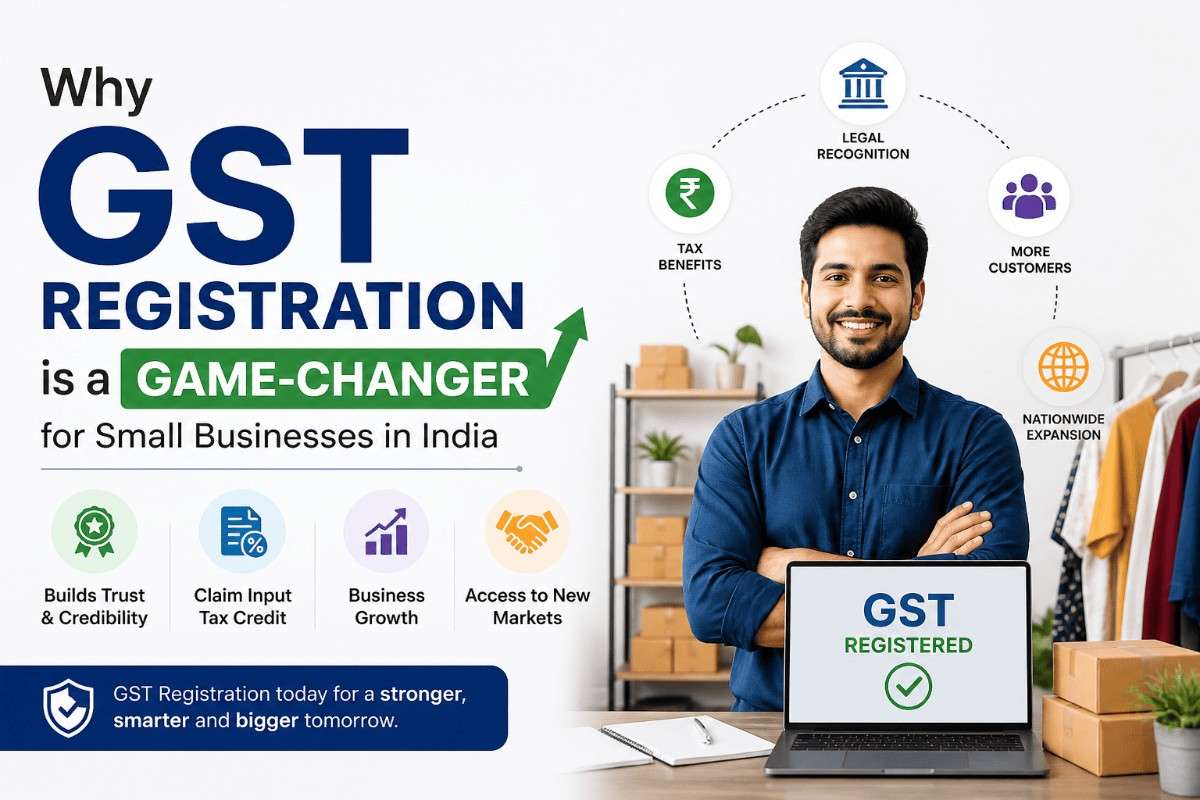
Why GST Registration is a Game-Changer for Small Businesses in India
-

- May 06th, 2026
- 7,767 views
Published: May 2026 | Reading Time: ~7 minutes
Running a small business in India has never been easy. Between managing cash flow, building a customer base, and staying compliant with regulations, entrepreneurs have plenty on their plate. Yet one decision, completing your GST Registration, can fundamentally shift how your business operates, grows, and competes. If you've been sitting on the fence about it, this guide will walk you through exactly why GST registration matters, how the process works, and what practical benefits you can expect.
What Is GST Registration, and Who Needs It?
The Goods and Services Tax (GST) is a unified indirect tax that replaced a web of central and state levies, VAT, service tax, excise duty, and more, when it came into effect on July 1, 2017. GST Registration is the official enrollment of your business under this tax framework, giving you a unique 15-digit GSTIN (GST Identification Number).
You are legally required to register if:
Your aggregate annual turnover exceeds ₹40 lakhs (for goods) or ₹20 lakhs (for services) in most states
Your turnover exceeds ₹20 lakhs (goods) or ₹10 lakhs (services) in special category states like Himachal Pradesh, Uttarakhand, and northeastern states
You sell goods or services across state lines (interstate supply), regardless of turnover
You operate an e-commerce platform or sell through one (like Amazon, Flipkart, Meesho)
You are a casual taxable person or a non-resident taxable person
Even if your turnover falls below the threshold, voluntary GST registration is an option, and for many small businesses, it's a smart strategic move.
The GST Registration Process
One of the most common concerns small business owners raise is complexity. The truth is, the GST Registration Process has become significantly streamlined since its early days. Here's how it works:
Step 1: Gather Your Documents
Before you begin, keep these ready:
PAN card of the business/owner
Aadhaar card of the proprietor/partners/directors
Proof of business address (electricity bill, rent agreement, or NOC from property owner)
Bank account details (cancelled cheque or passbook front page)
Photographs of the proprietor/partners/directors
Partnership deed or certificate of incorporation (for firms/companies)
Digital Signature Certificate (DSC), required for companies and LLPs
Step 2: Go to the GST Portal
The entire GST Registration Online process is handled at www.gst.gov.in. There is no need to visit a government office. Navigate to Services → Registration → New Registration.
Step 3: Fill Part A of the Application
Enter your PAN, mobile number, and email address. An OTP will be sent to both your mobile and email for verification. Once verified, you'll receive a Temporary Reference Number (TRN).
Step 4: Complete Part B Using Your TRN
Log back in using the TRN and complete the full application. This includes:
Business details (name, constitution, date of commencement)
Principal place of business and additional places if any
Details of goods/services using HSN/SAC codes
Bank account information
Upload of all required documents
Step 5: Submit and Await Verification
Submit the application using DSC (for companies/LLPs) or Aadhaar-based e-Sign / EVC (for others). The GST officer reviews your application. If everything is in order, your GSTIN is issued within 7 working days. If clarification is needed, you'll receive a notice (Form GST REG-03) and must respond within 7 days.
Step 6: Receive Your Registration Certificate
Once approved, a GST Registration Certificate (Form GST REG-06) is issued. This is your proof of registration and must be displayed prominently at your place of business.
Pro Tip: The Aadhaar authentication step was introduced to speed up approvals. If you opt for Aadhaar authentication and it's successfully verified, registration is granted within 3 working days, making new GST registration faster than ever before.
7 Ways GST Registration Is a Game-Changer for Small Businesses
1. Unlocks the Input Tax Credit (ITC) Advantage
This is the single biggest financial benefit. As a registered business, you can claim credit for the GST you've already paid on your purchases, raw materials, and operational expenses, and offset it against your GST liability on sales.
Example: You buy raw materials worth ₹1,00,000 and pay ₹18,000 as GST. You sell finished goods and collect ₹27,000 as GST. Instead of paying ₹27,000, you pay only ₹9,000 (₹27,000 − ₹18,000). That's ₹18,000 saved, cash that stays in your business.
Businesses without GST registration cannot claim ITC, meaning they absorb those input taxes as a cost. Over time, this compounds into a significant competitive disadvantage.
2. Enables You to Sell Across India Without Barriers
Pre-GST, selling across state lines meant navigating multiple state taxes, entry permits, and paperwork at every check post. GST eliminated all of that. With a valid GSTIN, your small business can supply goods and services to any part of India under a single tax framework.
This is particularly transformative for businesses exploring e-commerce. Platforms like Amazon Seller Central, Flipkart, and Meesho require a GSTIN before you can list products. GST registration is, effectively, your entry ticket to India's booming digital marketplace.
3. Builds Credibility and Attracts Better Clients
Larger companies — corporate buyers, institutional clients, government departments, almost always prefer dealing with GST-registered vendors. Why? Because they need to claim ITC on their purchases, and they can only do so if their supplier is registered.
A GSTIN on your invoice signals that your business is legitimate, structured, and serious. It's a trust signal that opens doors to contracts and partnerships that unregistered businesses simply cannot access.
4. Simplifies Tax Compliance and Reduces Cascading Taxes
Before GST, businesses paid multiple overlapping taxes, VAT at the state level, excise at the central level, service tax, and more. Each tax was calculated on a base that often already included another tax, creating a "tax on tax" effect that inflated costs.
GST replaced this entire structure with a single, transparent tax. While filing compliance still requires attention, the overall tax burden is more predictable and the structure far simpler than the pre-2017 regime.
5. Strengthens Access to Formal Credit
Banks and NBFCs increasingly rely on GST returns (GSTR-1, GSTR-3B) as financial documentation when evaluating small business loan applications. Your GST filings essentially serve as an audited revenue track record.
Schemes like the MSME loan programs under SIDBI and fintech lenders on the Open Credit Enablement Network (OCEN) use GST data to underwrite credit decisions quickly. Without a GSTIN and filing history, accessing formal, affordable credit becomes significantly harder.
6. Composition Scheme — A Relief for Eligible Small Businesses
If your turnover is below ₹1.5 crore (₹75 lakhs for some special category states), you may opt for the GST Composition Scheme. This allows you to:
Pay GST at a flat, reduced rate (1% for traders, 5% for restaurants, 6% for service providers)
File simplified quarterly returns instead of monthly ones
Reduce your compliance burden dramatically
This is ideal for small retailers, local manufacturers, and small food businesses who want the benefits of registration without heavy monthly compliance.
7. Legal Protection and Avoiding Penalties
Operating without GST registration when you are liable exposes your business to serious consequences: a penalty of 10% of the tax due (minimum ₹10,000) for non-fraudulent cases, and 100% of the tax due for deliberate evasion. GST officers also have powers to seize goods and restrict business operations.
Registration protects you from this risk entirely and ensures your business operates on the right side of the law.
New GST Registration: Common Mistakes to Avoid
Whether you're applying for the first time or guiding an employee through it, avoid these frequent errors:
Incorrect HSN/SAC codes: Always verify the correct Harmonized System of Nomenclature (HSN) code for goods or SAC code for services. Errors here can cause registration rejection.
Address mismatch: The business address on your application must match the address on your proof document exactly, even minor differences (like "Road" vs "Rd") can trigger a query.
Using a personal bank account: Open a dedicated current account for the business before registering. Using a personal savings account can complicate your financial records and raise red flags.
Missing Aadhaar authentication: Skipping this step means your application goes to a physical officer for verification, which can take up to 30 days instead of 3.
Frequently Asked Questions
Can I do GST Registration Online on my own, or do I need a CA? Yes, the process is entirely self-serviceable on the GST portal. That said, for businesses with complex structures (multiple partners, multiple business verticals), engaging a CA or tax consultant ensures your HSN codes, business category, and documents are all correct from the start.
How much does GST Registration cost? Government registration fees are zero, there is no charge for applying on the official portal. If you hire a CA or consultant, typical professional fees range from ₹500 to ₹2,000 depending on the complexity.
What happens after registration? What do I need to file? Regular registered businesses typically file GSTR-1 (outward supplies) monthly or quarterly, and GSTR-3B (summary return with tax payment) monthly. Composition dealers file CMP-08 quarterly and GSTR-4 annually.
Can I cancel GST Registration if my business closes? Yes. You can apply for cancellation on the GST portal under Services → Registration → Application for Cancellation. Alternatively, GST officers can cancel registration if a business is found non-compliant or non-operational.
Final Thoughts
GST registration isn't just a regulatory checkbox, it's a strategic foundation for business growth. From unlocking Input Tax Credit and enabling pan-India sales to building creditworthiness and credibility with larger buyers, the benefits are concrete and compounding. The GST Registration Online process has matured into a genuinely user-friendly system, and with Aadhaar-based verification, a new GST registration can be live within 3 working days.
If your business is approaching the threshold, or if you're already beyond it, there is no good reason to delay. Take an afternoon, gather your documents, log on to the GST portal, and complete your registration. It may be one of the best half-days you invest in your business this year.