Every Home Has 40 Small Emergencies a Year. A Home Services App Turns Them Into Revenue.
-

- Published Updated
- 4,250 views
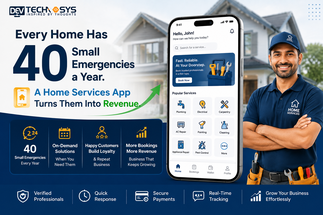
Count them sometime. The tap that starts dripping in March. The AC that gives up in the first week of real summer. The geyser that trips the breaker, the sofa that needs deep cleaning before guests arrive, the switchboard that sparks once and gets nervously ignored, the water purifier overdue for a filter change, the wall that needs one coat of paint before Diwali. Add pest control, appliance servicing, bathroom deep cleans, and the annual pre-monsoon terrace inspection, and an ordinary urban household quietly generates somewhere between thirty and fifty service needs a year.
Almost none of them are big. That's precisely the business.
Big renovations get planned, quoted, and negotiated. Small emergencies get dispatched — the customer wants a competent person at the door today, at a price they don't have to haggle over, without calling three numbers saved as "Plumber Ramesh (maybe?)". Whoever removes the friction from that moment captures a purchase that repeats forty times a year, per household, forever.
That's what a home services app really is: not a directory of workers, but a machine that converts household micro-emergencies into scheduled, priced, trackable jobs. Building that machine well is harder than it looks, and this article walks through the whole of it — both sides of the marketplace, the matching engine between them, and the business decisions that determine whether the economics ever work.
The demand side is easy to win and easy to lose
The customer-facing app is the simplest part of the system to describe: browse services, pick a slot, see a price, pay, rate. Every competitor has those screens. Winning happens in four less obvious places:
Upfront pricing beats quotes. The single biggest trust unlock in this category is a price shown before booking — per service, per unit, flat where possible ("AC service: ₹599 per unit"). The moment pricing becomes "technician will assess and quote," the app has recreated the exact anxiety it exists to remove. This forces real product work: a structured service catalog with defined scopes, add-ons priced separately, and clear rules for what happens when the job turns out bigger than booked.
Slots must be real. Showing a 4–6 PM slot the app can't actually staff is how a platform trains its own customers to leave. Slot availability has to be computed from genuine provider capacity in that micro-zone — which means the demand side is only as good as the supply engine behind it.
The repeat loop is the business. A customer's first booking is acquired with marketing money; profit lives in bookings two through forty. That makes rebooking flows, service history ("same technician as last time?"), scheduled reminders (filter changes, seasonal AC service), and membership plans the most valuable screens in the app — and the most commonly under-built.
Emergency vs. planned are different products. "Book a deep clean for Saturday" and "my geyser is leaking right now" have different tolerance for wait, price, and choice. Mature platforms separate the two flows: scheduled bookings optimize for selection and price; urgent flow optimizes for nearest-available-now, with surge-style pricing handled transparently.
The supply side is where these platforms actually live or die
Every failed home services startup has the same autopsy finding: they built a beautiful customer app on top of an unmanaged labor pool. Service quality was inconsistent, good professionals left, and the ratings graph did the rest.
The provider side deserves equal engineering investment:
Onboarding and verification. Identity checks, skill verification, document collection, background screening, and training/certification tracking. This is compliance-grade workflow software, and it's also the platform's core trust asset — customers are letting strangers into their homes.
A provider app that respects earnings. Job offers with clear payout shown upfront, sensible radius and route logic so a technician isn't sent across the city between jobs, instant or fast payout cycles, transparent earnings dashboards, and a dispute process that doesn't default to "customer is always right." Platforms bleed supply when providers feel like the algorithm's cattle; retention features for professionals matter as much as for customers.
Inventory and parts. Real jobs need spare parts. The stronger platforms handle parts catalogs, technician stock, and part-plus-labor billing in one flow, because a technician who has to leave, buy a part, and return has just doubled the job cost and halved the rating.
The matching engine: the actual product
Between demand and supply sits the system customers never see and entirely depends on: dispatch. Given a booking, the engine must weigh provider skill match, current location and route, existing jobs, rating, acceptance history, and fairness of work distribution — then assign, handle rejection and reassignment, and keep the customer's promised window intact. Layer on real-time tracking once the job starts, OTP-verified job start/completion so billing disputes have a factual anchor, and automated escalation when a job runs long.
This is genuinely hard software. It's also the moat: catalogs and screens are copyable in a month; a dispatch engine tuned on real operational data is not.
Business models, because the app must eventually pay for itself
Three revenue architectures dominate, and the choice shapes the build:
Commission marketplace — the platform takes 15–30 percent per job. Simple to explain, but it creates permanent tension with providers and invites off-platform leakage ("next time call me directly, madam"). Countermeasures — masked phone numbers, in-app chat, rebooking incentives, warranty valid only on platform bookings — are product features, not policies, and belong in the initial scope.
Subscription/membership — customers pay monthly or annually for priority slots, discounted rates, and bundled services (the "home care plan" model). This smooths revenue and deepens the repeat loop, but requires enough service breadth to feel worth it.
Hybrid with fees — commission plus visit charges, surge pricing for urgent jobs, and promoted placement for providers. Most scaled platforms end up here.
There's also the single-brand variant: an established local services company (a cleaning firm, an AC service chain) building an app for its own workforce rather than a marketplace. That build is meaningfully cheaper — no provider marketplace dynamics, no commission leakage problem — and is often the smarter first step for businesses that already have supply.
What it takes to build, honestly
A credible MVP — customer app, provider app, admin panel, structured catalog, slot booking, payments, ratings, basic dispatch — is a four-to-six month build with a competent team. The full machine described above, with intelligent dispatch, parts billing, memberships, and anti-leakage architecture, is a staged roadmap over a year or more. Teams that promise the full machine in ninety days are describing the screens, not the system.
This is where partner selection matters, and where Dev Technosys fits the problem unusually well. Our engineering teams have shipped the components this category runs on, in adjacent industries where the stakes were higher: real-time tracking and status verification built for cold-chain monitoring systems (the same checkpoint logic that makes OTP-verified job flows trustworthy), KYC and identity verification flows from fintech platforms that translate directly into provider onboarding and background-check workflows, and wallet, subscription, and installment billing engines from eWallet and BNPL products that map onto membership plans and part-plus-labor invoicing. For businesses evaluating home services app development, that prior machinery matters in a very practical way: the expensive, failure-prone parts of the platform arrive as tested patterns rather than experiments run on your budget.
The takeaway
The forty small emergencies were always there. Households have always needed the tap fixed, the AC serviced, the sofa cleaned — what changed is that an app can now stand between the emergency and the solution, and take a margin for making the moment painless. The platforms that win don't have better marketing or even better prices. They have the boring machinery — verified supply, honest slots, upfront prices, a dispatch engine that keeps promises — built properly underneath.
Get that right, and you don't need to create demand. Every home in your city is already generating it, about once a week, forever.