Your Hotel's Housekeeping Problem Is Probably an Information Problem
-

- Published Updated
- 78 views
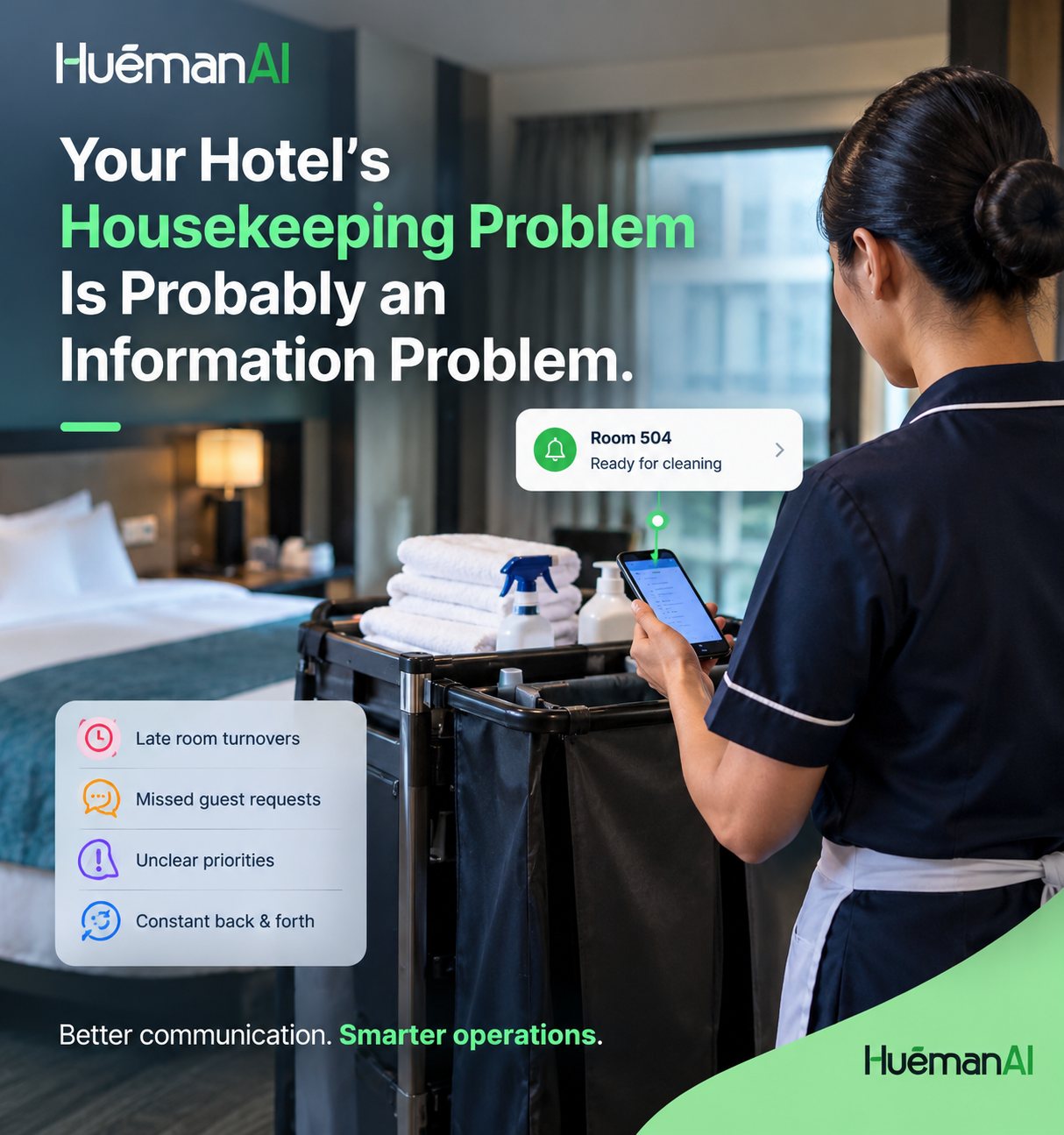
A room is finished at 11:25. The front desk still sees it as dirty until 11:45. In between, a guest who hoped for an early check-in is standing at reception, and a supervisor is walking a corridor with a radio, passing on news that no system knows yet.
Nobody in that story is slacking. The cleaning was quick. The delay came from the gap between the work being done and everyone knowing it was done. That gap is where an AI housekeeping agent earns its place.
What an AI housekeeping agent actually does
It does not make beds. Housekeeping is really two jobs: the physical work (cleaning, restocking, inspecting) and the coordination around it (knowing which room matters next, telling the right person, hearing back, recording the result).
An agent takes on the second job. It reads live data from your PMS, turns guest and staff requests into assigned tasks, chases acknowledgement, and writes room status back to the PMS. Anything outside its rules goes to a person.
In practice, the split looks like this:
- The agent: reads check-outs and early-arrival flags, classifies requests such as extra towels or a cot, sends tasks, tracks acknowledgement and escalates if nobody responds.
- Your team: cleans the room, passes or fails the inspection, handles sensitive complaints, and decides when a room goes Out of Order.
Why room status updates matter most
Room status is the field the front desk sells rooms against, so a stale status costs real money and real goodwill. It is also the part that depends most on your PMS.
Both Oracle OPERA Cloud and Mews let partner software write housekeeping status through their APIs. An agent can mark a room Clean or Inspected, but taking a room Out of Order is a deliberate human decision recorded through a separate route. Statuses also differ by system. If your property does not use Inspected, an agent built around it will wait for a status that never arrives, so configuration matters as much as the software.
A sensible starting rule: let the agent write Clean automatically, and write Inspected only after a supervisor confirms.
"Without adding headcount": what that really means
This phrase deserves a straight answer. An agent cannot clean rooms, so it will not fix a shortage of room attendants.
What it can absorb is coordination time: relaying messages, re-keying information, chasing tasks and answering "is 214 ready?" That time usually sits with supervisors and receptionists. With the UK National Living Wage at £12.71 an hour from April 2026, every wasted minute costs more than it did, even though hospitality vacancies have cooled from their 2022 peak.
The early public numbers are modest. Apaleo and THE FLAG Zürich report an agent creating around 30 tasks a day and saving an estimated 3.5 hours a week in task-creation time (the companies' own figures). It is one narrow task, so be wary of any vendor promising far more without showing the baseline.
The stronger case usually rests on time-to-ready, faster response to guest requests and more supervisor capacity, rather than cutting attendants.
Measure your status lag first
Before speaking to any vendor, spend about ten days measuring how long information takes to travel in your own hotel. Sample 30 to 50 departure rooms and record:
- Check-out time in the PMS
- When the attendant started
- When the attendant finished
- When inspection finished, if you inspect
- When the PMS showed the room ready
Status lag is the time the PMS showed ready minus the time the room was actually ready. If it is a couple of minutes, you do not have a coordination problem and an agent will not move much. If it is closer to 20 minutes, you do.
A low-risk 45-day pilot
- Days 1 to 10: Run the status-lag audit and agree your measures.
- Days 11 to 20: Connect the PMS and let the agent propose tasks while people carry on as normal.
- Days 21 to 35: Go live on one floor or one shift. The agent writes Clean; supervisors confirm Inspected.
- Days 36 to 45: Compare against your baseline, then expand, adjust or stop.
Write your stop conditions in advance: wrong statuses reaching the PMS, a rise in re-cleans, or attendants working around the system.
Questions to ask any vendor
- Which statuses does it write, and to which PMS?
- Which actions are automatic, and which need a supervisor?
- What will attendants actually use: handheld, phone app, messaging or voice?
- What happens when a status write fails?
- Is there a time-stamped audit trail?
- How is staff and guest data used and stored?
The bottom line
An AI housekeeping agent shortens the distance between a guest asking, an attendant acting and the PMS knowing. It will not clean a room or replace judgement at inspection. If your audit shows that coordination is where your hotel loses time, it is worth a closer look.
Read the full guide: AI Housekeeping Agent for Hotels: Automating Requests Without Adding Headcount
Want to see it in your own workflow? Book a demo with Hueman AI